On eBird ↗
Gray-capped Cuckoo
Live sightings near you, the range map, bar charts of when it is seen, and Macaulay Library photos and recordings.
Gray-capped Cuckoo
Coccyzus lansbergi
The grey-capped cuckoo (Coccyzus lansbergi) is a species of bird in the tribe Phaenicophaeini, subfamily Cuculinae of the cuckoo family Cuculidae. It is found in Colombia, Ecuador, Peru, and Venezuela, as a vagrant on Bonaire and in the Galápagos Islands, and possibly in Panama.
From the article Grey-capped cuckoo on Wikipedia (CC BY-SA), quoted section by section
Description
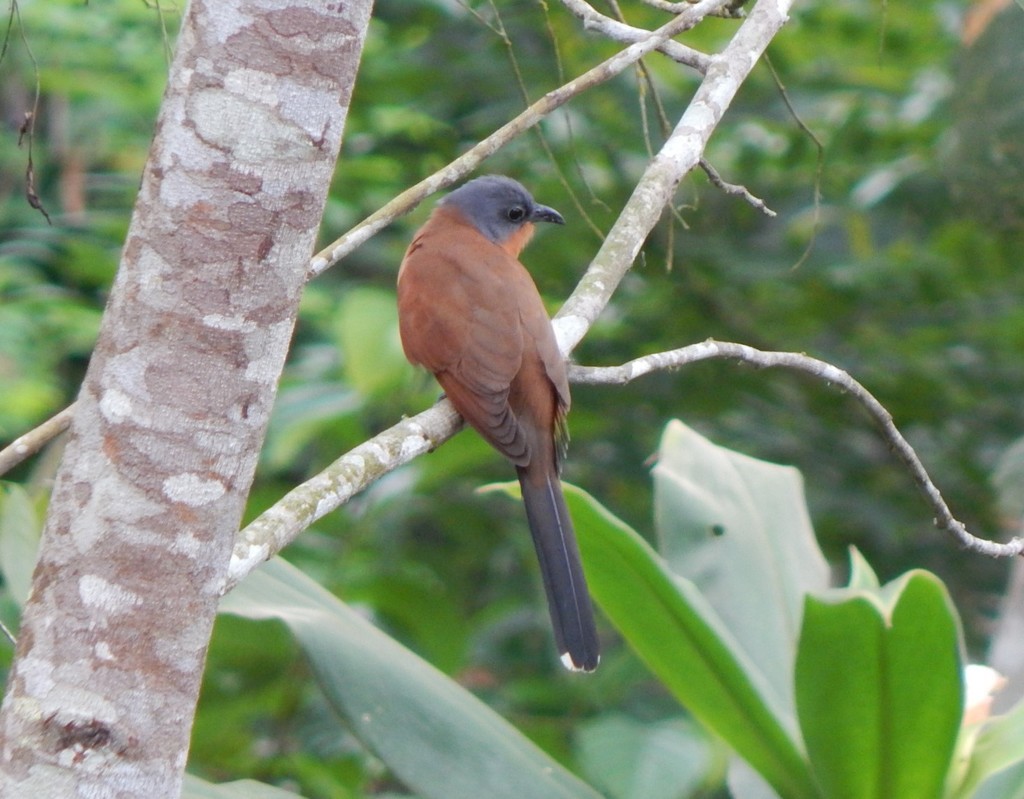
The grey-capped cuckoo is 25 to 28 cm (9.8 to 11 in) long, about half of which is the tail. Males weigh 46 to 56 g (1.6 to 2.0 oz). The species' bill is stout, somewhat decurved, and black with sometimes a gray or yellow spot at the base of the mandible. Males and females have the same plumage. Adults have a slate-gray cap to below the eye. Their upperparts and wings are rufous brown. The upper surface of their tail is black; the underside of the central pair of feathers is black and the rest black with white tips. Their eye is surrounded by a narrow ring of bare skin that is yellow, white, or yellowish gray. Their underparts are dark rufous buff. Juveniles are similar to adults but have a brown crown and less white on the tail.
Range & habitat
The grey-capped cuckoo has two separate populations. One is in northern Colombia and northwestern Venezuela and the other in western Ecuador and extreme northern Peru. The species has been documented as a vagrant on Bonaire (an island off the Venezuelan coast) and on the Galapagos Islands. Two reports from Panama have apparently not been accepted by the North American Classification Committee of the American Ornithological Society. The grey-capped cuckoo inhabits a variety of landscapes including tropical moist to dry semi-deciduous forest, arid forest, gallery forest, and shrubby savanna. In elevation it mostly ranges from sea level to 800 m (2,600 ft) in Peru, to 1,800 m (5,900 ft) in Ecuador, to 600 m (2,000 ft) in Colombia, and to 1,400 m (4,600 ft) in Venezuela. There are a few records from higher elevations.
Wikipedia: “Distribution and habitat”
What it does
The grey-capped cuckoo feeds on insects; caterpillars and some wasps appear to form the bulk of its diet.
Wikipedia: “Feeding”
Listen
Looking for field recordings…
Where it lives
Recorded sightings
—
geo-referenced records in GBIF, from museums, herbaria and field observers.
Drag the globe to turn it. Dots are where records exist, not a range map; darker means more records.
In the stacks
Searching the stacks…
Every page naming Coccyzus lansbergi in the Biodiversity Heritage Library →
This page is assembled live from iNaturalist, GBIF, Wikipedia, the Source Library and the Internet Archive. It is not yet part of the hand-edited codex. iNaturalist taxon 1961.