On eBird ↗
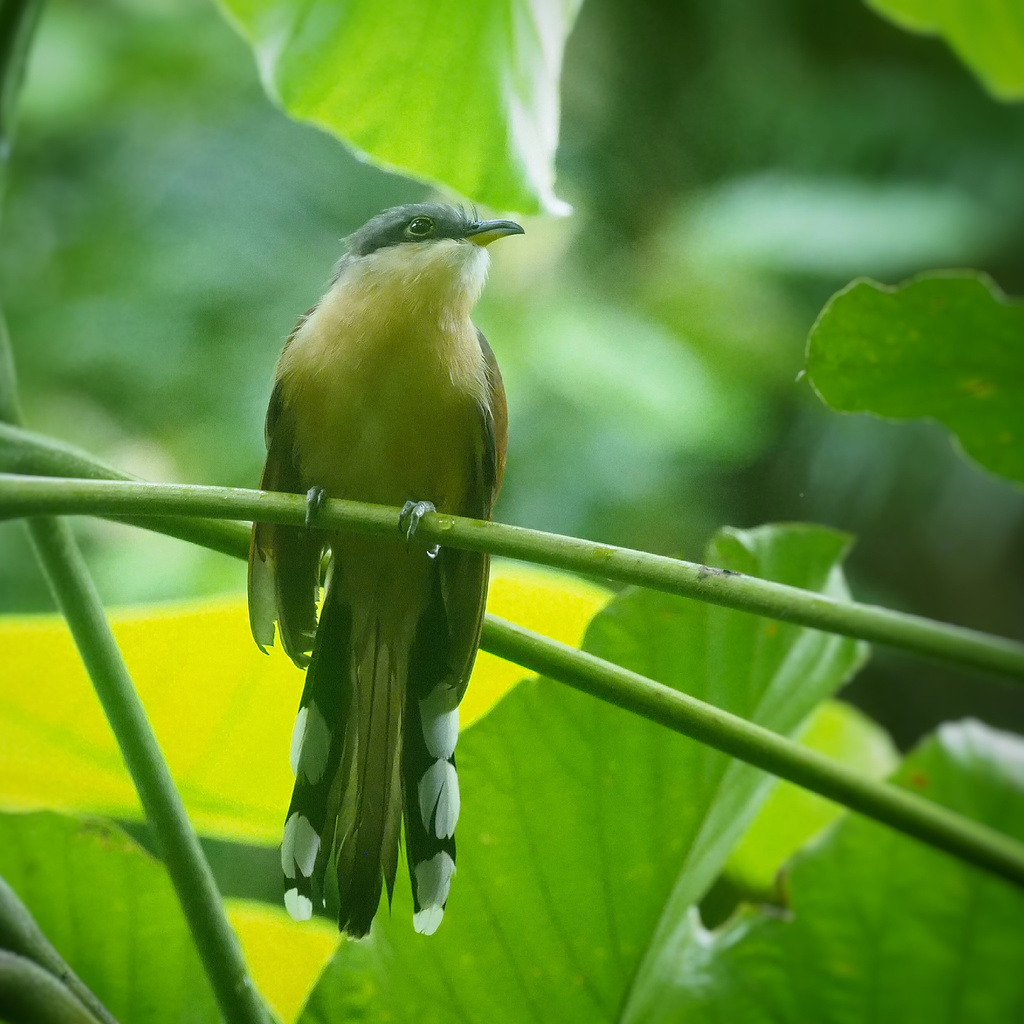
Cocos Cuckoo
Live sightings near you, the range map, bar charts of when it is seen, and Macaulay Library photos and recordings.
Cocos Cuckoo
Coccyzus ferrugineus
The Cocos cuckoo (Coccyzus ferrugineus) is a Vulnerable species of bird in the tribe Phaenicophaeini, subfamily Cuculinae of the cuckoo family Cuculidae. It is endemic to Cocos Island, an island in the Pacific Ocean which is part of Costa Rica.
From the article Cocos cuckoo on Wikipedia (CC BY-SA), quoted section by section
Description
The Cocos cuckoo is 32 to 33 cm (13 to 13 in) long, about half of which is the tail, and weighs about 70 g (2.5 oz). Their bill is stout and somewhat decurved. Its maxilla is black and its mandible yellow to yellow-orange with a black tip. Males and females have the same plumage. Adults' forehead and crown are slate gray and their upperparts grayish brown. Their wings are rufous. The upper surface of their tail is grayish brown and the undersides black with wide white tips. Their face has a narrow blackish "mask" past the eye, which is surrounded by a narrow ring of yellow to orange yellow bare skin. Their throat and breast are buffy white and the belly and undertail coverts rich buff. Juveniles are similar to adults but have less contrast between the head and back colors, a less contrasting facial mask, a whitish throat, chest and belly, and less white on the tail.
Range & habitat
The Cocos cuckoo is found only on Cocos Island, which is about 550 km (340 mi) miles off Costa Rica's Pacific coast. It inhabits essentially the entire island, using most of the plant communities on it: flooded bay forest, riparian forest, tropical rainforest, and tropical cloudforest. It is found from sea level the highest points on the island at about 450 m (1,500 ft).
Wikipedia: “Distribution and habitat”
What it does
The adult Cocos cuckoo feeds primarily on caterpillars, especially those of the giant sphinx moth (Cocytius antaeus) and the Orion cecropian butterfly (Historis odius). Young are fed crickets and cockroaches. Its foraging technique varies by habitat, including hunting at ground level by short flights, gleaning from understory plants, and probing in Guzmania sanguinea bromeliads on Sacoglottis holdridgei trees. In addition to caterpillars and other arthropods, it also occasionally eats Anolis towsendi, an endemic lizard.
Wikipedia: “Feeding”
Listen
Looking for field recordings…
Where it lives
Recorded sightings
—
geo-referenced records in GBIF, from museums, herbaria and field observers.
Drag the globe to turn it. Dots are where records exist, not a range map; darker means more records.
In the stacks
Searching the stacks…
Every page naming Coccyzus ferrugineus in the Biodiversity Heritage Library →
This page is assembled live from iNaturalist, GBIF, Wikipedia, the Source Library and the Internet Archive. It is not yet part of the hand-edited codex. iNaturalist taxon 1962.