On eBird ↗
Eared Poorwill
Live sightings near you, the range map, bar charts of when it is seen, and Macaulay Library photos and recordings.
Eared Poorwill
Nyctiphrynus mcleodii
The eared poorwill (Nyctiphrynus mcleodii) is a species of nightjar in the family Caprimulgidae. It is endemic to Mexico.
From the article Eared poorwill on Wikipedia (CC BY-SA), quoted section by section
Description
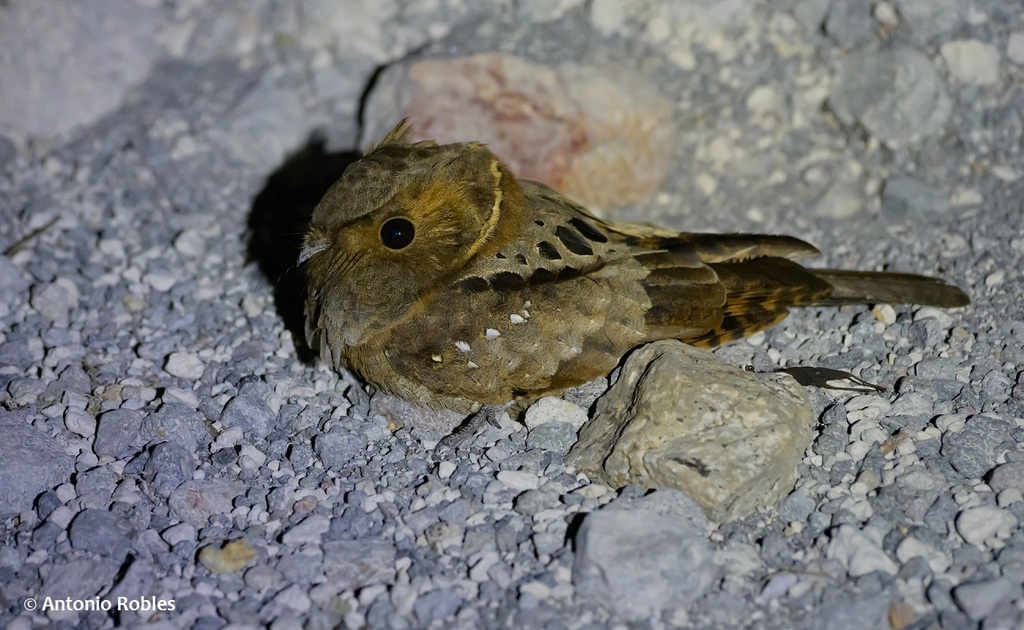
The eared poorwill is 20 to 21 cm (7.9 to 8.3 in) long. Males weigh 30.8 to 37 g (1.1 to 1.3 oz) and females 24 to 35.3 g (0.85 to 1.2 oz). The nominate subspecies' upperparts are grayish with black and white spots on the wings. A white band that is wider on the throat encircles the neck. They have crown feathers that project as "ear tufts". The breast is grayish and the belly buff with white spots. The tail feathers except the central pair have white tips. There is also a rufous morph that has an overall cinnamon to reddish brown color. N. m. rayi has darker and grayer underparts and the white spots on the wings are smaller.
Range & habitat
The eared poorwill is found for most of the length of western Mexico. N. m. mcleodii is found from Chihuahua and Sonora south to Jalisco and Colima. N. m. rayi is found in Guerrero and Oaxaca. (All of the records in the last state are between February and May, indicating some seasonal movement.) They mainly inhabit open pine/oak or oak woodland in semi-arid mountainous terrain. They can also be found in wooded gulleys, hillsides below cloudforest, and overgrown fields. In elevation the species ranges mostly from 600 to 2,000 m (2,000 to 6,600 ft) but has been recorded up to 2,500 m (8,200 ft).
Wikipedia: “Distribution and habitat”
What it does
The eared poorwill forages for insects by sallying from trees or the ground. Beetles and moths appear to form the bulk of its diet.
Wikipedia: “Feeding”
Listen
Looking for field recordings…
Where it lives
Recorded sightings
—
geo-referenced records in GBIF, from museums, herbaria and field observers.
Drag the globe to turn it. Dots are where records exist, not a range map; darker means more records.
In the stacks
Searching the stacks…
Every page naming Nyctiphrynus mcleodii in the Biodiversity Heritage Library →
This page is assembled live from iNaturalist, GBIF, Wikipedia, the Source Library and the Internet Archive. It is not yet part of the hand-edited codex. iNaturalist taxon 19639.