- Animals
- ›Chordates
- ›Vertebrates
- ›Ray-finned Fishes
- ›Spiny-rayed fishes
- ›Gobies, cardinalfishes and allies
- ›Gobies and allies
- ›Gobies
- ›Sea Gobies
- ›Eviota
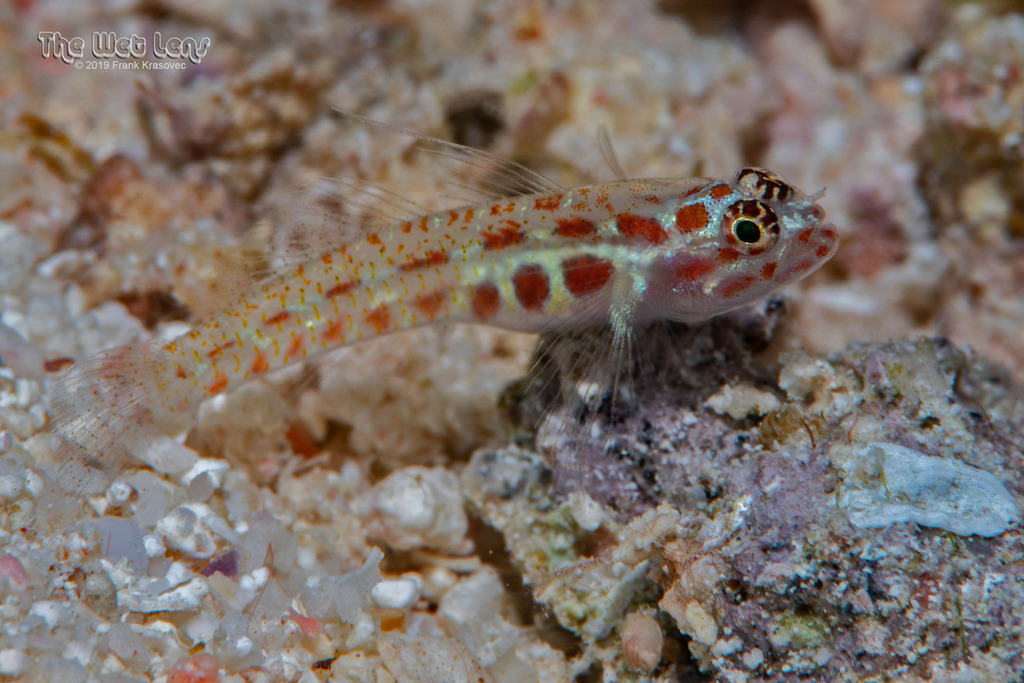
Whitestriped Dwarfgoby
Eviota guttata
Eviota guttata, the spotted dwarfgoby, is a species of ray-finned fish from the family Gobiidae, the "true gobies". It is found in the western Indian Ocean.
From the article Eviota guttata on Wikipedia (CC BY-SA), quoted section by section
Description
Eviota guttata has a total of 6–7 spines in its dorsal fins and a total of 8–9 soft rays. The anal fin has a single spine and 8-9 soft rays. It closely resembles Eviota albolineata and its counts or measurements match closely. There are, however, distinct differences in colour, both in live and preserved specimens with this species having a dark spot on the underside of the head about in line with the rear part of the jaws and it also has a few scattered melanophores on the ventral side of the lower jaw near its tip, the intensity of the dark pigmentation varies, from just a few melanophores to a patch of very dark colour, this feature is absent in E. albolineata. They grow to a total length of 3.2 centimetres (1.3 in).
Range & habitat
Eviota guttata was originally described from specimens taken in the Red Sea and the Gulf of Oman, with the holotype being from an Ethiopian Navy base, Massawa, in modern Eritrea. It is now known to occur in the western Indian Ocean including the Maldives, Seychelles, Red Sea, Gulf of Aqaba, and the Gulf of Oman. Records from the Pacific are probably misidentifications of similar species of Eviota gobies, such as Eviota theresae in Fiji.
Wikipedia: “Distribution”
Where it lives
Recorded sightings
—
geo-referenced records in GBIF, from museums, herbaria and field observers.
Drag the globe to turn it. Dots are where records exist, not a range map; darker means more records.
In the stacks
Searching the stacks…
Every page naming Eviota guttata in the Biodiversity Heritage Library →
This page is assembled live from iNaturalist, GBIF, Wikipedia, the Source Library and the Internet Archive. It is not yet part of the hand-edited codex. iNaturalist taxon 196632.