- Animals
- ›Chordates
- ›Vertebrates
- ›Ray-finned Fishes
- ›Spiny-rayed fishes
- ›Blennies, Damselfishes and Allies
- ›Blennies
- ›Combtooth Blennies
- ›Typical Blennies
- ›Aspidontus
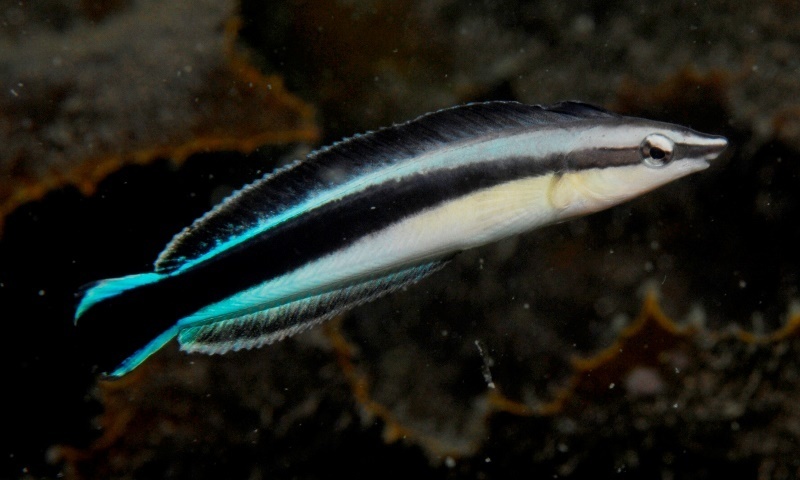
False Cleanerfish
Aspidontus taeniatus
The false cleanerfish (Aspidontus taeniatus) is a species of combtooth blenny, a mimic that copies both the dance and appearance of Labroides dimidiatus (the bluestreak cleaner wrasse), a similarly colored species of cleaner wrasse. It likely mimics that species to avoid predation, as well as to occasionally bite the fins of its victims rather than consume parasites. Most veiled attacks occur on juvenile fish, as adults that have been attacked in the past may avoid or even attack A. taeniatus.
It is indigenous to coral reef habitats in the Indo-Pacific.
From the article False cleanerfish on Wikipedia (CC BY-SA), quoted section by section
Description
The false cleanerfish primarily lives in coral reef margins among the cleaning stations of the bluestreak cleaner wrasse (Labroides dimidiatus), and are usually seen near locations of one or more L. dimidiatus. With its territory primarily overlapping with its model fish, the false cleanerfish mimics both the appearance and occasionally the behavior of said fish. Though A. taeniatus is typically known to exhibit the characteristic black stripe and blue body and general body shape and structure of L. dimidiatus, some individuals have been witnessed to mimic the appearance of other reef fish, as well as atypically colored cleaner wrasses that live in the same territory. Juvenile A. taeniatus fish match the appearance of juvenile L. dimidiatus (black body, blue dorsal stripe), and continue to match the coloration of cleaner wrasses of the same size throughout growth. It is not known whether the false cleanerfish adopts a permanent color pattern or if it alters its coloration to mimic the appearance of neighboring cleaner wrasses. One major difference in appearance between the false cleanerfish and its model is the location of the mouth. A. taeniatus has an underslung mouth, whereas L. dimidiatus has its mouth in the terminal position. …
Wikipedia: “Appearance”
What it does
The false cleanerfish has been observed to mimic the unusual "dance" of the bluestreak cleaner wrasse by spreading its caudal fin and oscillating its posterior end up and down. By doing so, the false cleanerfish elicits the same posing behavior in client fish, similarly to L. dimidiatus. Occasionally, however, rather than feeding on ectoparasites like the cleaner wrasse, the false cleanerfish will attack and attempt (and sometimes succeed) at tearing away portions of fin from the client fish. This typically occurs and is most successful with juvenile client fish, as adults have been evidenced to avoid or even indiscriminately attack cleanerfish, suggesting adult client fish remember being attacked. Also, evidence indicates adult fish are able to distinguish between L. dimidiatus and A. taeniatus, and thus avoid it altogether.
Wikipedia: “Cheating behaviour”
Where it lives
Recorded sightings
—
geo-referenced records in GBIF, from museums, herbaria and field observers.
Drag the globe to turn it. Dots are where records exist, not a range map; darker means more records.
In the stacks
Searching the stacks…
Every page naming Aspidontus taeniatus in the Biodiversity Heritage Library →
This page is assembled live from iNaturalist, GBIF, Wikipedia, the Source Library and the Internet Archive. It is not yet part of the hand-edited codex. iNaturalist taxon 196714.