On eBird ↗
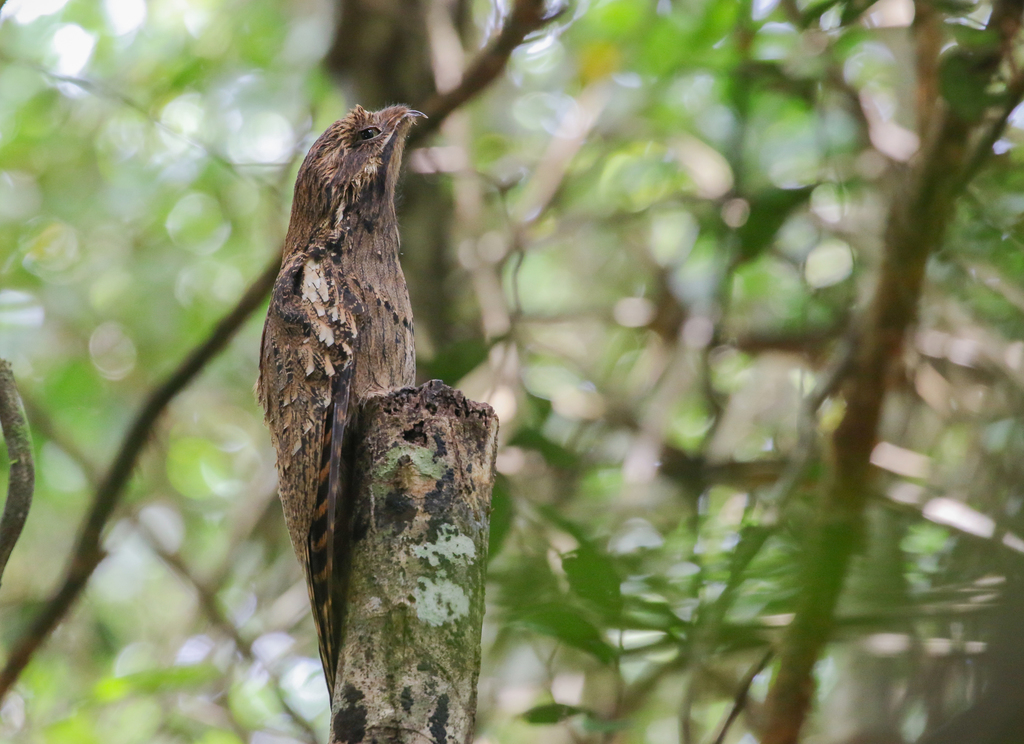
Long-tailed Potoo
Live sightings near you, the range map, bar charts of when it is seen, and Macaulay Library photos and recordings.
Long-tailed Potoo
Nyctibius aethereus
The long-tailed potoo (Nyctibius aethereus) is a species of bird in the Nyctibiidae family. It is found in Brazil, Venezuela, Guyana, Colombia, Ecuador, Peru, Bolivia, and Paraguay; also in Argentina in the extreme northeast. Its natural habitat is subtropical or tropical moist lowland forests.
From the article Long-tailed potoo on Wikipedia (CC BY-SA), quoted section by section
Description
The long-tailed potoo is 42 to 58 cm (17 to 23 in) long and weighs 280 to 447 g (9.9 to 15.8 oz). The nominate subspecies' upperparts are tawny brown. The crown and nape have buff spots and speckles and blackish brown streaks. The mantle, back, and rump are mottled brown and buff and have blackish brown streaks. The tail is graduated and overall brown, with tawny buff barring and brown streaks or vermiculation. Much of the face is tawny and it has a buffish "moustache". The wings are generally brown with broad pale tawny bars. The chin and throat are grayish buff. The breast and flanks are brown with buff speckles, blackish brown streaks, and bold buff and blackish brown spots. The lower belly is buff with brown streaks and vermiculation. N. a. longicaudatus is smaller than the nominate subspecies; often it is a more tawny brown overall and especially on the breast. N. a. chocoensis is smaller than longicaudatus but darker. The black streaks on the upperparts are larger and bolder and the brown base color tends towards chestnut.
Range & habitat
The nominate subspecies of long-tailed potoo is found in far northeastern Argentina, southeastern Paraguay, and southeastern Brazil approximately from Minas Gerais and southern Bahia south to Paraná. N. a. chocoensis is found only in western Colombia's Chocó Department. N. a. longicaudatus is by far the most widely distributed. It is found in Amazonia from Ecuador and Peru east through southern Colombia and Venezuela to the Guianas, in far northern Bolivia, and in much of western Brazil. The long-tailed potoo inhabits the interiors of lowland tropical evergreen forests. It is usually found from the understory to the subcanopy. The forests range in humidity from rather dry to very wet. In the Atlantic Forest region, the nominate subspecies is found as high as 1,200 m (3,900 ft). The other subspecies occur at lower elevations, reaching only 700 m (2,300 ft) in Ecuador and 750 m (2,460 ft) in Peru.
Wikipedia: “Distribution and habitat”
What it does
The long-tailed potoo is nocturnal. It forages by sallying for flying insects in short flights from a perch, looking "clumsy and over-sized". Its diet has not been detailed but is known to include termites, moths, and beetles.
Wikipedia: “Feeding”
Listen
Looking for field recordings…
Where it lives
Recorded sightings
—
geo-referenced records in GBIF, from museums, herbaria and field observers.
Drag the globe to turn it. Dots are where records exist, not a range map; darker means more records.
In the stacks
Searching the stacks…
Every page naming Nyctibius aethereus in the Biodiversity Heritage Library →
This page is assembled live from iNaturalist, GBIF, Wikipedia, the Source Library and the Internet Archive. It is not yet part of the hand-edited codex. iNaturalist taxon 19676.