- Animals
- ›Chordates
- ›Vertebrates
- ›Ray-finned Fishes
- ›Spiny-rayed fishes
- ›Puffers and Filefishes
- ›Spikefishes and Tripodfishes
- ›Tripodfishes
- ›Trixiphichthys
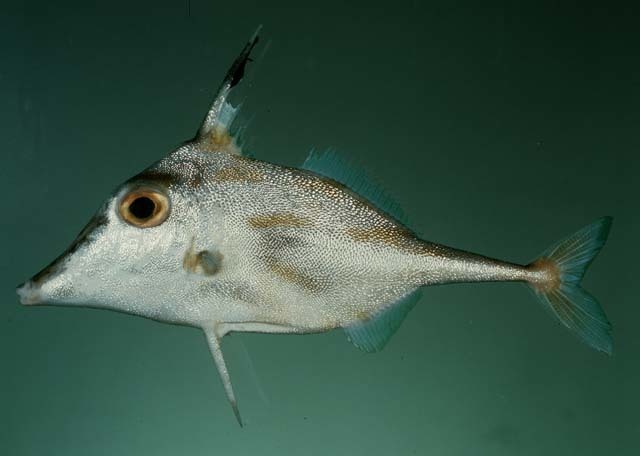
Blacktip Tripodfish
Trixiphichthys weberi
Trixiphichthys weberi, the Blacktip tripodfish, is a species in the tripod fish family (Triacanthidae) native to the tropical Indian and western Pacific Oceans. It is of minor commercial importance to local fisheries. This species grows to a length of 30 centimetres (12 in) TL. This species is the only known member of its genus....
From the article Trixiphichthys on Wikipedia (CC BY-SA), quoted section by section
Description
Trixiphichthys has the scaly ventral surface of the pelvis which is wider to the front and tapers to a distinct point. The distance between the eye to the upper end of the gill cover is short, just greater than the duiameter of the eye. It has a long snout which has aclear concave dorsal profile and is slightly compressed. The lower thisr of the first dorsal fin spine is paler than the upper two thirds. This species has a maximum total length of 30 cm (12 in)>
Range & habitat
Trixiphichthys is found in the eastern Indian Ocean and western Pacific Ocean in the Bay of Bengal, the South China Sea, the Gulf of Thailand and Indonesia. They are found at depths down to 65 m (213 ft) over san and mud flats in coastal waters.
== References ==
Wikipedia: “Distribution and habitat”
In human culture
Trixiphichthys, the genus name, is derived from the word xiphos, meaning "sword", and prefixes it with tri-, meaning "three" and suffixes it with -ichthys, the Greek word for fish. Fraser-Brunner did not explain what this alluded to but it is presumed to allude to the large first spine on the dorsal fin and the two large pelvic fin spines. The specific name honours the German-born Dutch ichthyologist Max Carl Wilhelm Weber, who helped Chaudhuri with notes in his original description.
Wikipedia: “Etymology”
Where it lives
Recorded sightings
—
geo-referenced records in GBIF, from museums, herbaria and field observers.
Drag the globe to turn it. Dots are where records exist, not a range map; darker means more records.
In the stacks
Searching the stacks…
Every page naming Trixiphichthys weberi in the Biodiversity Heritage Library →
This page is assembled live from iNaturalist, GBIF, Wikipedia, the Source Library and the Internet Archive. It is not yet part of the hand-edited codex. iNaturalist taxon 196850.