- Animals
- ›Chordates
- ›Vertebrates
- ›Ray-finned Fishes
- ›Spiny-rayed fishes
- ›Puffers and Filefishes
- ›Triggerfishes, Boxfishes, and Filefishes
- ›Deepwater Boxfishes
- ›Aracana
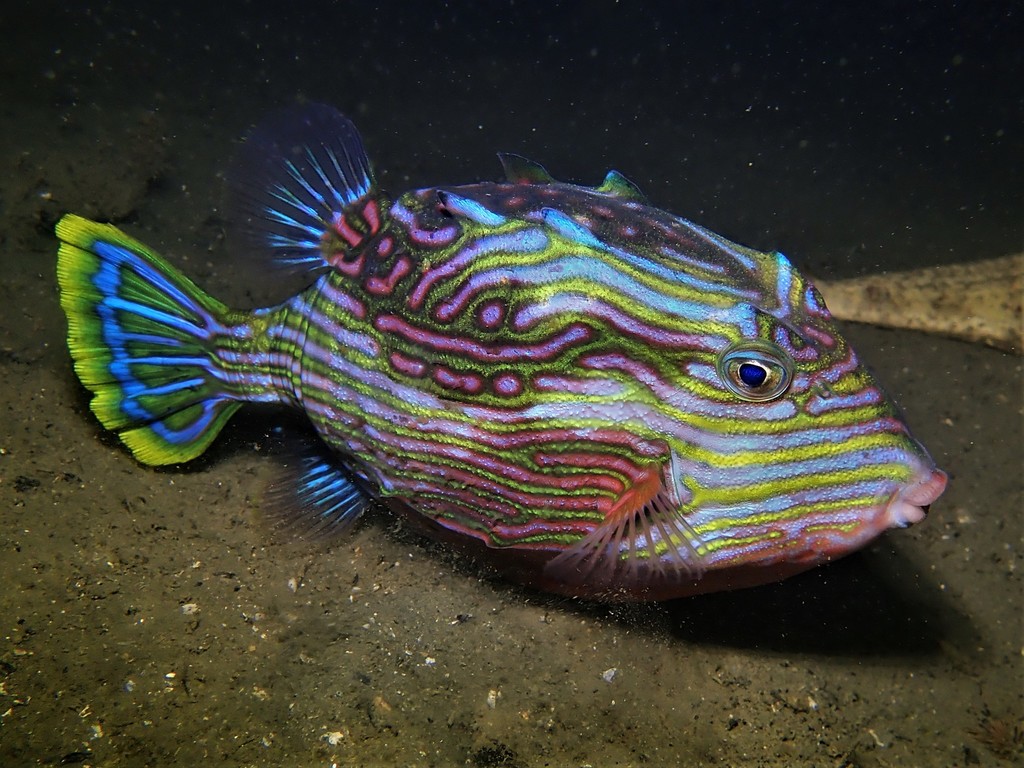
Shaw's Cowfish
Aracana aurita
Aracana aurita (striped cowfish, Shaw's cowfish or Shaw's boxfish) is a species of boxfish native to the Eastern Indian Ocean. The species was first described by George Shaw in 1798. It is carnivorous and exposes prey in the benthic zone by blowing a jet of water onto sediment.
From the article Aracana aurita on Wikipedia (CC BY-SA), quoted section by section
Description
Aracana aurita has 10 or 11 soft rays in the dorsal fin and in the anal fin while there are 11 or 12 soft rays in both the pectoral fin and caudal fin. A stiff, boxy carapace made up of sculptured bony plates girds the body. This carapace has large recurved spines along its ridges. The dorsal and anal fins are set very far back on the body and are opposite each other. The bony plates on the caudal peduncle are less well developed than the carapace but they almost form a complete band in adults. The lines on the snout are nearly horizontal. They show sexual dimorphism in the colouration with the males having bright colouration with light blue wavy lines and spots on an orange background colour. The females and juveniles have a light orange to light brown overall colour marked with irregular brown and white sinuous lines or stripes. This species has a maximum published total length of 20 cm (7.9 in).
Range & habitat
Aracana aurita is endemic to southern Australia from Newcastle, New South Wales south to Tasmania west to Kalbarri, Western Australia. They are found in seagrass beds and offshore rocky reefs in sheltered waters in bays, harbours and inlets at depths between 10 and 160 m (33 and 525 ft).
Wikipedia: “Distribution and habitat”
In human culture
Aracana aurita is classified in the genus Aracana, a name which was variously spelt by Gray as Acarana in 1833, Acerana in 1835 and Aracana in 1838. The 1838 name is the one used because it has become the most commonly used name. Grey did not explain the name but in 1835 he referred to boxfishes as "parrotfishes", so the name may refer the aracanga (Macrocercus aracanga), an old name for the scarlet macaw (Ara macao). The specific name aurita, means "eared", an allusion to the spines resembling horns above each eye, these horns together looking similar to a pair of ears.
Wikipedia: “Etymology”
Where it lives
Recorded sightings
—
geo-referenced records in GBIF, from museums, herbaria and field observers.
Drag the globe to turn it. Dots are where records exist, not a range map; darker means more records.
In the stacks
Searching the stacks…
Every page naming Aracana aurita in the Biodiversity Heritage Library →
This page is assembled live from iNaturalist, GBIF, Wikipedia, the Source Library and the Internet Archive. It is not yet part of the hand-edited codex. iNaturalist taxon 196868.