On eBird ↗
Papuan Frogmouth
Live sightings near you, the range map, bar charts of when it is seen, and Macaulay Library photos and recordings.
Papuan Frogmouth
Podargus papuensis
The Papuan frogmouth (Podargus papuensis) is a species of bird in the family Podargidae, found in the Aru Islands, New Guinea, and in Cape York Peninsula, Queensland, Australia.
From the article Papuan frogmouth on Wikipedia (CC BY-SA), quoted section by section
Description
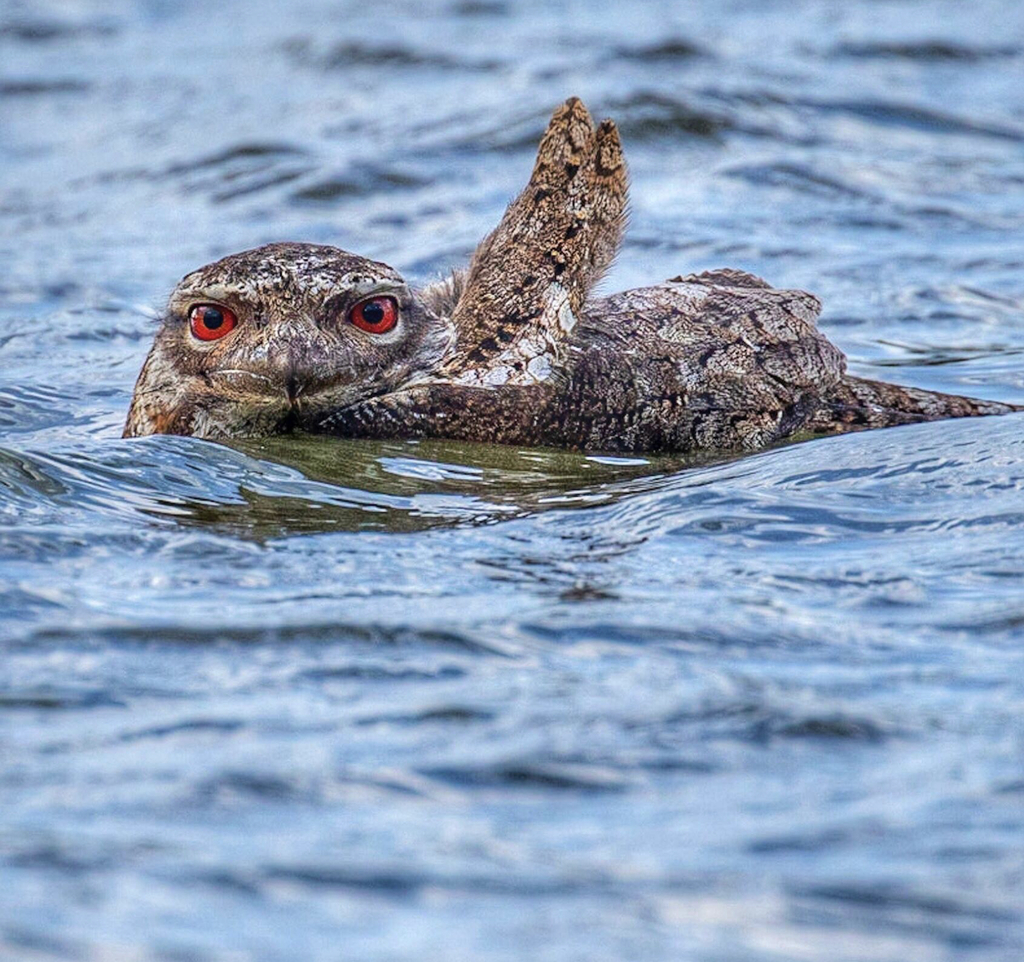
The Papuan frogmouth is the largest of frogmouths in terms of length. Average sizes indicate that it only falls behind the Neotropical great potoo and oilbird (if the latter is a true member of the order) among the largest species in the order Caprimulgiformes. On average these birds are about 53 cm (21 in), with a range of 50 to 60 cm (20 to 24 in). This species was found to average 414 g (14.6 oz) in males and 314 g (11.1 oz) in females, with a total range of 290 to 570 g (10 to 20 oz). The tawny frogmouth is smaller on average than this but is capable of reaching higher maximum weights. The Papuan frogmouth has a bulbous bill, red eye, cream eyebrow, long tail and dark wings. The male of the species is slightly larger, darker and marbled in appearance. The female is more rufous in appearance. P. p. baileyi is smaller, and darker. P. p. rogersi is larger and paler. Similar species include the tawny frogmouth. The Papuan frogmouth is larger, has red eyes, a longer tail, and darker wings.
Range & habitat
It is found in the Aru Islands, New Guinea, and Cape York Peninsula. This species' natural habitat is subtropical or tropical, moist, lowland forests.
Wikipedia: “Distribution and habitat”
What it does
The Papuan frogmouth is strictly nocturnal. It hunts for large insects on the ground from dusk. On occasion, it also takes small reptiles, amphibians, or birds as prey. The Papuan frogmouth may secrete a substance in its mouth that attracts flies. According to a number of observers, it is able to wait with its mouth open and flies enter to investigate the odor.
Wikipedia: “Feeding”
Listen
Looking for field recordings…
Where it lives
Recorded sightings
—
geo-referenced records in GBIF, from museums, herbaria and field observers.
Drag the globe to turn it. Dots are where records exist, not a range map; darker means more records.
In the stacks
Searching the stacks…
Every page naming Podargus papuensis in the Biodiversity Heritage Library →
This page is assembled live from iNaturalist, GBIF, Wikipedia, the Source Library and the Internet Archive. It is not yet part of the hand-edited codex. iNaturalist taxon 19710.