On eBird ↗
Tropical Screech-Owl
Live sightings near you, the range map, bar charts of when it is seen, and Macaulay Library photos and recordings.
Tropical Screech-Owl
Megascops choliba
The tropical screech owl (Megascops choliba) is a small species of owl in the family Strigidae. It is found in Costa Rica, Panama, Trinidad, and every mainland South American country.
From the article Tropical screech owl on Wikipedia (CC BY-SA), quoted section by section
Description
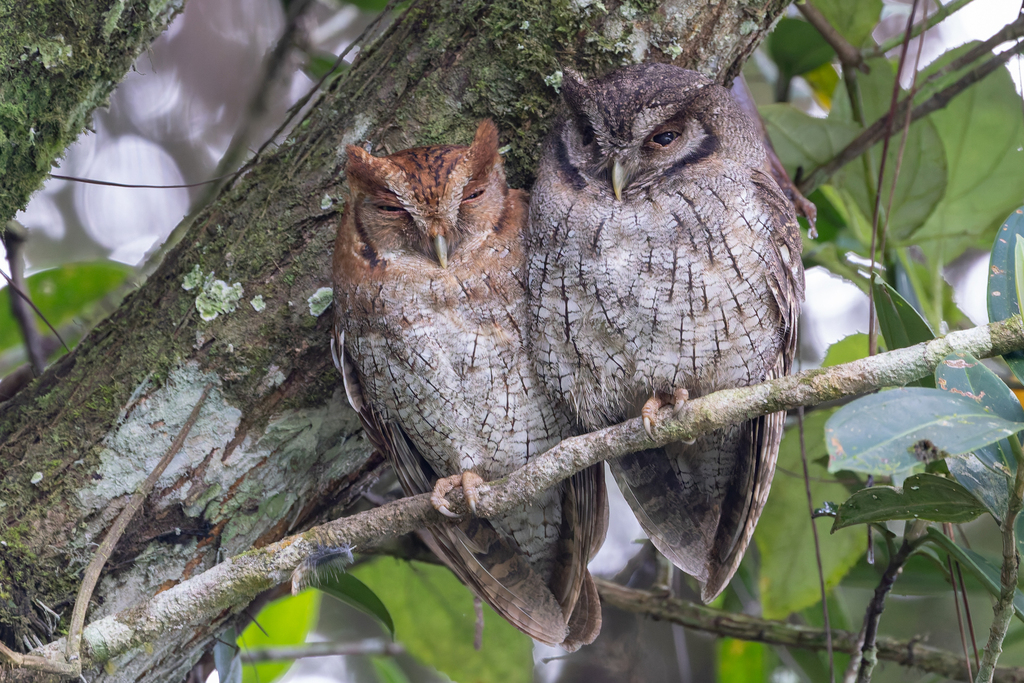
The tropical screech owl is polymorphic, with much variation in color. It is overall gray-brown or (less commonly) brown or rufous, but always with a relatively distinctive blackish edge to the face and yellow irides. Its undersides are pale with a black "herringbone" pattern. The subspecies differ in the intensity of the colors and the amount of black markings on the upper- and underparts. Adults are 21 to 23 cm (8.3 to 9.1 in) long and weigh 97 to 160 g (3.4 to 5.6 oz).
Range & habitat
The tropical screech owl is "the most common and widespread screech-owl of the neotropics." It is found from Costa Rica and Panama south and throughout South America (including Trinidad and Tobago), almost entirely east of the Andes, but not in the far south. The subspecies are distributed thus:
M. c. choliba, southern Mato Grosso and São Paulo, Brazil, south to eastern Paraguay M. c. luctisomus, the Pacific slope in Costa Rica south to the Canal Zone in Panama, and on the Pearl Islands M. c. margaritae, restricted to Margarita Island off of northern Venezuela M. c. cruciger, Trinidad, and eastern Colombia and Venezuela east to the Guianas and south to eastern Peru M. c. duidae, Cerro Duida and Cerro de la Neblina in southern Venezuela M. c. decussatus, central and southern Brazil M. c. uruguaii, southeastern Brazil, northeastern Argentina, and Uruguay M. c. surutus, Bolivia M. c. wetmorei, Paraguay and Argentina The tropical screech owl inhabits a wide variety of landscapes. Most tend to be partially to mostly open, such as secondary forest, open woodland, coffee plantations, residential areas, and the borders of terra firme and várzea forests. Except for M. c. duidae, it shuns the interior of forests; that subspecies is found in dense forest and bamboo scrub.
Wikipedia: “Distribution and habitat”
What it does
The tropical screech owl is nocturnal. It forages by sallying from a low perch to capture prey on the ground, from branches, or in the air. Its diet is large arthropods and small vertebrates. The former include earthworms, scorpions, spiders, harvestmen, and a large variety of insects (such as grasshoppers, katydids, moths and caterpillars, ants, cockroaches, cicadas, termites, mantids, crickets, and beetles). Vertebrate prey includes small frogs, other amphibians, small reptiles (such as snakes), other birds, opossums, bats, and rodents.
Wikipedia: “Feeding”
Listen
Looking for field recordings…
Where it lives
Recorded sightings
—
geo-referenced records in GBIF, from museums, herbaria and field observers.
Drag the globe to turn it. Dots are where records exist, not a range map; darker means more records.
In the stacks
Searching the stacks…
Every page naming Megascops choliba in the Biodiversity Heritage Library →
This page is assembled live from iNaturalist, GBIF, Wikipedia, the Source Library and the Internet Archive. It is not yet part of the hand-edited codex. iNaturalist taxon 19788.