On eBird ↗
Andean Pygmy-Owl
Live sightings near you, the range map, bar charts of when it is seen, and Macaulay Library photos and recordings.
Andean Pygmy-Owl
Glaucidium jardinii
The Andean pygmy owl (Glaucidium jardinii) is a species of owl in the family Strigidae. It is found in Colombia, Ecuador, Peru, and Venezuela.
From the article Andean pygmy owl on Wikipedia (CC BY-SA), quoted section by section
Description
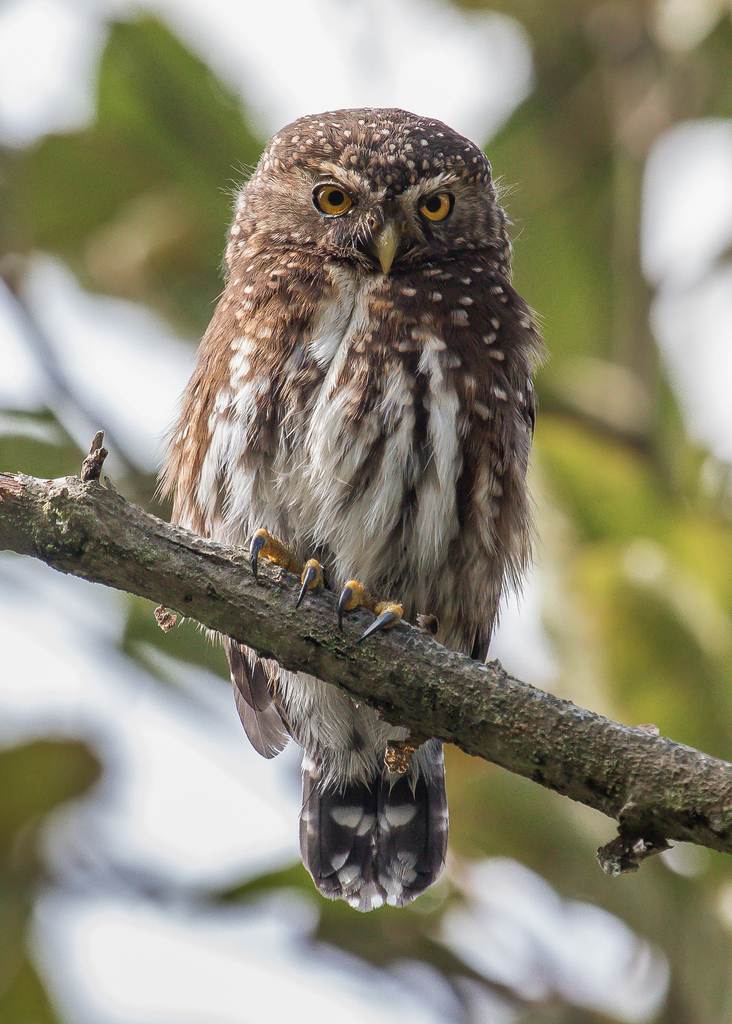
The Andean pygmy owl is 15 to 16 cm (5.9 to 6.3 in) long. Males weigh 54.9 to 77.4 g (1.9 to 2.7 oz) and females 54.6 to 75 g (1.9 to 2.6 oz). It has two distinct color morphs; in one the head, most of the body, wings, and tail are dull dark brown with white markings and in the other the same areas are dark chestnut with buff markings. In both the crown has small white dots. They have white "brows" over yellow eyes, white "moustaches", and a broad white throat. Their nape has a black and white face-like pattern. Their backs have spots and the tail bars, white or buff respectively. The sides of the breast are dark brown or chestnut with pale markings; the white breast and belly have heavy dark brown or chestnut streaks.
Range & habitat
The Andean pygmy owl is found in far western Venezuela and the central and western Andes of Colombia south through Ecuador to central Peru. It inhabits a variety of mountain landscapes including cloudforest, elfin forest, Polylepis woodland, and sometimes more open landscapes like forest edge and pastures with scattered trees. It is found from the middle levels of the forest to the canopy. In elevation it ranges from about 1,500 to 3,500 m (4,900 to 11,500 ft) in Colombia and somewhat higher in Venezuela, Ecuador, and Peru.
Wikipedia: “Distribution and habitat”
What it does
The Andean pygmy owl is active both day and night. Its diet is invertebrates, small birds, and small mammals.
Wikipedia: “Feeding”
Listen
Looking for field recordings…
Where it lives
Recorded sightings
—
geo-referenced records in GBIF, from museums, herbaria and field observers.
Drag the globe to turn it. Dots are where records exist, not a range map; darker means more records.
In the stacks
Searching the stacks…
Every page naming Glaucidium jardinii in the Biodiversity Heritage Library →
This page is assembled live from iNaturalist, GBIF, Wikipedia, the Source Library and the Internet Archive. It is not yet part of the hand-edited codex. iNaturalist taxon 19820.