On eBird ↗
Chaco Owl
Live sightings near you, the range map, bar charts of when it is seen, and Macaulay Library photos and recordings.
Chaco Owl
Strix chacoensis
The Chaco owl (Strix chacoensis) is an owl which inhabits dry Chaco woodland in southern Bolivia, western Paraguay and northern Argentina.
From the article Chaco owl on Wikipedia (CC BY-SA), quoted section by section
Description
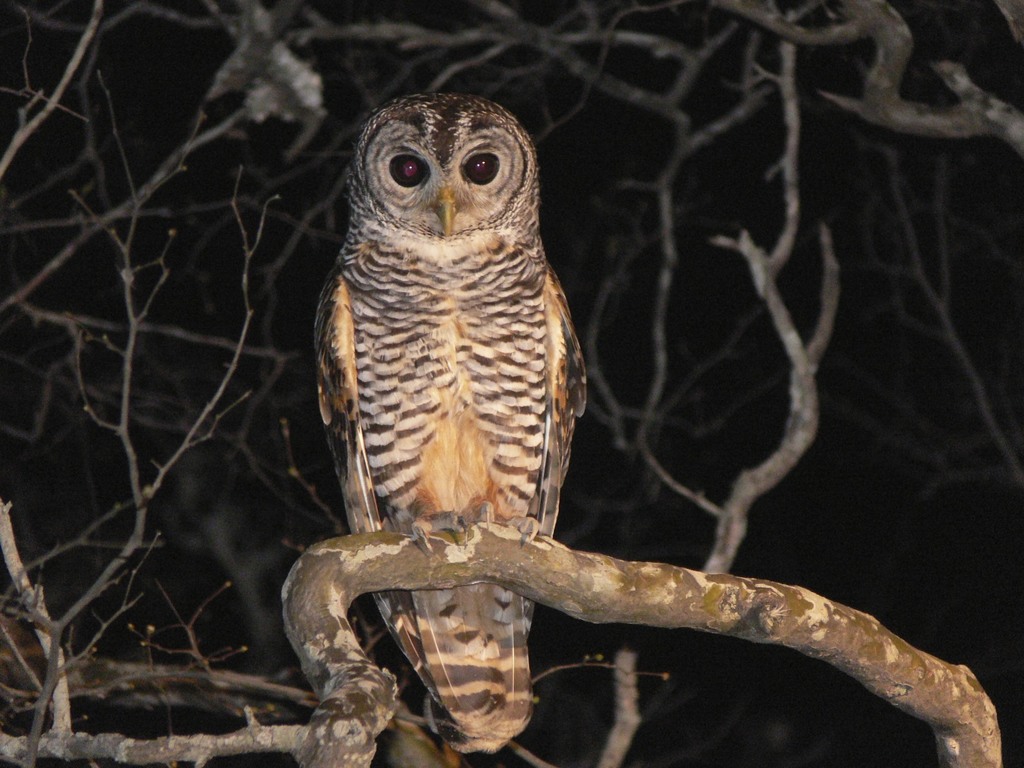
The Chaco owl is 35 to 38 cm (14 to 15 in) long. Males weigh 360 to 435 g (12.7 to 15.3 oz) and females 420 to 500 g (15 to 18 oz). It has a round head with no ear tufts. Adults have a pale grayish white facial disk with concentric dark lines. Their upperparts are dusky brownish black with narrow white and yellowish buff barring. Their underparts are off-white with dark brown barring. The tail is dark grayish brown with narrow pale bars.
Range & habitat
The Chaco owl is found in southern South America, from Bolivia's Santa Cruz Department south through western Paraguay into north-central Argentina as far as Córdoba and Buenos Aires provinces. Its elevational range is not well known, but in Argentina it is found between 500 and 1,300 m (1,600 and 4,300 ft). It inhabits the Gran Chaco, a biome characterized by low rainfall. The species is found there in hilly, rolling, and flat terrain with a wide variety of forest types, both dense and semi-open.
Wikipedia: “Distribution and habitat”
What it does
The Chaco owl is primarily nocturnal but is vocally active at dawn and dusk. It hunts from a perch, dropping on or flying to small mammals, birds, reptiles, and invertebrates.
Wikipedia: “Feeding”
Listen
Looking for field recordings…
Where it lives
Recorded sightings
—
geo-referenced records in GBIF, from museums, herbaria and field observers.
Drag the globe to turn it. Dots are where records exist, not a range map; darker means more records.
In the stacks
Searching the stacks…
Every page naming Strix chacoensis in the Biodiversity Heritage Library →
This page is assembled live from iNaturalist, GBIF, Wikipedia, the Source Library and the Internet Archive. It is not yet part of the hand-edited codex. iNaturalist taxon 19942.