On eBird ↗
Pel's Fishing-Owl
Live sightings near you, the range map, bar charts of when it is seen, and Macaulay Library photos and recordings.
Pel's Fishing-Owl
Scotopelia peli
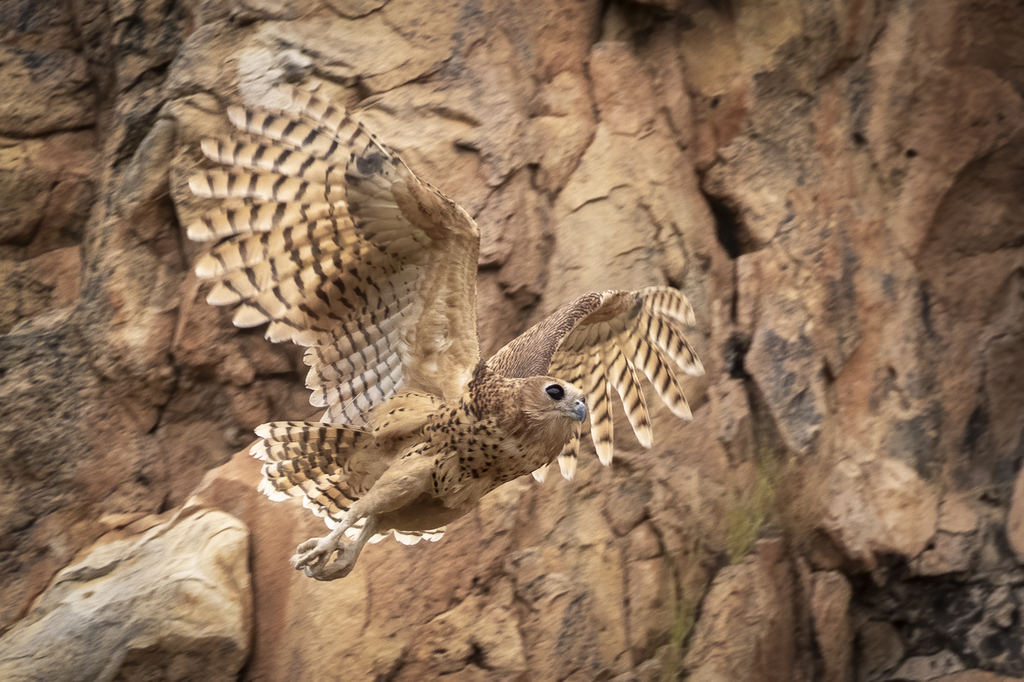
Pel's fishing owl (Scotopelia peli) is a large species of owl in the family Strigidae, found in Africa. It lives near rivers and lakes, and feeds nocturnally on fish and frogs snatched from the surface of lakes and rivers. The species prefers slow-moving rivers with large, overhanging trees to roost in and forage from. It nests in hollows and the forks of large trees. Even though two eggs are laid, often only one chick is raised.
From the article Pel's fishing owl on Wikipedia (CC BY-SA), quoted section by section
Description
Pel's fishing owl is one of the largest owl species in the world. Among the world's owls, it ranks as the fifth-heaviest on average, the seventh-longest in length and measured wing chord, and fourth-longest in mean wingspan, although not all large species have had measured wingspans. It measures 51–63 cm (20–25 in) in length, spans around 153 cm (60 in) across the wings and weighs up to at least 2.35 kg (5.2 lb). One male was found to weigh 1.72 kg (3.8 lb) and four females averaged 2.19 kg (4.8 lb), it may outrival the snowy owl (only around 4% lighter on average in six datasets) as the fifth- or sixth-heaviest living owl on average. Under current classification, it is the heaviest extant owl outside of the genus Bubo, although some authors may also include the fishing owls in Bubo. Among standard measurements, the wing chord is 40.7–44.7 cm (16.0–17.6 in) and the tail is 20.7–24.3 cm (8.1–9.6 in) long. They are well adapted to their aquatic lifestyle. Unlike most owls, they have minimal feathering on their toes and the tarsi, thus minimizing the amount of plumage that gets wet while fishing. Like diurnal raptors that specialize in fish, they have spiky scales on the bottoms of their feet that help them grip slippery fish. …
Range & habitat
It is found throughout a large part of sub-Saharan Africa, but it is generally rather local, uncommon, and absent from drier regions. It is patchily distributed in Nigeria, Senegal, the Gambia, Guinea, Sierra Leone, and in central Africa from the coast to eastern Zaire and discontinuously to South Sudan, Somalia, Kenya, and Tanzania and southwards to Zambia, Zimbabwe, Botswana, and eastern South Africa. Pel's fishing owl is found in forests along rivers and lakes. It can be found in swamps and estuaries at sea level up to an elevation of around 1,700 m (5,600 ft). Its favorite habitat is riverine forests with large trees, although large numbers are also found on islands with large, old trees within larger rivers, swamps or lakes, so long as the islands are not too far from the bank. The species is largely residential and has no seasonal movement, although young, nonbreeding birds may wander somewhat before claiming their own territories. Pel's fishing owl may move outside of its own range in pursuit of prey.
Wikipedia: “Distribution and habitat”
What it does
In general, this species is nocturnal and is most vocally active on moonlit nights, especially near dawn. However, they are sometimes seen to be active during the day, especially when prey is scarce. During the daytime, they usually roost on a large tree branch. Often, the male and female roost together. At dusk, they leave the roost and instead perch on stumps, branches, and other objects that extend over the water.
Diet and feeding. The main prey of Pel's fishing owls is fish. They can take fish weighing as much as 2 kg (4.4 lb), but most fish caught are much smaller, usually weighing 100–200 g (3.5–7.1 oz). They are not picky eaters among fish species and any fish that is in a reasonable size range and found close to the water's surface is readily caught and consumed. Compared with the fish owls in the genus Bubo, the three fishing owls are more completely piscivorous and rarely vary their prey selection from fish. They may also take other aquatic animals such as frogs, crabs, mussels and large insects. In one case, a Pel's fishing owl was observed to prey on a baby Nile crocodile (Crocodylus niloticus). While perched over the water, these owls detect the movement of fish from ripples in the water and swoop down to seize their prey with their powerful talons and then swoop back to their perch for consumption. …
Wikipedia: “Behaviour”
Listen
Looking for field recordings…
Where it lives
Recorded sightings
—
geo-referenced records in GBIF, from museums, herbaria and field observers.
Drag the globe to turn it. Dots are where records exist, not a range map; darker means more records.
In the stacks
Searching the stacks…
Every page naming Scotopelia peli in the Biodiversity Heritage Library →
This page is assembled live from iNaturalist, GBIF, Wikipedia, the Source Library and the Internet Archive. It is not yet part of the hand-edited codex. iNaturalist taxon 19971.