- Animals
- ›Chordates
- ›Vertebrates
- ›Birds
- ›Hawks, Eagles, Kites, and Allies
- ›Hawks, Eagles, and Kites
- ›Buteonine Hawks, Kites, and allies
- ›Pseudastur
On eBird ↗
White Hawk
Live sightings near you, the range map, bar charts of when it is seen, and Macaulay Library photos and recordings.
White Hawk
Pseudastur albicollis
The white hawk (Pseudastur albicollis), a bird of prey breeding in the tropical New World, belongs to the family Accipitridae. Though it is commonly placed in the subfamily Buteoninae, the validity of this group is doubtful and currently under review.
From the article White hawk on Wikipedia (CC BY-SA), quoted section by section
Description
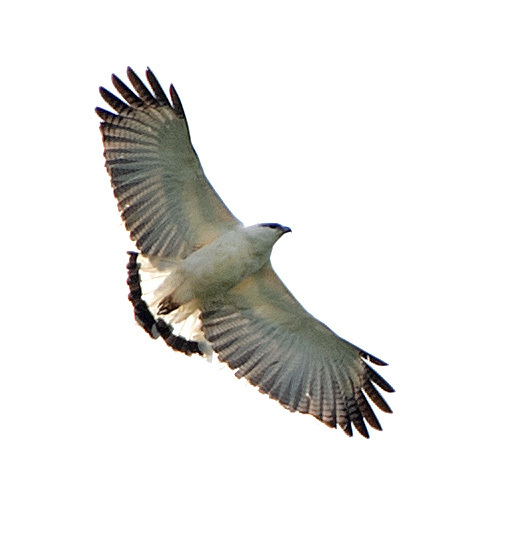
The adult white hawk ranges from 46–56 cm (18–22 in) long with very broad wings and has a white head, body and underwings. The upper wings are black, and the very short tail is black with a broad white band. The bill is black and the legs are yellow. The sexes are similar, but females are larger and heavier—840 g (1.85 lb) compared to the male's 650 g (1.43 lb). Immature birds have extensive black spotting on the upperparts and dark-streaked whitish underparts. The call of the white hawk is a plaintive kerwee.
Subspecies. There are four subspecies:
Pseudastur albicollis ghiesbreghti – Southern Mexico to Nicaragua Entirely white, except for black markings on the outer primaries, and a black sub-terminal tail bar. The eyes are yellow. Pseudastur albicollis costaricensis – Honduras to Panama and Colombia. Similar to ghiesbreghti but with more distinct black markings on the wings and tail. The eyes are brown. Pseudastur albicollis williaminae – Locally in north-western Colombia and western Venezuela. Wing feathers are more heavily marked with black, and it has black streaks on the crown and collar. The tail band is broader and the eyes are brown. Pseudastur albicollis albicollis – Northern Colombia and central Venezuela to Brazil. Smaller than the northern forms and the wings are mostly black, with white markings. …
Range & habitat
This is a bird of lowland forest and other woodlands. It ranges from southern Mexico through Central and South America to Peru, Bolivia and Brazil. It also breeds on Trinidad. The white hawk's range in central South America is the entire Amazon basin, from the Andes on the west to the Guianas on the Atlantic on the northeast, and to the transition lands to the south. A widespread species, it is usually not common, but the IUCN considers it not to be globally threatened due to the large extent of its range. The white hawk feeds mainly on reptiles (such as lizards and snakes, including the eastern coral snake) with some insects (such as beetles and grasshoppers), crabs, amphibians and mammals (including rats, squirrels, small opossums and bats), caught in a sortie from a perch. Researchers have documented the white hawk feeding on a number of bird species including the keel-billed toucan, the mottled owl, the white-breasted wood wren and the great tinamou. They may feed on young and weak birds, as well. Though rare, there is some evidence that this hawk may occasionally feed on fish. One researcher in Suriname found remains of a fish in a white hawk's stomach. It associates with foraging groups of tufted capuchin monkeys (Cebus apella) and South American coatis (Nasua nasua) to snatch prey startled by these animals. …
Wikipedia: “Distribution and ecology”
Listen
Looking for field recordings…
Where it lives
Recorded sightings
—
geo-referenced records in GBIF, from museums, herbaria and field observers.
Drag the globe to turn it. Dots are where records exist, not a range map; darker means more records.
In the stacks
Searching the stacks…
Every page naming Pseudastur albicollis in the Biodiversity Heritage Library →
This page is assembled live from iNaturalist, GBIF, Wikipedia, the Source Library and the Internet Archive. It is not yet part of the hand-edited codex. iNaturalist taxon 199830.