On eBird ↗
Mexican Whip-poor-will
Live sightings near you, the range map, bar charts of when it is seen, and Macaulay Library photos and recordings.
Mexican Whip-poor-will
Antrostomus arizonae
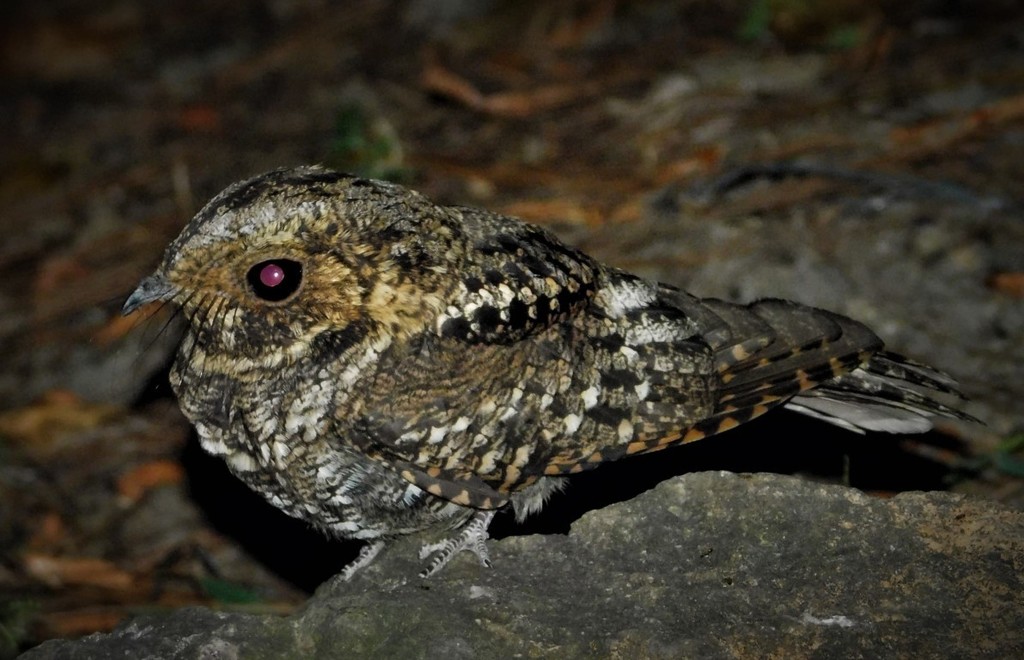
The Mexican whip-poor-will, (Antrostomus arizonae), is a medium-sized (22–27 cm) nightjar from the southwestern United States and Mexico. The whip-poor-will is more often heard within its range, but less often seen. It is named onomatopoeically after its song.
From the article Mexican whip-poor-will on Wikipedia (CC BY-SA), quoted section by section
Description
The Mexican whip-poor-will is 23 to 24 cm (9.1 to 9.4 in) long and weighs 45 to 50 g (1.6 to 1.8 oz). In general its upperparts are grayish brown with blackish brown streaks; the crown has wide blackish brown stripes. The throat and breast are blackish with a thin white band on the lower throat between them. The belly is buff with brown bars. The male's outermost three pairs of tail feathers have broad white tips; the female's are narrower and buffy. The wings are brown with tawny and buff spots and speckles. The subspecies differ somewhat. They are lighter in the north and darker in the south and there are variations in the tone of the body color (some are redder) and the size and shape of the spots and speckles.
Range & habitat
The subspecies of the Mexican whip-poor-will are distributed thus:
A. a. arizonae, breeds from southeastern California to southwestern Texas and south into the Mexican states of Jalisco and Guanajuato. The northernmost withdraw to the south in winter. A. a. setosus, resident in eastern Mexico from central Tamaulipas south to the Isthmus of Tehuantepec in northwestern Chiapas. A. a. oaxacae, resident in southwestern Mexico from Michoacán to the Isthmus of Tehuantepec. A. a. chiapensis, resident in eastern Oaxaca and northern Chiapas south to central Guatemala. A. a. vermiculatus, resident in Honduras and El Salvador. A. a. arizonae inhabits several similar mid- to mid-upper elevation, semi-arid to moist, landscapes with the common features being oaks and pines. The habitat of the more southerly resident subspecies is poorly known but there too they are birds of forest and woodland.
Wikipedia: “Distribution and habitat”
What it does
The behavior of the Mexican whip-poor-will has not been extensively studied but is assumed to be essentially the same as that of eastern whip-poor-will. That species is crepuscular and nocturnal, and roosts motionless during the day.
Feeding. Mexican whip-poor-wills are assumed to forage like eastern whip-poor-wills by sallying from a tree perch and less frequently from the ground. The latter's prey is insects, with moths and beetles being the dominant types.
Breeding. The Mexican whip-poor-will lays its clutch of two eggs directly on leaf litter with no conventional nest. In Arizona they are laid in May and early June; laying dates are not known elsewhere. Both male and female have a brood patch, which probably means that both sexes tend the eggs as do eastern whip-poor-wills.
Vocalization. The Mexican whip-poor-will is more often heard than seen. Its song is an onomatopoeic whip-poor-will like that of its eastern congener, but lower in pitch and "less 'snappy' and slightly 'lazier'". It also makes a variety of other sounds including "a single, low, mellow quirt or queerp note", a growl, and a "growl-chuck".
Wikipedia: “Behavior”
Listen
Looking for field recordings…
Where it lives
Recorded sightings
—
geo-referenced records in GBIF, from museums, herbaria and field observers.
Drag the globe to turn it. Dots are where records exist, not a range map; darker means more records.
In the stacks
Searching the stacks…
Every page naming Antrostomus arizonae in the Biodiversity Heritage Library →
This page is assembled live from iNaturalist, GBIF, Wikipedia, the Source Library and the Internet Archive. It is not yet part of the hand-edited codex. iNaturalist taxon 199831.