On eBird ↗
Purple Finch
Live sightings near you, the range map, bar charts of when it is seen, and Macaulay Library photos and recordings.
Purple Finch
Haemorhous purpureus
The purple finch (Haemorhous purpureus) is a bird in the finch family, Fringillidae. It breeds in the northern United States, southern Canada, and the west coast of North America.
From the article Purple finch on Wikipedia (CC BY-SA), quoted section by section
Description
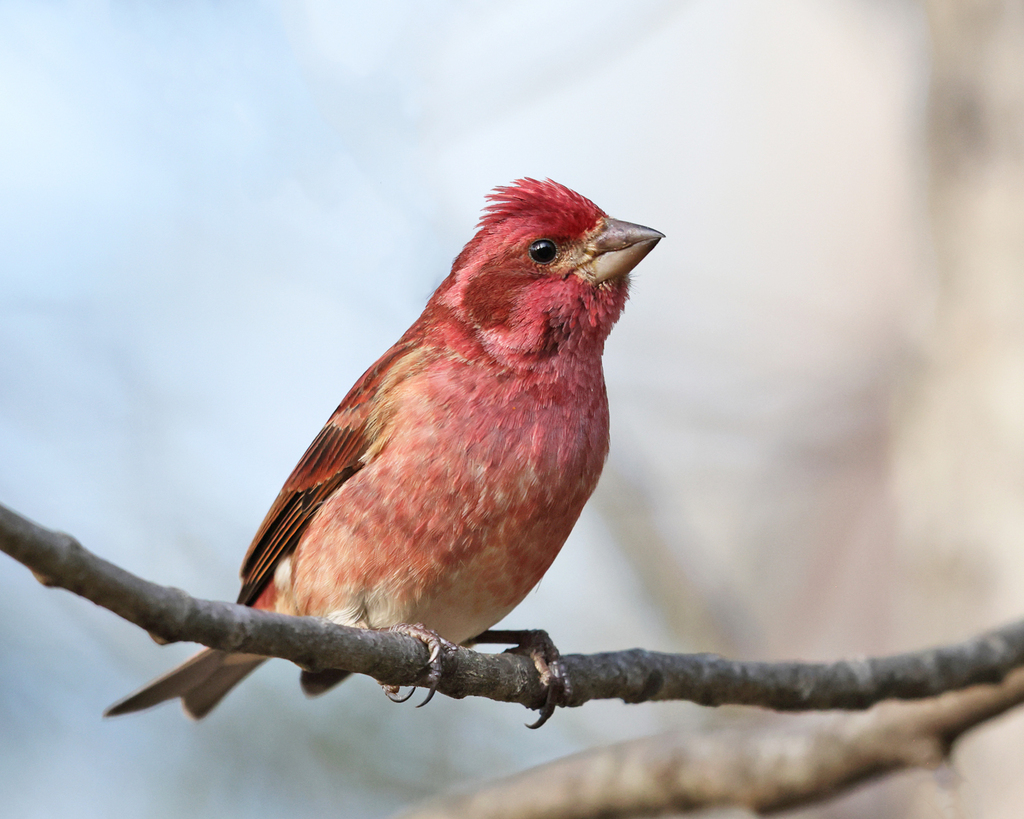
The purple finch is 12–16 cm (4.7–6.3 in) in overall length and weighs a mean 23.3 g (0.82 oz), ranging from 19.8 to 28.4 g (0.7 - 1.0 oz). It has a short forked brown tail and brown wings. Adult males are raspberry red on the head, breast, back and rump; their back is streaked. Adult females have light brown upperparts and white underparts with dark brown streaks throughout; they have a white line on the face above the eye. The subspecies H. P. californicus differs from the nominate in having a longer tail and shorter wings. The plumage of both males and females is darker, and the coloration of the females is more greenish. It also has a longer bill.
Range & habitat
Their breeding habitat is coniferous and mixed forest in Canada and the northeastern United States, as well as various wooded areas along the U.S. Pacific coast. Birds from northern Canada migrate to the southern and midwestern United States; other birds are permanent residents. The purple finch population has been displaced from some breeding season habitats in the Eastern United States following the introduction of the house finch, which is native to the western U.S. and Mexico. The two species share a similar niche, with the house finch often outcompeting the purple finch during the summer.
Wikipedia: “Distribution and habitat”
What it does
These birds forage in trees and bushes, sometimes in ground vegetation. They mainly eat seeds, berries, and insects. They also eat tree buds, caterpillars, and beetles.
Wikipedia: “Food and feeding”
In human culture
In 1957 the purple finch was designated as the state bird of New Hampshire. The New Hampshire red hen (breed of domestic chicken) was also proposed, but was not chosen in favor of the purple finch. In 1763, Richard Brookes made the description of the female purple finch in Mexico with the name of "chiantototl" (chia seed bird).
Wikipedia: “Cultural depictions”
Listen
Looking for field recordings…
Where it lives
Recorded sightings
—
geo-referenced records in GBIF, from museums, herbaria and field observers.
Drag the globe to turn it. Dots are where records exist, not a range map; darker means more records.
In the old herbals & bestiaries

In the stacks
Searching the stacks…
Every page naming Haemorhous purpureus in the Biodiversity Heritage Library →
This page is assembled live from iNaturalist, GBIF, Wikipedia, the Source Library and the Internet Archive. It is not yet part of the hand-edited codex. iNaturalist taxon 199841.