On eBird ↗
Green Warbler-Finch
Live sightings near you, the range map, bar charts of when it is seen, and Macaulay Library photos and recordings.
Green Warbler-Finch
Certhidea olivacea
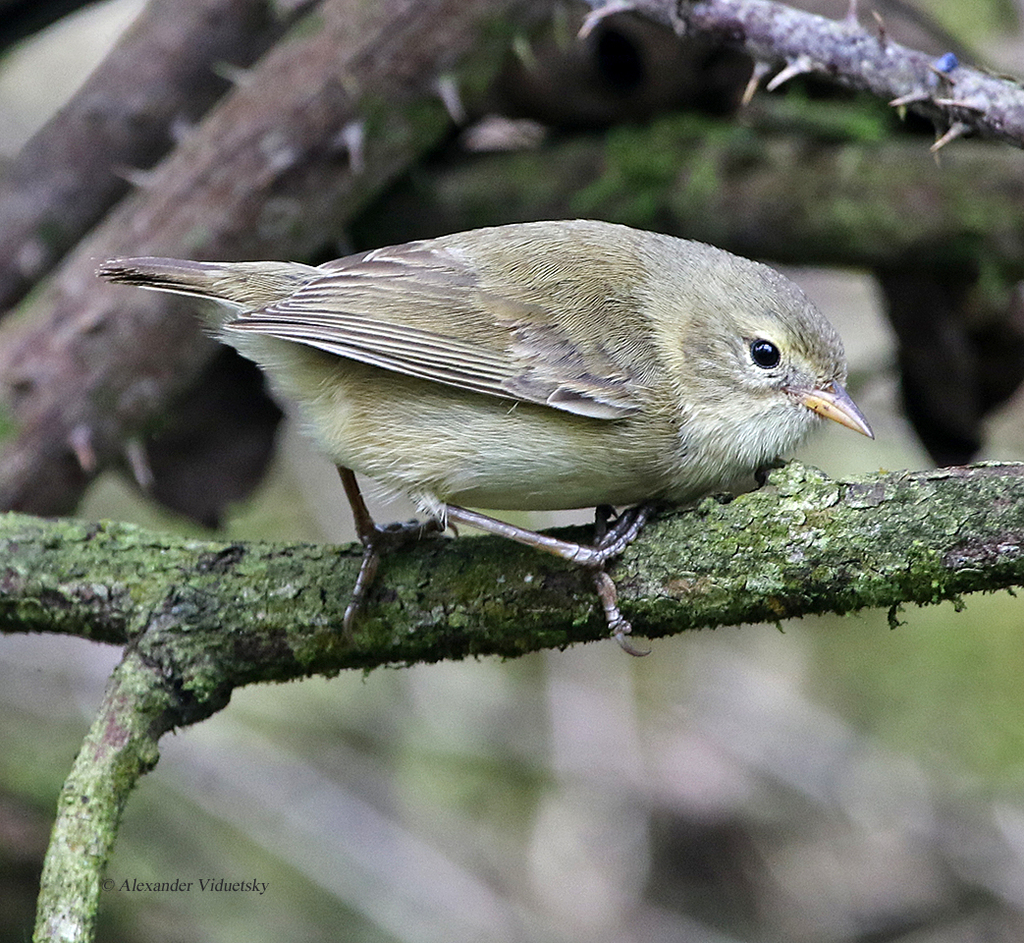
The green warbler-finch (Certhidea olivacea) is a species of bird, one of Darwin's finches (which are mainly found in the Galápagos Islands) in the tanager family Thraupidae. Sometimes classified in the family Emberizidae, more recent studies have shown it to belong in the tanager family.
When Darwin collected it in 1835 during the Beagle survey expedition he mistakenly thought it was a wren, but on return to England he was informed in March 1837 by the ornithologist John Gould that the bird was in the group of finches.
From the article Green warbler-finch on Wikipedia (CC BY-SA), quoted section by section
Description
The average size of green warbler-finches is 10 cm (3.9 in), and their weight can range from 8 to 10 grams (0.28 to 0.35 oz). Green warbler-finches have a greenish coloration to blend into their lusher semi-humid forest habitats, as well as distinctive reddish throat patches on breeding males. The upper half of the adult male is typically more sandy-brown, which differs from the female, as they have a more olive-brown upper half.
Wikipedia: “Appearance”
Range & habitat
The green warbler-finch can use its sharp beak to gain access to different foods. Their diet consists mainly of seeds, insects, and small fruits. Some insects they eat include caterpillars, beetles, and ants, as well as spiders. They tend to eat more insects during the summer and more seeds, fruits, and berries during the winter months. The green warbler-finch tends to forage for food in small groups or alone. The green warbler-finch consists of only one subspecies, the nominate olivacea, from Santiago, Rábida, Pinzón, Isabela, Fernandina, and Santa Cruz. Its natural habitats are subtropical or tropical dry forests, subtropical or tropical moist montane forests, and subtropical or tropical dry shrubland. They are most typically found on larger islands, most abundant in places that are humid and have higher elevation, and less abundant at places with low elevation and dry.
Wikipedia: “Feeding and habitat”
What it does
The green warbler-finch exhibits monogamous behavior, often forming long-term bonds, and defends a small territory. It typically breeds during the hot wet season when bugs are plentiful. The male constructs a spherical nest using dry grasses, moss, and lichens, placing it on small branches. The female will then lay approximately 3 to 5 white eggs with reddish brown spots and incubate them alone for about 12 days. The young birds leave the nest only two weeks after hatching, contributing to the species' reproductive success.
Wikipedia: “Reproduction”
Listen
Looking for field recordings…
Where it lives
Recorded sightings
—
geo-referenced records in GBIF, from museums, herbaria and field observers.
Drag the globe to turn it. Dots are where records exist, not a range map; darker means more records.
In the stacks
Searching the stacks…
Every page naming Certhidea olivacea in the Biodiversity Heritage Library →
This page is assembled live from iNaturalist, GBIF, Wikipedia, the Source Library and the Internet Archive. It is not yet part of the hand-edited codex. iNaturalist taxon 200000.