On eBird ↗
Pharaoh Eagle-Owl
Live sightings near you, the range map, bar charts of when it is seen, and Macaulay Library photos and recordings.
Pharaoh Eagle-Owl
Bubo ascalaphus
The pharaoh eagle-owl (Bubo ascalaphus) is a species of owl in the family Strigidae. It is found in Algeria, Chad, Egypt, Eritrea, Iraq, Israel, Jordan, Kuwait, Libya, Mali, Mauritania, Morocco, Niger, Oman, Palestine, Qatar, Saudi Arabia, Senegal, Sudan, Tunisia, United Arab Emirates.
From the article Pharaoh eagle-owl on Wikipedia (CC BY-SA), quoted section by section
Description
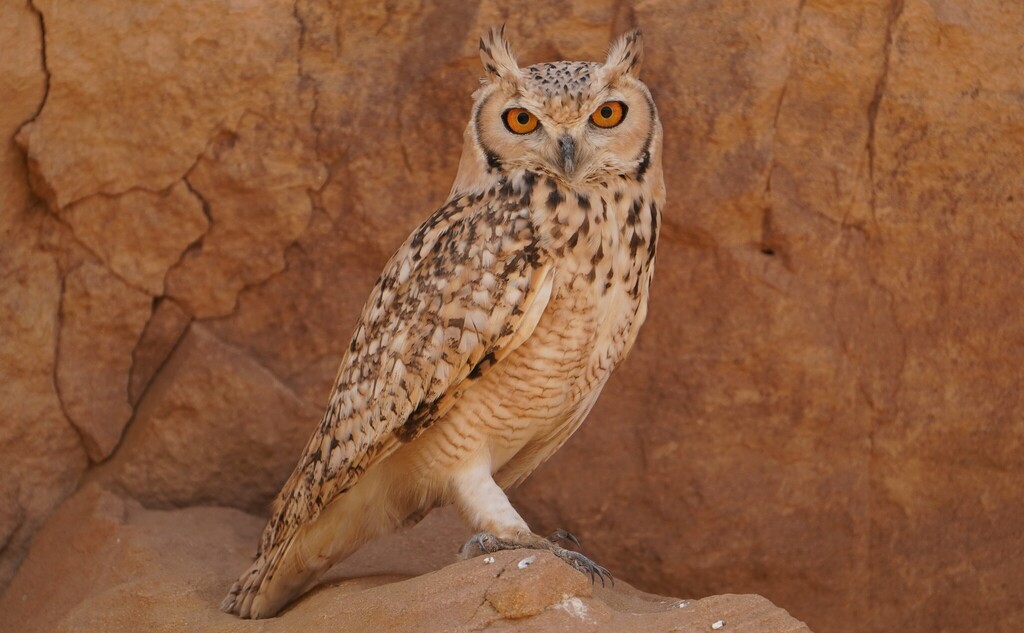
The Pharaoh eagle-owl has a mottled plumage and large orange-yellow eyes. The head and upperparts are tawny and densely marked with black and creamy-white streaks and blotches, while the underparts are pale creamy-white, with black streaks on the upper breast and fine reddish-brown vermiculations on the lower breast and belly. The face has the disc-like form typical of most owls, defined by a dark rim, the robust bill is black and hooked, and the head is crowned with small ear tufts. With a body length of 46–50 cm (18–20 in), it is one of the smaller eagle-owl species. Two subspecies have been named, B. a. ascalaphus and B. a. desertorum, the latter formerly cited as being smaller and paler with sandier colour; they are no longer accepted as distinct, as the variation is continuous and without geographic basis, so the species now regarded as monotypic.
Range & habitat
The Pharaoh eagle-owl is native to much of arid Northern Africa, including some of the most desolate parts of the central Saharan Desert, where it may be found in Algeria, Chad, Egypt, Eritrea, Libya, Mali, Mauritania, Morocco, Niger, Senegal (vagrant owls), Sudan and Tunisia. Its range extends eastward into the Arabian Peninsula and the Middle East, where it is found in Iran, Iraq, Israel, Jordan, Kuwait, Oman, Palestine, Qatar, Saudi Arabia, Syria and the United Arab Emirates. Its preferred habitat is mostly open, barren plains or desert with scattered palms or other endemic plants, where it nests in rocky outcrops, wadis and cliffs.
Wikipedia: “Distribution and habitat”
What it does
The Pharaoh eagle-owl is nocturnal and emerges at dusk to hunt over an area of about 5 km2 (1.9 sq mi). It perches on an eminence and watches and listens to detect moving prey before swooping down on its victim. It will feed on any small creatures it can find, but rodents, especially gerbils are favoured prey. Other mammals such as bats, desert foxes, and hares are also taken, as well as small birds, snakes, lizards, beetles, and scorpions. They occasionally prey on other birds of prey such as barn owls, little owls, and common kestrels. This owl is monogamous and forms a lifelong relationship. Breeding takes place in late winter; the nest is a scrape in a crevice or among rocks. Two eggs are laid and incubated by the female for about 31 days. Both parents feed the chicks and leave the nest at about 20 to 35 days old, but remain reliant on their parents for several more months.
Wikipedia: “Behaviour and ecology”
Listen
Looking for field recordings…
Where it lives
Recorded sightings
—
geo-referenced records in GBIF, from museums, herbaria and field observers.
Drag the globe to turn it. Dots are where records exist, not a range map; darker means more records.
In the stacks
Searching the stacks…
Every page naming Bubo ascalaphus in the Biodiversity Heritage Library →
This page is assembled live from iNaturalist, GBIF, Wikipedia, the Source Library and the Internet Archive. It is not yet part of the hand-edited codex. iNaturalist taxon 20040.