- Animals
- ›Chordates
- ›Vertebrates
- ›Reptiles
- ›Snakes and Lizards
- ›Lizards
- ›Skinks and allies
- ›Skinks
- ›Eugongyline skinks
- ›Oligosoma
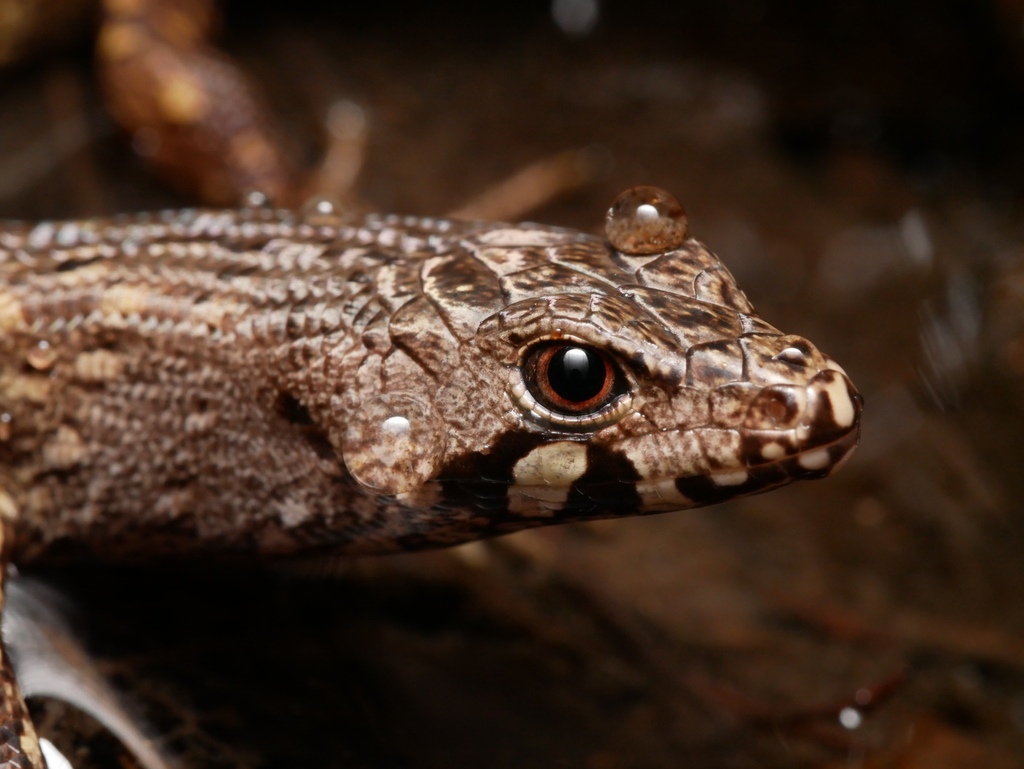
Chevron Skink
Oligosoma homalonotum
The chevron skink (Oligosoma homalonotum; Māori: niho taniwha) is a large species of skink that is endemic to New Zealand. Previously found across Northland and the northern Auckland Region, it is now found only on the Great Barrier and Little Barrier islands in the Hauraki Gulf. A cryptic forest dweller, it can hide underwater. The chevron skink is the longest species of skink in New Zealand, reaching lengths of up to 340 mm (13 in). It is under threat from introduced rats.
From the article Chevron skink on Wikipedia (CC BY-SA), quoted section by section
Description
Boulenger's original text (the type description) reads as follows:
Body subquadrangular, back quite flat. The distance between the end of the snout and the fore limb is contained once and two thirds in the distance between axilla and groin. Snout rather elongate, obtusely pointed. Lower eyelid with an undivided transparent disk. Nostril pierced in a single nasal; no supranasal; frontonasal broader than long, broadJy in contact with the rostral, narrowly with the frontal; latter shield a little shorter than frontoparietals and interparietal together, in contact with the two anterior supraoculars; four supraoculars, second largest; eight supracillaries; frontoparietals and interparietal distinct, subequal in size; parietals in contact behind the interparietal, bordered by a pair of nuchals and a pair of temporals; fourth, fifth, and sixth upper labials below the eye. Ear-opening oval, a little larger than the transparent palpebral disk. 30 scales round the body, dorsals, especially the two median rows, largest and faintly striated. Praeanal scales slightly enlarged. The adpressed limbs nearly meet. Digits moderately long, subcylindrical; subdigital lamella smooth, 20 under the fourth toe. …
Range & habitat
The species is endemic to Great Barrier Island and Little Barrier Island in the Auckland Region. Chevron skinks were once found on the northern North Island: subfossil remains of large skinks have been recovered from Tokerau Beach and Waipu, and large lizards were reported from the Hokianga in the early 20th century. The species' historic range included mainland Northland Region and northern Auckland Region. Like many New Zealand lizards, introduced predators have confined them to offshore islands as "pseudoendemics". The species lives in areas of dense native forest, often found around streams and humid environments. Chevron skinks may occasionally be found in clay banks, occupying kingfisher and spider holes.
Wikipedia: “Distribution and habitat”
What it does
Although active during the day, the chevron skink is very secretive and well camouflaged against a background of fern fronds or leaf litter. It is prone to dehydration, so prefers to live on forested stream margins. It is able to retreat underwater and hold its breath to avoid predators, and will climb vegetation and hide to escape flash floods. Juveniles seem to prefer the banks of rocky streams, living in debris dams and rock crevices, and adults are occasionally found in trees. Chevron skinks eat invertebrates such as spiders, insect larvae, and small snails. Litters of up to eight young are produced in late summer–early autumn. The species reaches sexual maturity between 3 and 4 years of age, and can live up to 20 years in the wild.
Wikipedia: “Ecology”
Where it lives
Recorded sightings
—
geo-referenced records in GBIF, from museums, herbaria and field observers.
Drag the globe to turn it. Dots are where records exist, not a range map; darker means more records.
In the stacks
Searching the stacks…
Every page naming Oligosoma homalonotum in the Biodiversity Heritage Library →
This page is assembled live from iNaturalist, GBIF, Wikipedia, the Source Library and the Internet Archive. It is not yet part of the hand-edited codex. iNaturalist taxon 200835.