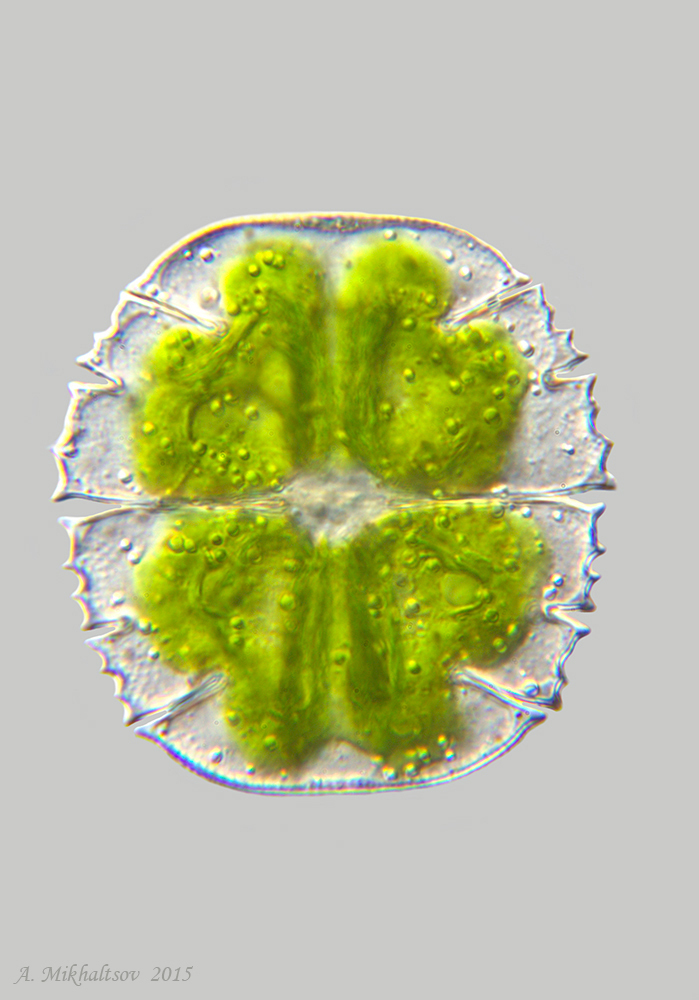
Micrasterias truncata
Micrasterias truncata is a species of desmid, a type of alga which inhabits freshwater areas. It inhabits acidic, mesotrophic waters. One of the most common species of Micrasterias, it is widely distributed on all continents, but most common in the North Temperate zone.
From the article Micrasterias truncata on Wikipedia (CC BY-SA), quoted section by section
Description
The typical variety of Micrasterias truncata is a unicellular alga which are somewhat flattened, thus appearing spindle-shaped when viewed from the top and elliptical when viewed from the side. Cells are (60–)85–120(–145) μm long and (60–)80–110(–135) μm wide, slightly longer than wide. They consist two identical halves, termed semi-cells, which are joined together at the center of the cell (the isthmus) with closed sinuses separating the two semi-cells. Semi-cells are trapezoidal to semicircular in outline. Each semi-cell has three deeply divided lobes, one polar and two lateral. The polar lobe is strongly widened near the cell apex. The side lobes are generally divided twice; lobes are short and broad and separated by narrow, shallow incisions. The angles of the apical lobes and the angles of the highest-order side lobes are denticulate. The incisions between the apical and side lobes are closed or narrowly open. Each semi-cell has a chloroplast with raised, longitudinal ridges and a few pyrenoids. The cell wall is punctate; the pores secrete a mucilaginous sheath around the cell.
What it does
Like other desmids, Micrasterias truncata reproduces asexually via cell division. Two new semi-cells are formed between the parental semi-cells. The developing semi-cells first contain only cytoplasm, then the divided nuclei migrate into them. The chloroplast migrates in later. Sexual reproduction in Micrasterias truncata results in the formation of zygospores, which are spherical and armed with long, sometimes curved spines. The zygospores are 75–80 μm in diameter without spines, and 118–130 μm including spines.
Wikipedia: “Reproduction”
Where it lives
Recorded sightings
—
geo-referenced records in GBIF, from museums, herbaria and field observers.
Drag the globe to turn it. Dots are where records exist, not a range map; darker means more records.
In the stacks
Searching the stacks…
Every page naming Micrasterias truncata in the Biodiversity Heritage Library →
This page is assembled live from iNaturalist, GBIF, Wikipedia, the Source Library and the Internet Archive. It is not yet part of the hand-edited codex. iNaturalist taxon 200882.