Oxpeckers
Buphagidae
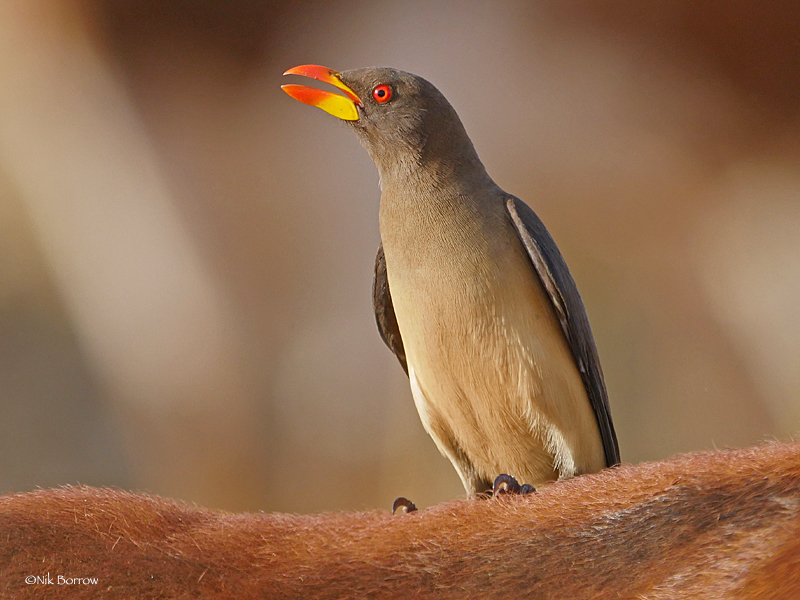
The oxpeckers are two species of bird which make up the genus Buphagus, from Ancient Greek βοῦς (boûs), meaning "ox", and φάγος (phágos), meaning "eater", and family Buphagidae. The oxpeckers were formerly usually treated as a subfamily, Buphaginae, within the starling family, Sturnidae, but molecular phylogenetic studies have consistently shown that they form a separate lineage that is basal to the sister clades containing the Sturnidae and the Mimidae (mockingbirds, thrashers, and allies). Oxpeckers are endemic to the savanna of Sub-Saharan Africa.
Both the English and scientific names arise from their habit of perching on large mammals (both wild and domesticated) such as cattle, zebras, impalas, hippopotamuses, rhinoceroses, and giraffes, eating ticks, small insects, botfly larvae, and other parasites, as well as the animals' blood. The behaviour of oxpeckers towards large mammals was thought to be exclusively mutual, though recent research suggests the relationship can be parasitic in nature as well.
1 branches of this family, most-observed first · about 2 known species
See this branch on the Wheel of Life →
Where it lives
Recorded sightings
—
geo-referenced records in GBIF, from museums, herbaria and field observers.
Drag the globe to turn it. Dots are where records exist, not a range map; darker means more records.
In the stacks
Searching the stacks…
Every page naming Buphagidae in the Biodiversity Heritage Library →
This page is assembled live from iNaturalist, GBIF, Wikipedia, the Source Library and the Internet Archive. It is not yet part of the hand-edited codex. iNaturalist taxon 200987.