On eBird ↗
Siberian Grouse
Live sightings near you, the range map, bar charts of when it is seen, and Macaulay Library photos and recordings.
Siberian Grouse
Falcipennis falcipennis
The Siberian grouse (Falcipennis falcipennis), also known as Siberian spruce grouse, Amur grouse, or Asian spruce grouse, is a short, rotund forest-dwelling grouse. A sedentary, non-migratory bird, it is the only member of the genus Falcipennis. The spruce grouse of North America, which physically looks similar, is now placed in the monotypic genus Canachites.
From the article Siberian grouse on Wikipedia (CC BY-SA), quoted section by section
Description
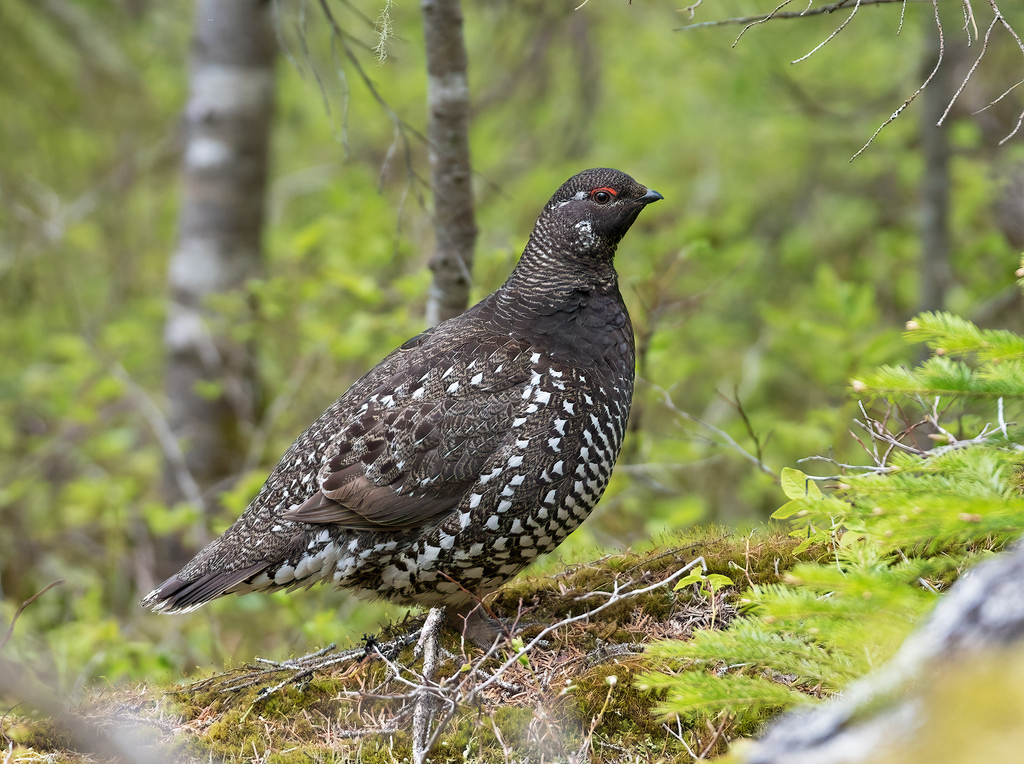
Adults measure around 38–43 centimetres (15–17 in). Males weigh at 580–735 grams (1.279–1.620 lb), while females weigh 650–740 grams (1.43–1.63 lb). Both sexes are intricately speckled white on the belly, flanks, and undertail coverts with white streaks on the wing coverts and rump, plus a white terminal band at the tail tip. Males have sooty brownish-grey feathers with a ruff around its neck and a black bib outlined in white with red skin above each eye. Females are more pale brown in color and lack the distinct facial markings of the male.
Range & habitat
The Siberian grouse is distributed across eastern Siberia and the Russian Far East in the federal districts of Primorsky Krai, Khabarovsk Krai, Amur Oblast, and Sakhalin. A small population formerly inhabited the far northeast of China, where they are probably now extinct. They prefer moist, shady coniferous forests (especially in the winter) with a dense understory of moss and berry bushes, including stands of Ezo spruce, Korean pine, Khingan fir, and Dahurian larch, as well as mixed forest communities interspersed with open glades. Grouse may switch to cranberry and other berries and leaves of Vaccinium, Empetrum, Rubus and other shrubs in their diet during the summer and fall months. They gather in small flocks numbering up to 10–11 birds in the autumn, especially when made up of females and subadult males. In winter, they roost in snow burrows, though they also sleep high in trees during milder weather.
Wikipedia: “Distribution and habitat”
What it does
Males assert their territory every spring by flicking their tails and erecting their neck feathers. Other courtship performances include a soft trilling coo ascending in pitch, followed by jumping and twirling twice while wing-clapping midair. Females may visit the display grounds between late April and mid May. Males older than 3 years do most of the copulations. The nest is built as a simple sink on the dirt floor lined with sticks and pine needles. 6-12 tawny-buff eggs with dark rusty spots laid in the nest are incubated for about 23–24 days.
Wikipedia: “Behaviour”
Listen
Looking for field recordings…
Where it lives
Recorded sightings
—
geo-referenced records in GBIF, from museums, herbaria and field observers.
Drag the globe to turn it. Dots are where records exist, not a range map; darker means more records.
In the stacks
Searching the stacks…
Every page naming Falcipennis falcipennis in the Biodiversity Heritage Library →
This page is assembled live from iNaturalist, GBIF, Wikipedia, the Source Library and the Internet Archive. It is not yet part of the hand-edited codex. iNaturalist taxon 201028.