- Animals
- ›Chordates
- ›Vertebrates
- ›Birds
- ›Hawks, Eagles, Kites, and Allies
- ›Hawks, Eagles, and Kites
- ›Typical Eagles and Hawk-Eagles
- ›Clanga
On eBird ↗
Lesser Spotted Eagle
Live sightings near you, the range map, bar charts of when it is seen, and Macaulay Library photos and recordings.
Lesser Spotted Eagle
Clanga pomarina
The lesser spotted eagle (Clanga pomarina) is a large Eastern European bird of prey. Like all typical eagles, it belongs to the family Accipitridae. The typical eagles are often united with the buteos, sea eagles, and other more heavy-set Accipitridae, but more recently it appears as if they are less distinct from the more slender accipitrine hawks than believed.
From the article Lesser spotted eagle on Wikipedia (CC BY-SA), quoted section by section
Description
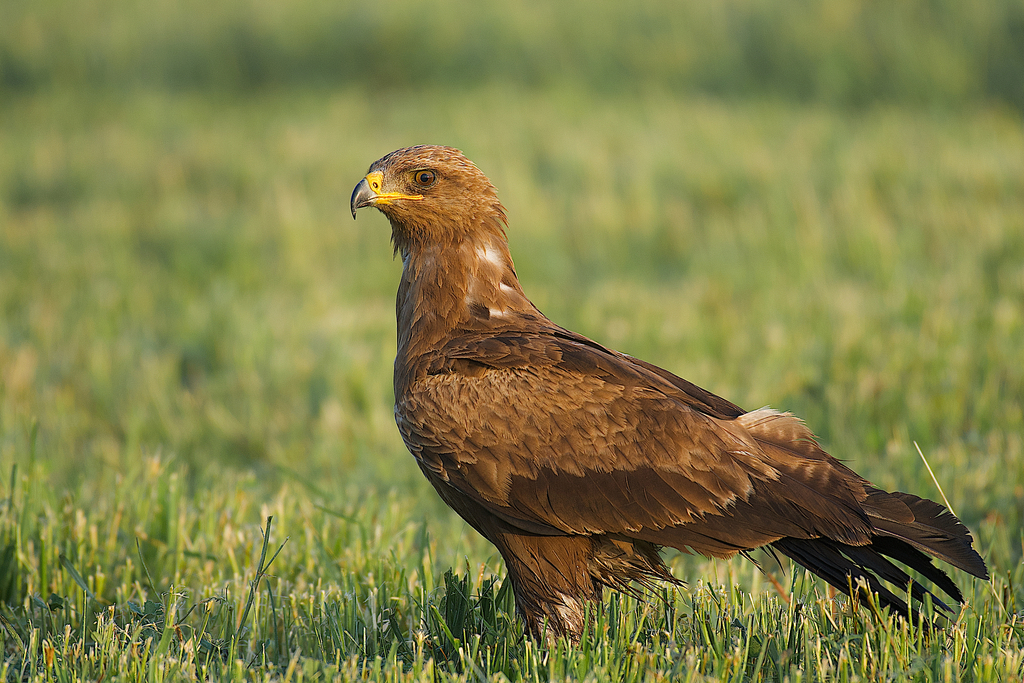
This is a medium-sized eagle, about 60 cm (24 in) in length and with a wingspan of 150 cm (59 in). Its head and wing coverts are pale brown and contrast with the generally dark plumage. The head and bill are small for an eagle. Usually, a white patch occurs on the upper wings, and even adults retain a clearly marked white "V" on the rump; the wing markings are absent and the white "V" is not well-defined in the greater spotted eagle. The juvenile has less contrast in the wings, but the remiges bear prominent white spots. It differs from greater spotted eagle juveniles by a lack of wing covert spotting and the presence of a cream-colored neck patch. The call is a dog-like yip.
Range & habitat
The lesser spotted eagle breeds in Central and Eastern Europe and southeastward to Turkey and Armenia; and winters in Africa. This is a very wary species of open or lightly wooded country, in which it hunts small mammals (especially voles, ground squirrels, rats, and mice) and similar terrestrial prey, such as small birds, amphibians, reptiles, and occasionally insects (including termites). It is known to occasionally feed on carrion.
Wikipedia: “Distribution and habitat”
What it does
The lesser spotted eagle uses regularly spaced territories consistently between years in the north-western part of its distribution. The distances between territories vary across the region, although this was not found to be related to breeding success. Synchronous variation in breeding success across the region indicates that the eagles are instead influenced by large-scale factors such as fluctuations in climate or prey availability. The lesser spotted eagle lays one to three white, buff-spotted eggs in a tree nest. As usual for eagles, only in breeding seasons with very abundant prey does more than one young fledge, but the female starts incubating when the first egg has been laid, thus the first young to hatch usually outgrows its clutch mate(s) and will kill and even eat them sooner or later.
Wikipedia: “Behaviour and ecology”
Listen
Looking for field recordings…
Where it lives
Recorded sightings
—
geo-referenced records in GBIF, from museums, herbaria and field observers.
Drag the globe to turn it. Dots are where records exist, not a range map; darker means more records.
In the stacks
Searching the stacks…
Every page naming Clanga pomarina in the Biodiversity Heritage Library →
This page is assembled live from iNaturalist, GBIF, Wikipedia, the Source Library and the Internet Archive. It is not yet part of the hand-edited codex. iNaturalist taxon 201033.