- Animals
- ›Chordates
- ›Vertebrates
- ›Birds
- ›Hawks, Eagles, Kites, and Allies
- ›Hawks, Eagles, and Kites
- ›Buteonine Hawks, Kites, and allies
- ›Pseudastur
On eBird ↗
Mantled Hawk
Live sightings near you, the range map, bar charts of when it is seen, and Macaulay Library photos and recordings.
Mantled Hawk
Pseudastur polionotus
The mantled hawk (Pseudastur polionotus) is a South American species of bird of prey in the family Accipitridae.
From the article Mantled hawk on Wikipedia (CC BY-SA), quoted section by section
Description
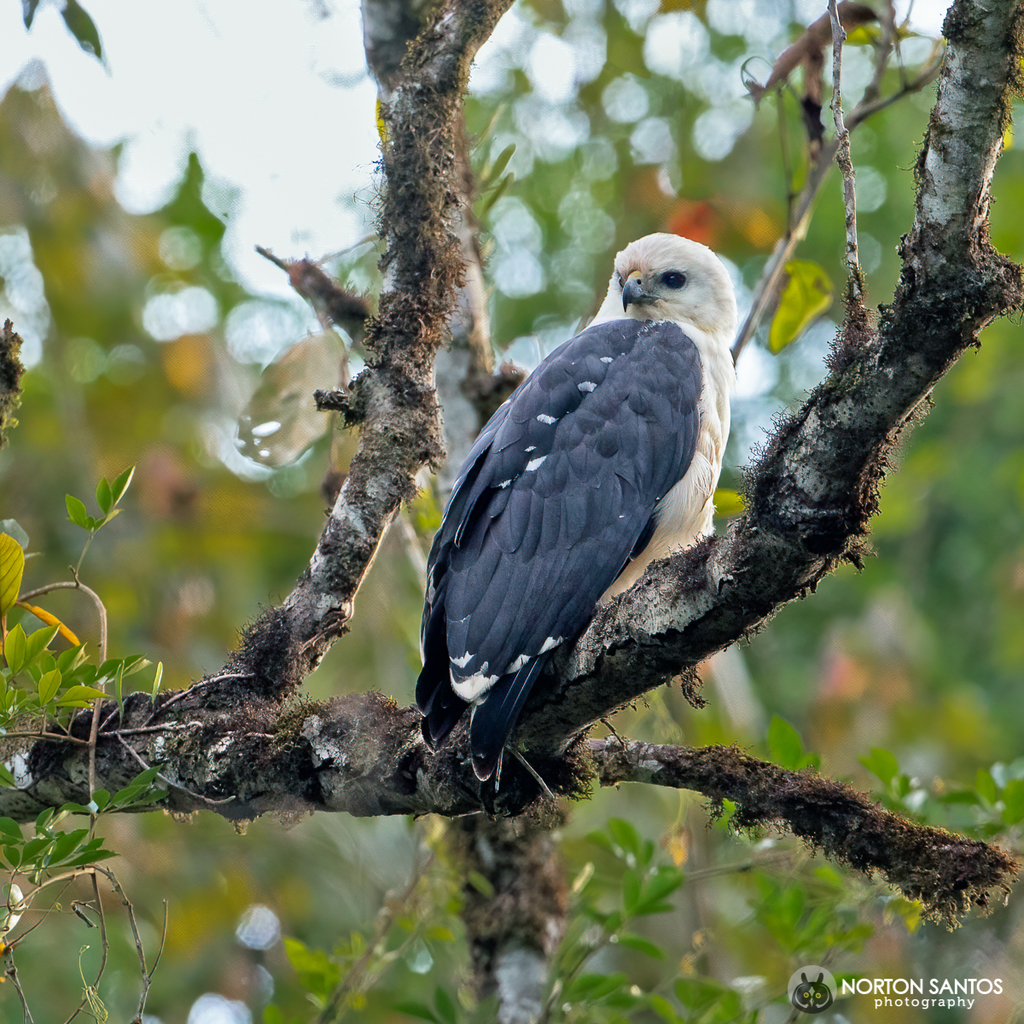
The adult of this medium-sized hawk has a bulky appearance with broad "shoulders" relative to total length. The body length measures 470-510mm, with females being slightly larger than males. The head, neck, upper back and entire undersurface except for the black wing tips and basal half of the tail are white. The white round head appears disproportionately large relative to the rest of the body and sometimes projects further than the tail. There are also markings around eyes, giving a masked appearance. The ceres and lores are grey or dull yellow. The bill is pale grey, gradually turning black at the tip. The iris is brown but often appears black in the field. The toes and tarsi are orange-yellow. The wings, lower back and rump are black or dark bluish grey, with the dark primaries, secondaries, tertials and upper tail coverts having greyish bases with thin white square tips. They also have 3-4 narrow darker bands and the broad white tips form a shallow U when seen from behind. The mantle, scapulars and upper tail coverts are also black or slate grey with broad white tips, but with the coverts appearing darker than the scapulars and are tipped white, sometimes giving a barred appearance. When perched, the long primaries reach or exceed the tail tip. …
Range & habitat
The mantled hawk has a small and patchy distribution within the Atlantic Forest of South America, but may generally occur at higher altitudes than similar species. It is endemic to lowland and montane forest fragments in eastern Brazil ranging from Alagoas and Bahia to Santa Catarina; southeast Paraguay in states such as Alto Paraná Department, Iguassu and Puerto Bertoni; and extreme northeast Argentina. It may also inhabit northern Uruguay. Within its humid forest habitat, this hawk especially favours foothills and the elevation of its habitat ranges from sea level to at least 1500m. Alongside continuous evergreen forest, it also appears to use edges, natural clearings and patches of dry trees along surrounding hills. Areas of secondary growth and extensive deforestation are also used, especially in association with Parana Pine. It is commonest in east Brazil, especially in the Parapiacaba fragment of the Atlantic Forest and rarer elsewhere, especially in east Uruguay and southeast Paraguay. It occurs at relatively low densities overall.
Wikipedia: “Habitat and distribution”
What it does
Like many other hawks, the mantled hawk is a sit-and-wait predator. It rests on perches 5-7m aboveground in relatively exposed areas to give a clear view of potential prey in its surroundings for it to catch and ambush and these areas may include recently cleared patches of forest. It captures its prey after a short rapid flight from its perch, where it returns to eat it. Prey consists primarily of smaller birds such as tanagers, trogons, doves and rufous-sided crake. Other prey may include lizards, snakes and small rodents.
Wikipedia: “Feeding”
In human culture
This raptor displays marked territorial behaviour in human presence, defending its territory against human intruders by regurgitating stomach contents or by pursuit. In human presence, mantled hawks are fairly vocal and call repeatedly, which makes them relatively easy to detect when present a few kilometres away.
Wikipedia: “In culture and relation to humans”
Listen
Looking for field recordings…
Where it lives
Recorded sightings
—
geo-referenced records in GBIF, from museums, herbaria and field observers.
Drag the globe to turn it. Dots are where records exist, not a range map; darker means more records.
In the stacks
Searching the stacks…
Every page naming Pseudastur polionotus in the Biodiversity Heritage Library →
This page is assembled live from iNaturalist, GBIF, Wikipedia, the Source Library and the Internet Archive. It is not yet part of the hand-edited codex. iNaturalist taxon 201045.