On eBird ↗
Everett's Scops-Owl
Live sightings near you, the range map, bar charts of when it is seen, and Macaulay Library photos and recordings.
Everett's Scops-Owl
Otus everetti
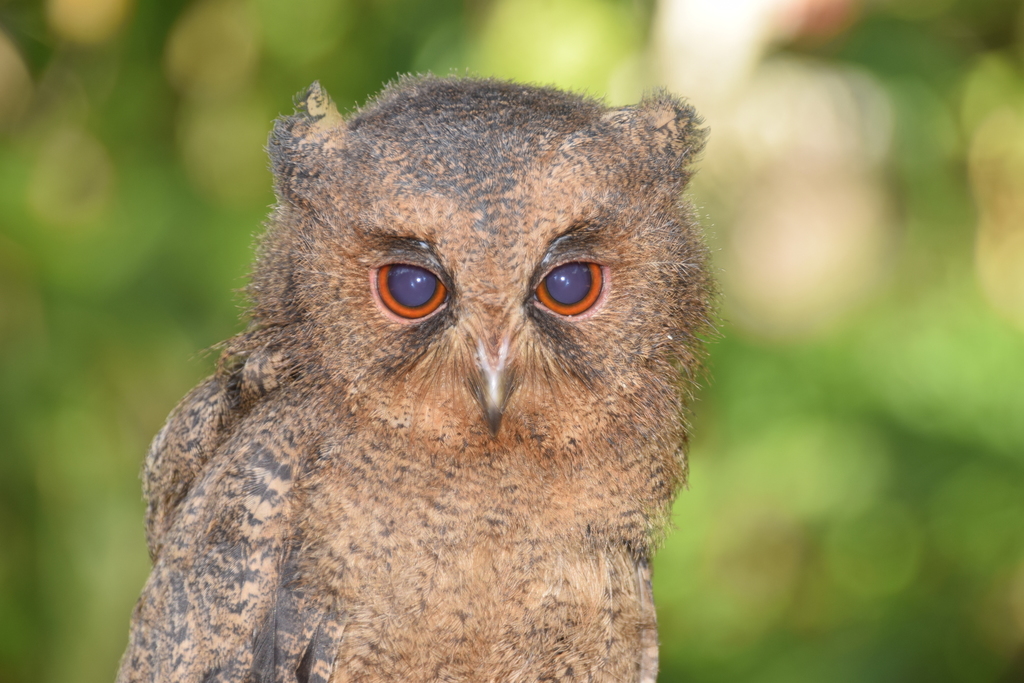
Everett's scops owl (Otus everetti) is an owl, endemic to the Philippines, belonging to the family of the typical owls Strigidae. Everett's scops owls feed at night on insects. They live alone or in monogamous pairs. They breed throughout the year, laying clutches of 1-2 eggs. They nest in trees holes of forests of the Philippine lowlands. They are found on Bohol, Samar, Biliran, Leyte, Mindanao and Basilan. They were formerly classified as a subspecies of...
From the article Everett's scops owl on Wikipedia (CC BY-SA), quoted section by section
Description
Everett's scops owl was part of the Philippine scops owl (O. megalotis) species complex, which also included the Negros scops owl (O. nigrorum), but these species were split following genetic analyses. O. everetti is differentiated by its darker plumage, face and darker orange eyes. This is species is monotypic.
Wikipedia: “Description and taxonomy”
Range & habitat
It is found in tropical moist lowland forest and the lower reaches of montane forest until 1,550 meters above sea level it is replaced by the smaller Mindanao scops owl. Typically roosts in dense bamboo groves during the daytime. IUCN has assessed this bird as least-concern species but the population is decreasing. This species' main threat is habitat loss with wholesale clearance of forest habitats as a result of logging, agricultural conversion and mining activities occurring within the range. The most affected part of its range is Bohol which only has 4% forest cover remaining. Occurs in a few protected areas like Pasonanca Natural Park, Mount Apo and Mount Kitanglad on Mindanao, Rajah Sikatuna Protected Landscape in Bohol and Samar Island Natural Park but actual protection and enforcement of laws surrounding illegal logging and hunting are lacking.
Wikipedia: “Habitat and conservation status”
What it does
Not much is known about this owl but they are presumed to have similar habits to other closely related scops owls. Their diet is presumed to be insects, small mammals, reptiles, and amphibians. They live alone or in monogamous pairs. They breed throughout the year, laying clutches of 1 or 2 eggs. They nest in tree hollows in forests of the Philippine lowlands.
Wikipedia: “Ecology and behavior”
Listen
Looking for field recordings…
Where it lives
Recorded sightings
—
geo-referenced records in GBIF, from museums, herbaria and field observers.
Drag the globe to turn it. Dots are where records exist, not a range map; darker means more records.
In the stacks
Searching the stacks…
Every page naming Otus everetti in the Biodiversity Heritage Library →
This page is assembled live from iNaturalist, GBIF, Wikipedia, the Source Library and the Internet Archive. It is not yet part of the hand-edited codex. iNaturalist taxon 201059.