On eBird ↗
Negros Scops-Owl
Live sightings near you, the range map, bar charts of when it is seen, and Macaulay Library photos and recordings.
Negros Scops-Owl
Otus nigrorum
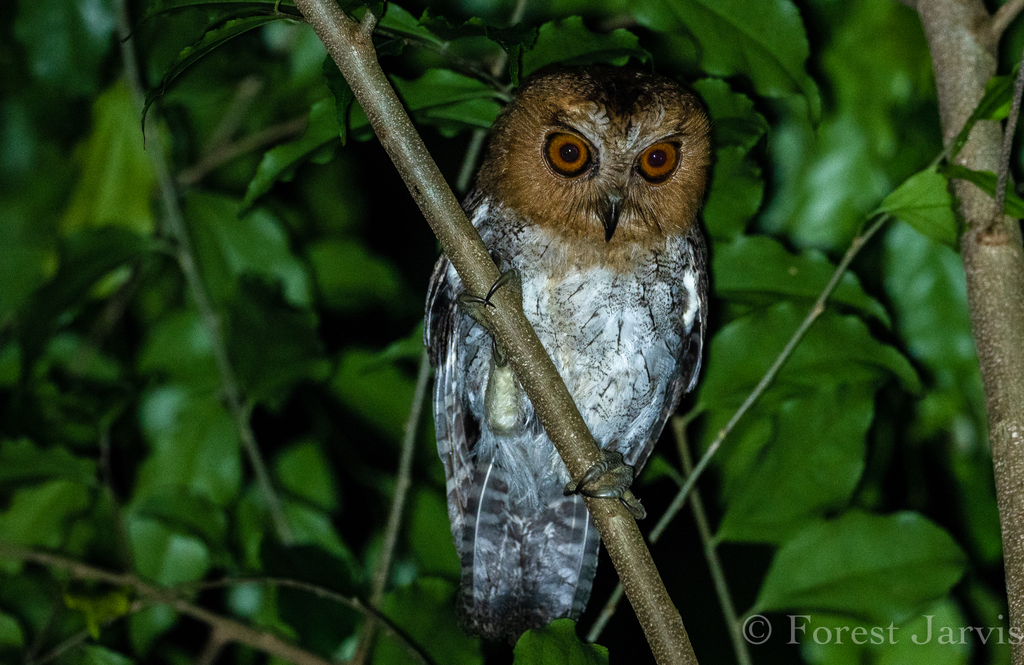
The Negros scops owl (Otus nigrorum) is an owl, endemic to the Philippines, belonging to the family of the typical owls Strigidae. Negros scops owls prey at night on insects. They live alone or in monogamous pairs. They breed throughout the year, laying clutches of 1–2 eggs. They nest in trees holes of forests of the Philippine lowlands. They are found on the island of Negros. They were formerly classified as a subspecies of the Philippine...
From the article Negros scops owl on Wikipedia (CC BY-SA), quoted section by section
Description
This is a small species of owl found in the forests of Negros and Panay. It has orange eyes and face, a white brow and pale gray belly. It was formerly conspecific with the Philippine scops owl and the Everett's scops owl. It is the smallest and palest of the endemic Philippine scops owl complex. It also has a distinct rufous crown and facial disc and its upper foot is not feathered. It is also the smallest in the Philippine scops owl complex. Its song is described as a rapid series of upward yelps
Wikipedia: “Description and taxonomy”
Range & habitat
Its natural habitats are tropical moist lowland and montane primary and secondary forest up to 1,000 meters above sea level. While they can tolerate secondary forest, they have the highest population densities and health in primary (old-growth) forest. As of 2025, this species is assessed as Near-threatened species by the International Union for Conservation of Nature. The population is believed to be declining, with populations estimated at between 2,500 and 9,999 mature individuals. Prior to 2025, this species was listed Vulnerable species. Its main threat is habitat destruction through both legal and Illegal logging, conversion into farmlands through slash-and-burn, charcoal burning, and mining. Habitat loss on both Negros and Panay has been extensive. By 2007, Negros and Panay had a 3% and 6% remaining forest cover with a huge chunk of this being in higher elevation forests where this bird does not thrive. Despite the already paltry numbers, these figures are still continuing to decline due to the above-mentioned threats. There are currently no species-specific conservation plans. It occurs in a few protected areas in Northern Negros Natural Park, Mount Kanlaon National Park and Northwest Panay Peninsula Natural Park. …
Wikipedia: “Habitat and conservation status”
What it does
Negros scops owls prey at night on insects. They live alone or in monogamous pairs. They breed throughout the year, laying clutches of 1 or 2 eggs. They nest in tree hollows in forests of the Philippine lowlands.
Wikipedia: “Ecology and behaviour”
Listen
Looking for field recordings…
Where it lives
Recorded sightings
—
geo-referenced records in GBIF, from museums, herbaria and field observers.
Drag the globe to turn it. Dots are where records exist, not a range map; darker means more records.
In the stacks
Searching the stacks…
Every page naming Otus nigrorum in the Biodiversity Heritage Library →
This page is assembled live from iNaturalist, GBIF, Wikipedia, the Source Library and the Internet Archive. It is not yet part of the hand-edited codex. iNaturalist taxon 201060.