On eBird ↗
Silky-tailed Nightjar
Live sightings near you, the range map, bar charts of when it is seen, and Macaulay Library photos and recordings.
Silky-tailed Nightjar
Antrostomus sericocaudatus
The silky-tailed nightjar (Antrostomus sericocaudatus) is a species of nightjar birds in the family Caprimulgidae. It is found in Brazil, Argentina, Bolivia, Paraguay, and Peru. Its natural habitat is subtropical or tropical moist lowland forests.
From the article Silky-tailed nightjar on Wikipedia (CC BY-SA), quoted section by section
Description
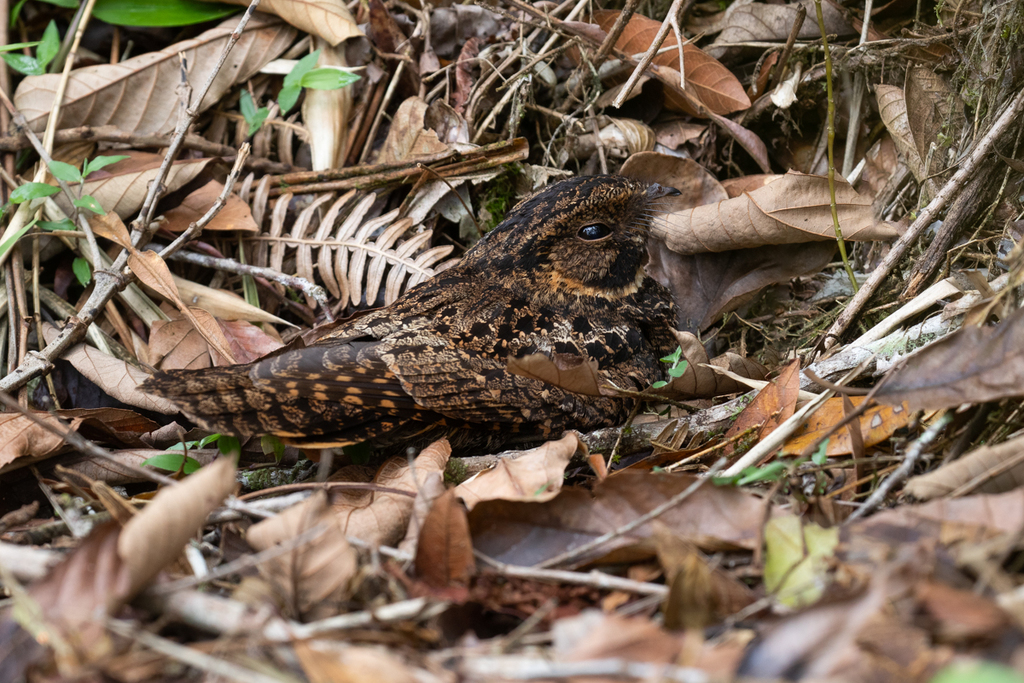
The adult male silky-tailed nightjar has light grey-brown, vermiculated plumage with a strong blackish streak on the top of the head and the nape. It has blackish facial bristles and blackish spots with rufous on the side. Its hind-neck has narrow rufous-tawny half-collar plumage. The mantle, back, rump, and upper tail of a silky-tailed nightjar converts to blackish-brown with irregular patterns of buff and cinnamon. The breast is blackish-brown with short narrow bars of cinnamon and the belly is blackish-brown with blotches and irregular narrow bars of buff.
Range & habitat
The nominate subspecies of silky-tailed nightjar is found in the Atlantic Forest region of southeastern Brazil, eastern Paraguay, and extreme northeastern Argentina (Misiones Province). It inhabits the interior and edges of secondary forest and subtropical evergreen forest. In elevation it ranges between 82 and 913 m (270 and 3,000 ft). A. s. mengeli is found in eastern Peru, northwestern Bolivia, and in scattered sites in Brazil's Pará state. It inhabits a variety of landscapes including mature tropical forest, terra firme forest, and lowland tropical rainforest. In elevation it ranges between 227 and 1,200 m (740 and 3,900 ft).
Wikipedia: “Distribution and habitat”
What it does
Nightjars eat a variety of insects and the young are fed by their parents via regurgitation. Regurgitation is used by birds where it is to bring already swallowed food back up through one's throat and out the mouth to feed their young. The nestlings also forage for ground insects around the nest-site or pick up small soil granules to aid in digestion.
Wikipedia: “Diet”
Listen
Looking for field recordings…
Where it lives
Recorded sightings
—
geo-referenced records in GBIF, from museums, herbaria and field observers.
Drag the globe to turn it. Dots are where records exist, not a range map; darker means more records.
In the stacks
Searching the stacks…
Every page naming Antrostomus sericocaudatus in the Biodiversity Heritage Library →
This page is assembled live from iNaturalist, GBIF, Wikipedia, the Source Library and the Internet Archive. It is not yet part of the hand-edited codex. iNaturalist taxon 201068.