- Animals
- ›Chordates
- ›Vertebrates
- ›Birds
- ›Rollers, Kingfishers, and Allies
- ›Kingfishers
- ›Tree Kingfishers
- ›Halcyon
On eBird ↗
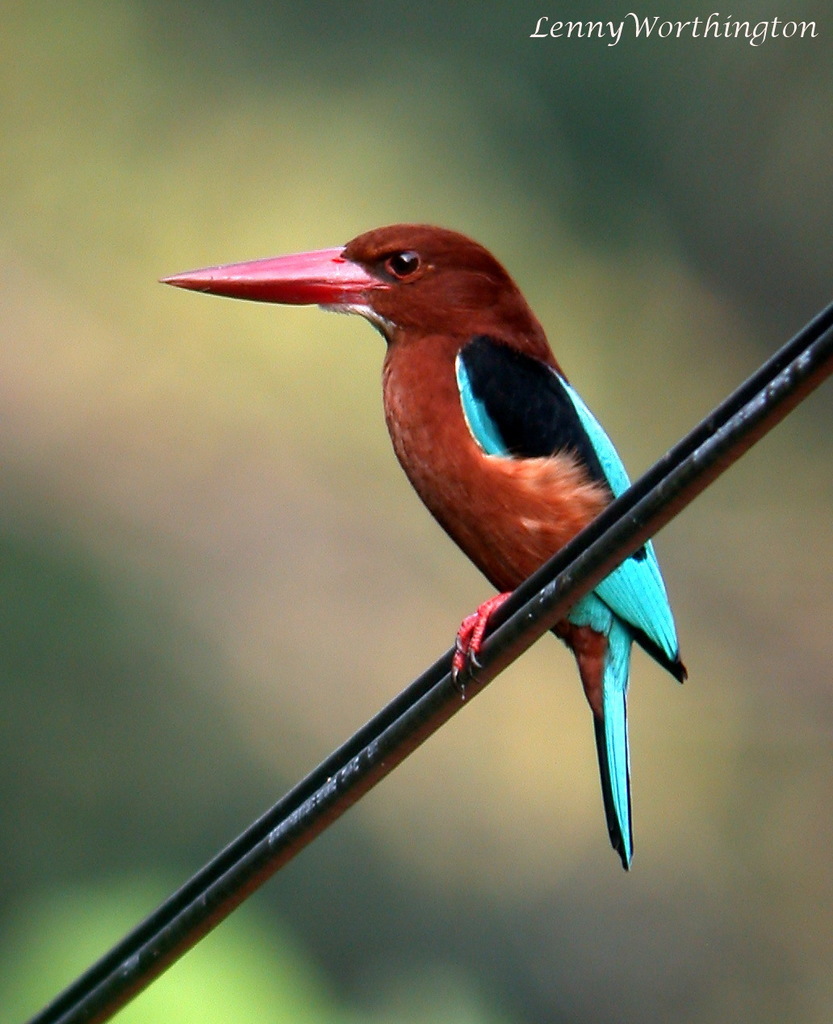
Brown-breasted Kingfisher
Live sightings near you, the range map, bar charts of when it is seen, and Macaulay Library photos and recordings.
Brown-breasted Kingfisher
Halcyon gularis
The white-throated kingfisher (Halcyon smyrnensis) also known as the white-breasted kingfisher is a tree kingfisher, widely distributed in Asia from Turkey east through the Indian subcontinent to the Philippines. This kingfisher is a resident over much of its range, although some populations may make short distance movements. It can often be found well away from water where it feeds on a wide range of prey that includes small reptiles, amphibians, crabs, small rodents and even birds....
From the article Brown-breasted kingfisher on Wikipedia (CC BY-SA), quoted section by section
Description
It was previously considered a subspecies of the white-throated kingfisher (H. smyrnensis), but was split as a distinct species by the IUCN Red List and BirdLife International in 2014, and the International Ornithological Congress followed suit in 2022. It is differentiated by its plummage white a smaller extent of white which is restricted to the chin versus the white-throated kingfishers which white spot includes the breast, a larger white wingpatch, more black on the wings and a shorter tail. This species is monotypic.
Wikipedia: “Description and taxonomy”
Range & habitat
Has a wide range of habitats that include clearings, fishponds, rivers, second growth scrubland, and forest edge. Typically found below 1,000 meters above sea level.
The IUCN has yet to classify this species as separate from white-throated kingfisher. This species is common all throughout and has well adapted and even benefited fromohuman modified habitats. While the Philippines has faced massive deforestation, this species adaptability has allowed it to survive and even thrive better than most Philippine birds.
Wikipedia: “Habitat and conservation status”
What it does
Feeds on insects, reptiles, amphibians, fish, small birds and mammals and even the occasional bat. Typically perches 5 to 10 meters above its hunting area and swoops down to its prey. Season is around April to May where it typically nests in termite mounds and lays 2 to 4 eggs.
Wikipedia: “Ecology and behavior”
Listen
Looking for field recordings…
Where it lives
Recorded sightings
—
geo-referenced records in GBIF, from museums, herbaria and field observers.
Drag the globe to turn it. Dots are where records exist, not a range map; darker means more records.
In the stacks
Searching the stacks…
Every page naming Halcyon gularis in the Biodiversity Heritage Library →
This page is assembled live from iNaturalist, GBIF, Wikipedia, the Source Library and the Internet Archive. It is not yet part of the hand-edited codex. iNaturalist taxon 201076.