On eBird ↗
Rufous-bellied Antwren
Live sightings near you, the range map, bar charts of when it is seen, and Macaulay Library photos and recordings.
Rufous-bellied Antwren
Isleria guttata
The rufous-bellied antwren (Isleria guttata) is a species of bird in the family Thamnophilidae. It is found in Brazil, French Guiana, Guyana, Suriname, and Venezuela. The bird's range is in the entire north of the Amazon Basin, from Venezuela in the west to the Brazilian state of Amapá to the east, but is not found south of the Amazon River.
From the article Rufous-bellied antwren on Wikipedia (CC BY-SA), quoted section by section
Description
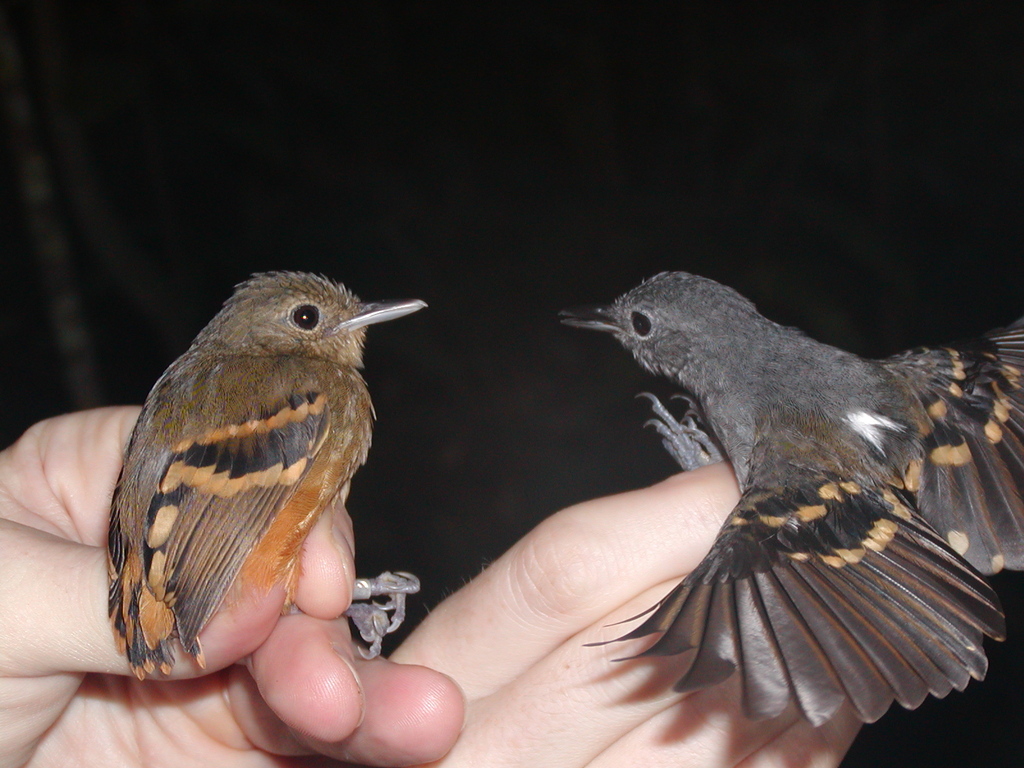
The rufous-bellied antwren is 8.5 to 9.5 cm (3.3 to 3.7 in) long and weighs 8.5 to 11 g (0.30 to 0.39 oz). It has a very short tail. Adult males are mostly gray. They have a white patch between their scapulars and pale cinnamon spots on their uppertail coverts. Their wings and tail are blackish brown with cinnamon edges on the flight feathers and pale cinnamon tips on the wing coverts and tail feathers. Their throat is pale gray and their lower belly, flanks, and crissum are tawny. Adult females have olive-gray upperparts and a grayish olive breast; they are otherwise like males.
Range & habitat
The rufous-bellied antwren is found in from southern Venezuela's Bolívar and Amazonas states east through the Guianas and Brazil north of the Amazon and east of the Negro rivers. It primarily inhabits terra firme evergreen forest. It favors areas with shady undergrowth and much leaf litter, especially near slow-moving streams and somewhat wet spots. In elevation it occurs from sea level to 600 m (2,000 ft).
Wikipedia: “Distribution and habitat”
What it does
The rufous-bellied antwren's diet has not been detailed but includes insects and spiders. It mostly forages singly or in pairs, and joins mixed-species feeding flocks while they pass through the antwren's territory. It typically forages from the ground up to within about 1 m (3 ft) above it but will feed as high as 2 m (7 ft). It actively gleans from leaves, stems, and branches by reaching from a perch and making short jumps while hitching up vertical stems and vines. It has been observed following army ant swarms in Brazil, Guyana, and Suriname.
Wikipedia: “Feeding”
Listen
Looking for field recordings…
Where it lives
Recorded sightings
—
geo-referenced records in GBIF, from museums, herbaria and field observers.
Drag the globe to turn it. Dots are where records exist, not a range map; darker means more records.
In the stacks
Searching the stacks…
Every page naming Isleria guttata in the Biodiversity Heritage Library →
This page is assembled live from iNaturalist, GBIF, Wikipedia, the Source Library and the Internet Archive. It is not yet part of the hand-edited codex. iNaturalist taxon 201092.