On eBird ↗
Tablas Fantail
Live sightings near you, the range map, bar charts of when it is seen, and Macaulay Library photos and recordings.
Tablas Fantail
Rhipidura sauli
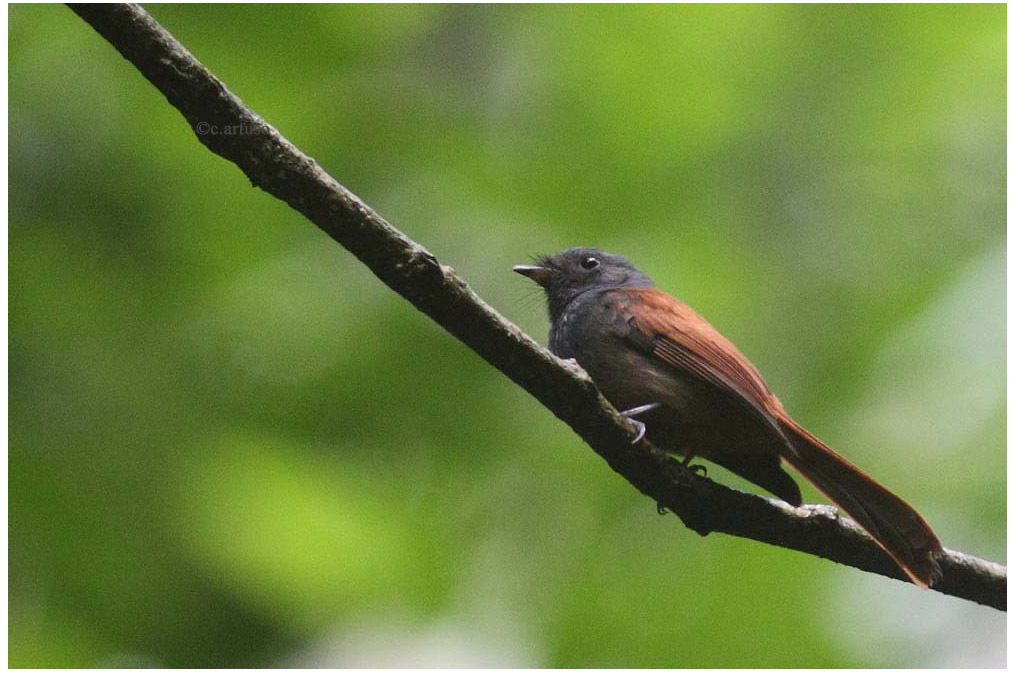
The Tablas fantail (Rhipidura sauli) is a fantail endemic to the Philippines on Tablas Island. Until recently, it was considered conspecific with the blue-headed fantail and Visayan fantail. It is threatened by habitat loss.
From the article Tablas fantail on Wikipedia (CC BY-SA), quoted section by section
Description
It was formerly deemed conspecific with the blue-headed and Visayan fantails but it is differentiated from them by its darker brown belly, longer wings, lower pitched calls, and a stronger rufous wingpanel connecting to its back. This species is monotypic and it has no subspecies.
Wikipedia: “Description and taxonomy”
Range & habitat
The species inhabits tropical moist lowland primary forest in areas with mature closed-canopy forest. It is believed to be less tolerant to habitat disturbances compared to its close relatives, the blue-headed fantail and Visayan fantail. The IUCN Red List classifies this bird as vulnerable with population estimates of 2,500 to 9,999 mature individuals. This species' main threat is habitat loss with wholesale clearance of forest habitats as a result of legal and illegal logging, and conversion into farmlands through Slash-and-burn and other methods. The species does not occur at high density even within the little remaining forest cover on Tablas. Mt Palaupau serves as a watershed for Tablas Island. There are no ongoing species specific conservation programs but proposed conservation actions include more species surveys to better understand its habitat and population, the initiation of education and awareness campaigns to raise the species' profile and instill pride in locals, besides lobbying for protection of remaining forest and assessment of the feasibility of reforestation projects.
Wikipedia: “Habitat and conservation status”
What it does
The diet of the Tablas fantail consists of insects. It is often observed in mixed flocks with other birds such as rufous paradise flycatcher, black-naped monarch, white-vented whistler and other small forest birds. Barely anything is known about this species' breeding behaviour. Young birds are seen in late March. Breeding habits are presumed to be similar to that of the blue-headed fantail which nests in a small cup made of plant fibers, roots and moss and lays 2 cream colored eggs with gray spots and blotches.
Wikipedia: “Ecology and behavior”
Listen
Looking for field recordings…
Where it lives
Recorded sightings
—
geo-referenced records in GBIF, from museums, herbaria and field observers.
Drag the globe to turn it. Dots are where records exist, not a range map; darker means more records.
In the stacks
Searching the stacks…
Every page naming Rhipidura sauli in the Biodiversity Heritage Library →
This page is assembled live from iNaturalist, GBIF, Wikipedia, the Source Library and the Internet Archive. It is not yet part of the hand-edited codex. iNaturalist taxon 201153.