On eBird ↗
Black-billed Sicklebill
Live sightings near you, the range map, bar charts of when it is seen, and Macaulay Library photos and recordings.
Black-billed Sicklebill
Drepanornis albertisi
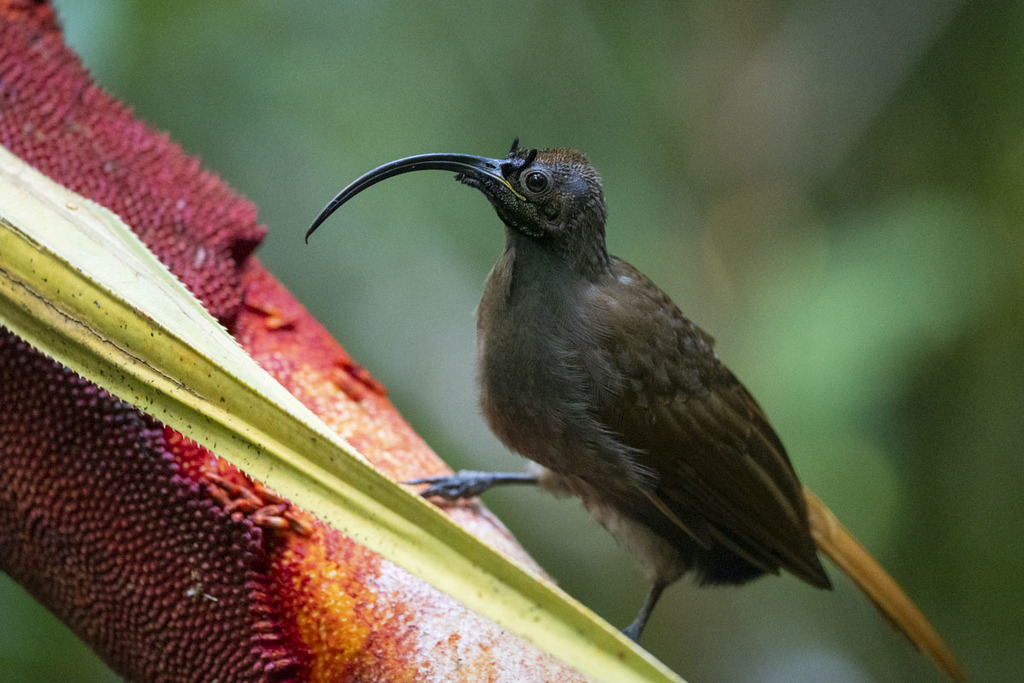
The black-billed sicklebill (Drepanornis albertisi), also referred to as the buff-tailed sicklebill (resulting in common confusion with the hummingbird of the same name), is a species of bird-of-paradise. It, along with its congener, are the only members of the genus Drepanornis.
From the article Black-billed sicklebill on Wikipedia (CC BY-SA), quoted section by section
Description
The black-billed sicklebill is medium-sized, about 35 cm long, brown. The male has a bare maroon-grey skin around its eye, buff-colored tail, dark-brown iris, yellow mouth and black sickle-like bill. It is adorned with dark, horn-like forecrown feathers, an erectile fan-like bronze neck plumes and elongated purple-tipped flank plumes. The unadorned brown female is smaller, with bill longer than male and dark-barred below.
Range & habitat
The black-billed sicklebill is found in mountainous areas with a scattered range of presence across western, central and eastern New Guinea. The species is mostly distributed in tropical montane forests at altitudes of 1100 to 1900 m above sea level. It overlaps with Drepanornis brujini only barely, but no hybridization has ever been recorded, though it is possible to occur.
Wikipedia: “Distribution”
In human culture
The generic name Drepanornis consists of the words Drepane for "sickle" and ornis for "bird", so the genus name literally means "sickle bird", referring to their sickle-shaped bill; the specific name commemorates the Italian naturalist Luigi Maria d'Albertis, who discovered this species in 1872. The race cervinicauda's subspecific name consists of cervinus for "stag-colored" and "cauda" for tail, geisleri honors Bruno Geisler, a German ornithologist who described this subspecies, and inversus means "overturned".
Wikipedia: “Etymology”
Listen
Looking for field recordings…
Where it lives
Recorded sightings
—
geo-referenced records in GBIF, from museums, herbaria and field observers.
Drag the globe to turn it. Dots are where records exist, not a range map; darker means more records.
In the stacks
Searching the stacks…
Every page naming Drepanornis albertisi in the Biodiversity Heritage Library →
This page is assembled live from iNaturalist, GBIF, Wikipedia, the Source Library and the Internet Archive. It is not yet part of the hand-edited codex. iNaturalist taxon 201167.