- Animals
- ›Chordates
- ›Vertebrates
- ›Birds
- ›Perching Birds
- ›Old World Flycatchers, Robins, and Chats
- ›Saxicola
On eBird ↗
European Stonechat
Live sightings near you, the range map, bar charts of when it is seen, and Macaulay Library photos and recordings.
European Stonechat
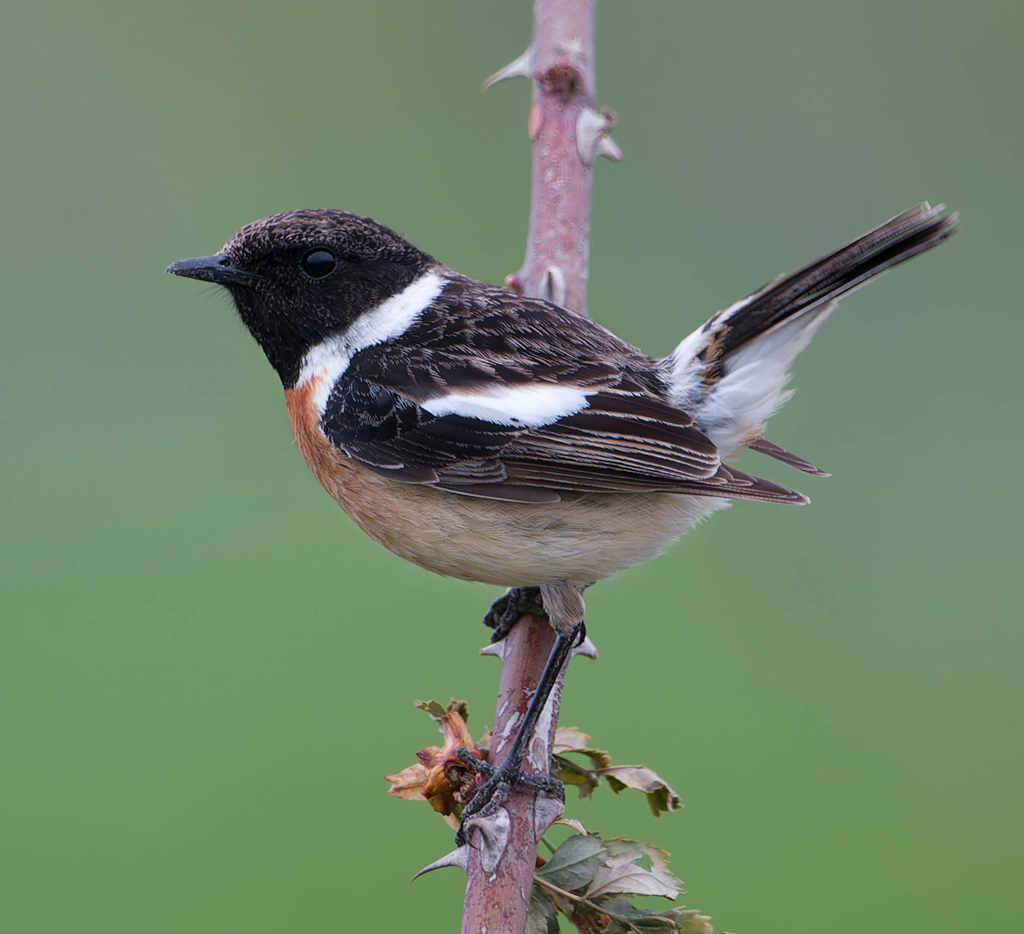
Saxicola rubicola
The European stonechat (Saxicola rubicola) is a small passerine bird that was formerly classed as a subspecies of the common stonechat. Long considered a member of the thrush family, Turdidae, genetic evidence has placed it and its relatives in the Old World flycatcher family, Muscicapidae. It is found across Europe, as far east as Ukraine and the South Caucasus, and in parts of North Africa.
From the article European stonechat on Wikipedia (CC BY-SA), quoted section by section
Description
The stonechat is 11.5–13 cm (4.5–5.1 in) long and weighs 13–17 g (0.46–0.60 oz), slightly smaller than the European robin. Both sexes have distinctively short wings, shorter than those of the more migratory whinchat and Siberian stonechat. The summer male has black upperparts, a black head, an orange throat and breast, and a white belly and vent. It also has a white half-collar on the sides of its neck, a small white scapular patch on the wings, and a very small white patch on the rump often streaked with black. The female has brown upperparts and head, and no white neck patches, rump or belly, these areas being streaked dark brown on paler brown, the only white being the scapular patch on the wings and even this often being buffy-white. The two subspecies differ in colour intensity following Gloger's rule, with S. r. rubicola paler and with larger white patches in the drier European continental and mediterranean climates, and S. r. hibernans darker brown with less white in the humid Atlantic oceanic climate. They intergrade broadly where their ranges meet, from southeastern England south through France and Spain, and many individuals are not identifiable to subspecies. Extreme examples of S. r. …
Range & habitat
European stonechats breed in heathland, coastal dunes and rough grassland with scattered small shrubs and bramble, open gorse, tussocks or heather. They are short-distance migrants or non-migratory, with part of the population (particularly from northeastern parts of the range, where winters are colder) moving south to winter further south in Europe and more widely in north Africa. Their range has grown northward in recent decades: in Poland, in the mid-20th century they inhabited only the southern part of the country (in the spring and summer) but by the early 2000s had expanded across the country up to the Baltic coast.
Wikipedia: “Distribution and habitat”
Listen
Looking for field recordings…
Where it lives
Recorded sightings
—
geo-referenced records in GBIF, from museums, herbaria and field observers.
Drag the globe to turn it. Dots are where records exist, not a range map; darker means more records.
In the stacks
Searching the stacks…
Every page naming Saxicola rubicola in the Biodiversity Heritage Library →
This page is assembled live from iNaturalist, GBIF, Wikipedia, the Source Library and the Internet Archive. It is not yet part of the hand-edited codex. iNaturalist taxon 201192.