On eBird ↗
Pale Spiderhunter
Live sightings near you, the range map, bar charts of when it is seen, and Macaulay Library photos and recordings.
Pale Spiderhunter
Arachnothera dilutior
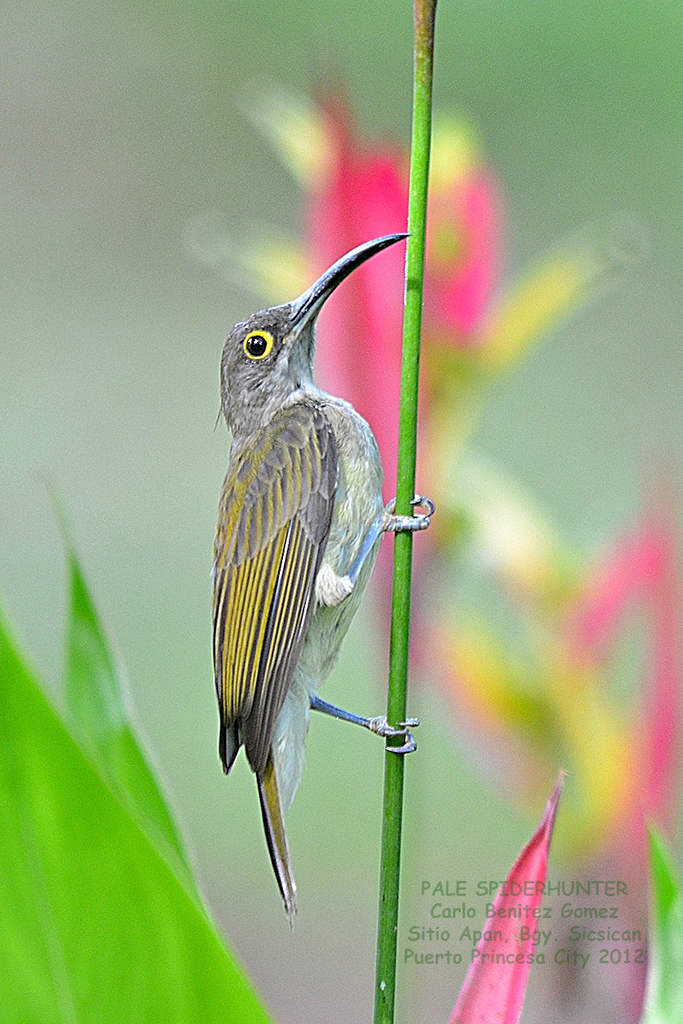
The pale spiderhunter (Arachnothera dilutior) is a species of bird in the family Nectariniidae. It is endemic to the island of Palawan in the Philippines. Along with the orange-tufted spiderhunter, it was originally considered a subspecies of the little spiderhunter. It is predominantly grayish in color, with olive-green wings, a pale yellow belly and a bold yellow eyering.
From the article Pale spiderhunter on Wikipedia (CC BY-SA), quoted section by section
Description
It was formerly considered conspecific with the little spiderhunter and orange-tufted spiderhunter, but the three were designated as distinct species in 2010. The pale spiderhunter differs from other two by its deeper and darker bill, longer tail, dark lores, and its striking eyering, gray breast and throat, and yellower wing edges. This species is monotypic and has no subspecies.
Wikipedia: “Description and taxonomy”
Range & habitat
Its habitat is primary lowland forest and second growth but it does occasionally visit secondary growth and banana plantations. It is found up to 1,000 meters (3,300 ft) above sea level. It is assessed as least-concern species under the IUCN as it seems to be tolerant of degraded habitat and is still common across its range. However, Palawan's forests are under threat due to illegal logging, deforestation, land conversion and mining. The whole of Palawan was designated as a Biosphere Reserve; however, protection and enforcement of laws has been difficult and these threats still continue. It occurs in just one protected area in the Iwahig Prison and Penal Farm.
Wikipedia: “Habitat and conservation status”
What it does
This species' diet has not yet been comprehensively studied but it is assumed to have a similar diet as the formerly conspecific Little spiderhunter which feeds on nectar, insects and spiders. It has been known to show nectar robbing behavior. It typically forages alone or in pairs in the lower levels of vegetation. Nothing has been published about its breeding habits.
Wikipedia: “Ecology and behavior”
Listen
Looking for field recordings…
Where it lives
Recorded sightings
—
geo-referenced records in GBIF, from museums, herbaria and field observers.
Drag the globe to turn it. Dots are where records exist, not a range map; darker means more records.
In the stacks
Searching the stacks…
Every page naming Arachnothera dilutior in the Biodiversity Heritage Library →
This page is assembled live from iNaturalist, GBIF, Wikipedia, the Source Library and the Internet Archive. It is not yet part of the hand-edited codex. iNaturalist taxon 201221.