On eBird ↗
White-browed Warbler
Live sightings near you, the range map, bar charts of when it is seen, and Macaulay Library photos and recordings.
White-browed Warbler
Myiothlypis leucoblephara
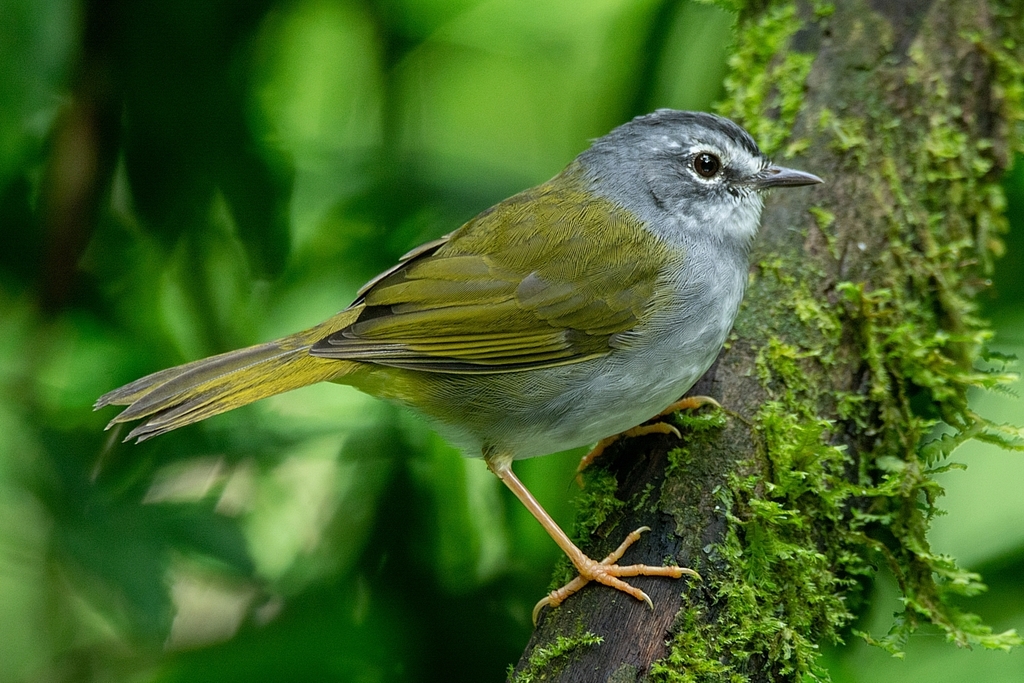
The white-rimmed warbler or white-browed warbler (Myiothlypis leucoblephara) is a species of bird in the family Parulidae. It is found in Argentina, Brazil, Paraguay, and Uruguay. Its natural habitats are subtropical or tropical moist lowland forests, subtropical or tropical moist montane forests, subtropical or tropical moist shrubland, and heavily degraded former forest.
From the article White-rimmed warbler on Wikipedia (CC BY-SA), quoted section by section
Description
The white-rimmed warbler is about 14.5 cm (5.7 in) long and weighs 14 to 21 g (0.49 to 0.74 oz). The sexes have the same plumage. Adults of the nominate subspecies have a mostly gray head with a blackish gray stripe in the middle of the crown, a white stripe above the lores, a thin black line through the eye, white crescents above and below the eye, and whitish cheeks. Their upperparts, wings, and tail are olive-green. Their throat and underparts are mostly whitish with a gray wash on the sides of the breast, an olive wash on the upper flanks, and pale olivaceous-yellow undertail coverts. Subspecies M. l. lemurum has darker upperparts than the nominate, with mostly medium gray underparts with whitish down the middle and gray undertail coverts that have pale yellow edges. Both subspecies have a dark iris, a blackish bill, and orange-pink legs and feet.
Range & habitat
The nominate subspecies of the white-rimmed warbler is the more northerly of the two and has by far the larger range. It is found in southern Brazil south of a line that roughly goes across the middle of Mato Grosso do Sul, far northern São Paulo state, and the midline of Minas Gerais to the Atlantic in Rio de Janeiro state. Its range continues south through eastern Paraguay, into northeastern Argentina south through most of Entre Ríos Province, and into Uruguay. At the time of its description in 1975, subspecies M. l. lemurum was known only from the Cerro de las Ánimas in far southern Uruguay. The dividing line between the two subspecies remains unresolved. The white-rimmed warbler primarily inhabits gallery forest and mature secondary forest that has a dense understory. It often occurs near water but is not as dependent on it as some other members of its genus. In elevation it ranges from sea level to 1,600 m (5,200 ft).
Wikipedia: “Distribution and habitat”
What it does
The white-rimmed warbler's diet has not been studied but is assumed to be entirely or nearly entirely invertebrates with very small amounts of plant material. It takes prey by gleaning on or near the ground. It forages mostly in dense undergrowth but will do so in the open. It seldom joins mixed-species feeding flocks.
Wikipedia: “Feeding”
Listen
Looking for field recordings…
Where it lives
Recorded sightings
—
geo-referenced records in GBIF, from museums, herbaria and field observers.
Drag the globe to turn it. Dots are where records exist, not a range map; darker means more records.
In the stacks
Searching the stacks…
Every page naming Myiothlypis leucoblephara in the Biodiversity Heritage Library →
This page is assembled live from iNaturalist, GBIF, Wikipedia, the Source Library and the Internet Archive. It is not yet part of the hand-edited codex. iNaturalist taxon 201224.