On eBird ↗
Pearly-bellied Seedeater
Live sightings near you, the range map, bar charts of when it is seen, and Macaulay Library photos and recordings.
Pearly-bellied Seedeater
Sporophila pileata
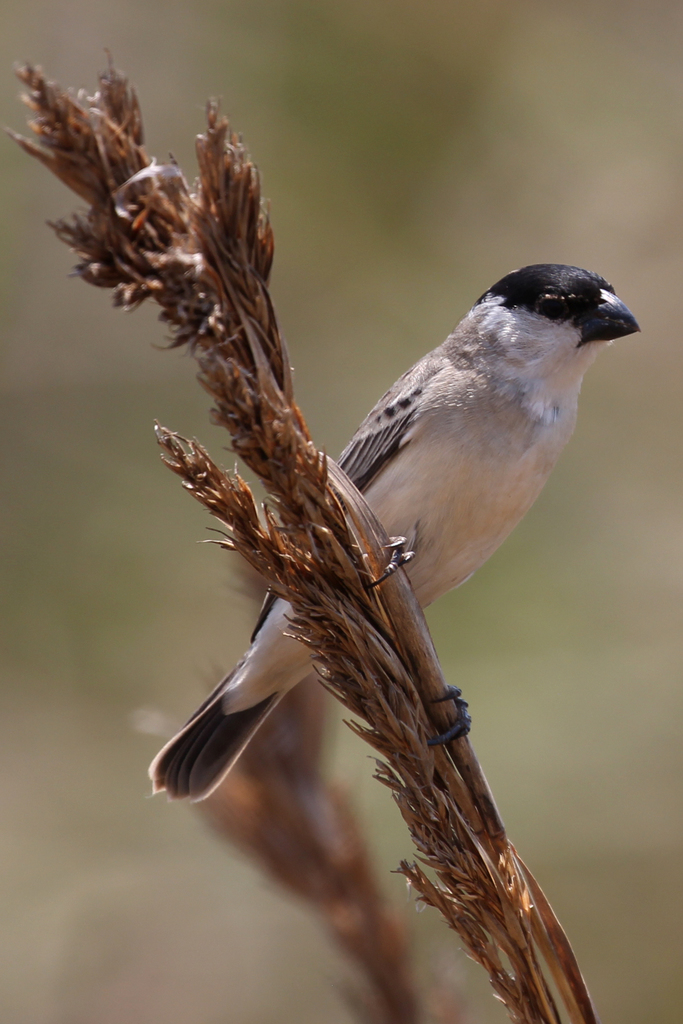
The pearly–bellied seedeater (Sporophila pileata) is a species of bird in the family Thraupidae. It was lumped with the copper seedeater, (S. bouvreuil) and known together as the capped seedeater before being split in February 2012.
From the article Pearly-bellied seedeater on Wikipedia (CC BY-SA), quoted section by section
Description
The pearly-bellied seedeater is about 10 cm (3.9 in) long and weighs 7.6 to 10 g (0.27 to 0.35 oz). It is one of the smallest of its genus. It has a short, thick bill with a rounded culmen. The species is sexually dimorphic. Adult males have a black cap down to the eye. Their face is off-white and their nape grayish pink. Their upperparts are mostly grayish pink with grayish brown uppertail coverts and a blackish tail. Their wings are blackish with very pale cinnamon-brown edges on the coverts and tertials. Their wing's primaries have white bases that show as a white rectangle on the folded wing. Their thighs are black. Females have an olive-brown head and upperparts. Their wings and tail are a slightly darker olive-brown with a small white primary patch on the former. Their throat and underparts are mostly ochre-buff with a whitish belly. Both sexes have a dark brown iris, a blackish bill, and blackish legs. Juveniles resemble adult females.
Range & habitat
The pearly-bellied seedeater is found in Brazil south of a line roughly from northwestern Mato Grosso do Sul east to southeastern Goías and then south to the Atlantic in east-central São Paulo state; its southern extent in the country is northern Rio Grande do Sul and Santa Catarina. Its range continues west and south into eastern Paraguay, northeastern Argentina's Misiones and Corrientes provinces, and far northern Uruguay. Though one source includes Bolivia in the species' range others do not and the South American Classification Committee (SACC) has only unconfirmed records there. The pearly-bellied seedeater inhabits open Cerrado, the ecotone between Cerrado and Atlantic Forest, savanna, and grasslands including the humid chaco. In elevation it ranges from sea level to 1,100 m (3,600 ft) in Brazil and to at least 1,200 m (3,900 ft) elsewhere.
Wikipedia: “Distribution and habitat”
What it does
The pearly-bellied seedeater feeds on grass seeds. It typically feeds while clinging to stems but it will feed on the ground. During the breeding season it usually forages in pairs and at other times it forages in groups that include other seed-eating species and can be quite large.
Wikipedia: “Feeding”
Listen
Looking for field recordings…
Where it lives
Recorded sightings
—
geo-referenced records in GBIF, from museums, herbaria and field observers.
Drag the globe to turn it. Dots are where records exist, not a range map; darker means more records.
In the stacks
Searching the stacks…
Every page naming Sporophila pileata in the Biodiversity Heritage Library →
This page is assembled live from iNaturalist, GBIF, Wikipedia, the Source Library and the Internet Archive. It is not yet part of the hand-edited codex. iNaturalist taxon 201230.