On eBird ↗
Italian Sparrow
Live sightings near you, the range map, bar charts of when it is seen, and Macaulay Library photos and recordings.
Italian Sparrow
Passer italiae
The Italian sparrow (Passer italiae), also known as the cisalpine sparrow, is a passerine bird of the sparrow family Passeridae, found in Italy and other parts of the Mediterranean region. In appearance, it is intermediate between the house sparrow, and the Spanish sparrow, a species of the Mediterranean and Central Asia closely related to the house sparrow. The Italian sparrow occurs in northern Italy and neighbouring regions, with intermediates with the house sparrow in a very narrow contact zone in the Alps, a slow gradation in appearance from the Italian to Spanish sparrows across central and southern Italy, and more birds of intermediate appearance in Malta, Crete, and other parts of the Mediterranean.
There has been much debate on the origins and taxonomic status of the Italian sparrow, especially given its possible hybrid origin. Some have classified it as a subspecies of the house sparrow, a subspecies of the Spanish sparrow, or as a separate species, a treatment followed if only for convenience by authorities such as the Handbook of the Birds of the World. A DNA analysis by Glenn-Peter Sætre and colleagues published in 2011 indicated an origin of the Italian sparrow through hybridisation between the Spanish and house sparrows, and Sætre and colleagues argued that given its origins and the limited extent of hybridisation, the treatment as a distinct species was supported. The Italian sparrow is unofficially considered the national bird of Italy.
From the article Italian sparrow on Wikipedia (CC BY-SA), quoted section by section
Description
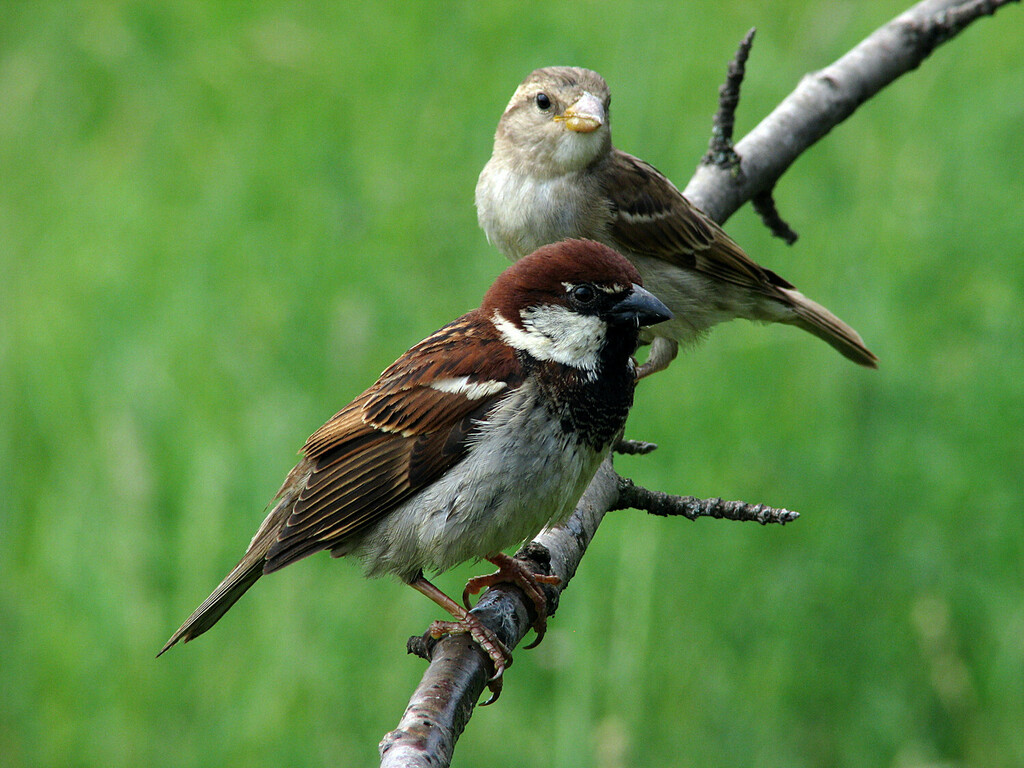
The Italian sparrow is a small chunky bird, with grey and brown plumage. The sexes differ in their plumage pattern, and slightly in length. The male has a head patterned like that of the Spanish sparrow, with a chestnut crown, nape and sides of head, and white cheeks. The male's upperparts are bright chestnut, and its underparts are pale grey, lacking the black streaking of the Spanish sparrow. The male has a black patch on its throat and chest, known as a bib or badge. This patch, like much of the male's plumage is dull in fresh non-breeding plumage and is brightened by wear and preening. The female is nearly identical to the female house sparrow, but it differs from the female Spanish sparrow in its lack of black streaks on the underparts. Albinism is occasionally recorded.
The Italian sparrow is about the same size as the house sparrow at 14–16 centimetres (5.5–6.3 in) in length. The tail is 5.3–6 centimetres (2.1–2.4 in), the tarsus 18.6–21 millimetres (0.73–0.83 in), and wing lengths for males are 7.3–8.2 centimetres (2.9–3.2 in). The Italian sparrow's weight varies seasonally from 30 grams (1.1 oz) in the winter to 26 grams (0.92 oz) in the summer. The vocalisations of the Italian sparrow are similar to those of both the Spanish sparrow and the house sparrow. Its vocalisations carry better in natural environments than those of the house sparrow. …
Range & habitat
The Italian sparrow is found in northern and central Italy, Corsica, and small parts of France, Switzerland, Austria, and Slovenia. Its distribution was described by Italian zoologist Enrico Hillyer Giglioli in 1881 as professing "'Conservative opinions'; for it keeps strictly within our current political frontiers". At the northernmost edge of its range in the southern Alps, there is a narrow hybrid zone about 20–30 km (12–19 mi) wide with the house sparrow. In southern Italy, there is a gradual clinal trend with the Spanish sparrow, with birds increasing in their similarity to the Spanish sparrow in appearance and ecology further south, from around Naples to western Sicily, where birds resemble pure Spanish sparrows. However, this trend may be superficial, and the Handbook of the Birds of the World recognises birds from Sicily and Crete as Italian sparrows. Sardinia is occupied by Spanish sparrows, while sparrows on Malta, Crete, and the adjacent islands are intermediates similar to the Italian sparrow. On Malta, sparrows resemble the Spanish sparrow, with urban birds behaving much like the house sparrow, and rural birds like the Spanish sparrow. The situation is complicated by house and Spanish sparrows which winter and migrate on Malta. …
Wikipedia: “Distribution and habitat”
What it does
The Italian sparrow's behaviour is similar in many ways to that of the house sparrow. It is a social bird, which feeds mostly on seeds and insects. It is mostly sedentary, but it wanders to some extent outside its breeding season. These wanderings are mostly local, but they may extend into southern France. Similarly, the house sparrow sometimes occurs as a winter visitor in northern Italy. Besides intergrading with the Spanish and house sparrows, the Italian sparrow has been recorded hybridising with the Eurasian tree sparrow. The eggs of the Italian sparrow do not seem to differ from those of the house sparrow. Broods may contain two to eight eggs, with an average of about 5.2.
Wikipedia: “Behaviour”
Listen
Looking for field recordings…
Where it lives
Recorded sightings
—
geo-referenced records in GBIF, from museums, herbaria and field observers.
Drag the globe to turn it. Dots are where records exist, not a range map; darker means more records.
In the stacks
Searching the stacks…
Every page naming Passer italiae in the Biodiversity Heritage Library →
This page is assembled live from iNaturalist, GBIF, Wikipedia, the Source Library and the Internet Archive. It is not yet part of the hand-edited codex. iNaturalist taxon 201233.