On eBird ↗
Sangihe Scops-Owl
Live sightings near you, the range map, bar charts of when it is seen, and Macaulay Library photos and recordings.
Sangihe Scops-Owl
Otus collari
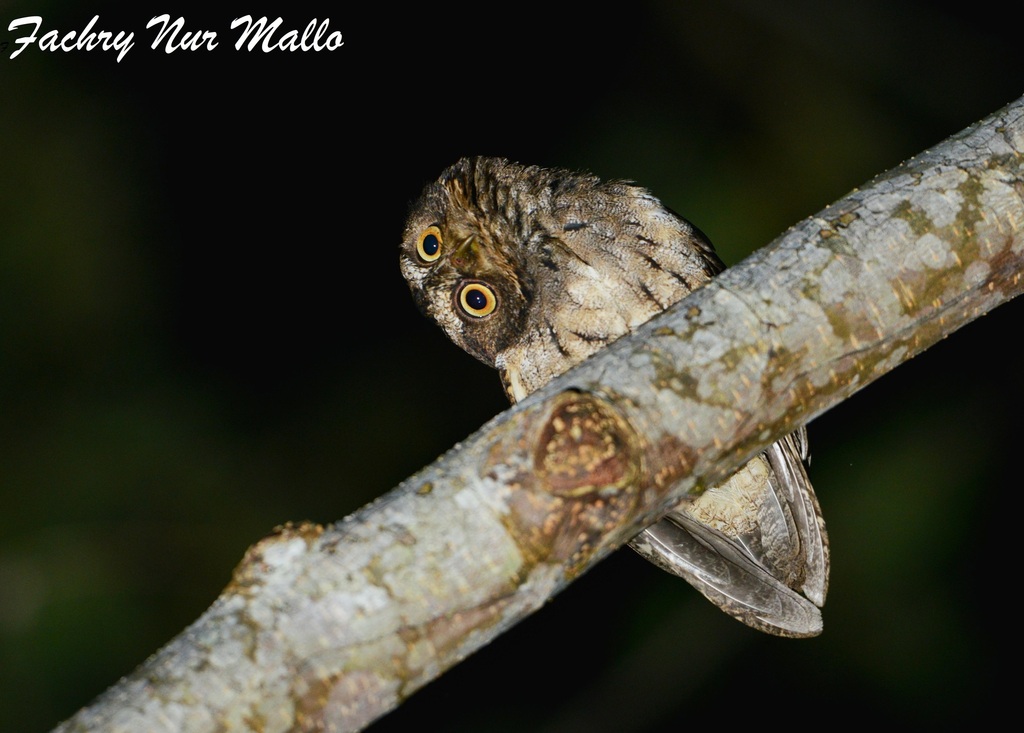
The Sangihe scops owl (Otus collari) is an owl species endemic to the Sangihe Island of Indonesia.
From the article Sangihe scops owl on Wikipedia (CC BY-SA), quoted section by section
Description
The Sangihe scops owl has a brown complexion to it. However, its facial disk has a pinch of white above the eyes. It has sporadic black streaks and patches, as each bird is unique and excellent for camouflage in its forest habitat. The upper parts are brown with dark shaft streaks. The bird's eyes are yellow with red pupils. It has tan feathers in its midsection. Along with that, the Sangihe scops owl's call sounds similar to a frail whistle. Its call is high pitched and can last from 7–8 seconds long.
Range & habitat
These birds are exclusive to the islands of Sangihe, mainly in North Sangihe in Southeast Asia next to Indonesia. They favor forests and mixed plantations. It is common and widespread on the island. They commonly reside in agricultural areas with trees up to 1150 feet and bushes.
Wikipedia: “Habitat”
What it does
Their diet consists of eating large insects, earthworms, small reptiles, mammals and birds.
Wikipedia: “Diet”
In human culture
The Sangihe scops owl is most likely part of a species group centered on Otus manadensis. Their original specimens were collected in 1866 and 1867. These owls were thought to be part of Otus magicus for a little bit. However, in 1996, examination of photographs and vocalization revealed that their species had differences from both O. mandensis and O. magicus. These birds are very closely related to O. mandensis because of their strong similarities, but are considered to be a separate species. The Sangihe scops owl is one of the 17 species of scops owls that can be found in Indonesia and is a member of the family Strigidae. The nocturnal Sangihe scops owl is distinguished by its unique sounds, which resemble high-pitched whistles. It is monotypic, no subspecies are recognized.
Wikipedia: “History”
Listen
Looking for field recordings…
Where it lives
Recorded sightings
—
geo-referenced records in GBIF, from museums, herbaria and field observers.
Drag the globe to turn it. Dots are where records exist, not a range map; darker means more records.
In the stacks
Searching the stacks…
Every page naming Otus collari in the Biodiversity Heritage Library →
This page is assembled live from iNaturalist, GBIF, Wikipedia, the Source Library and the Internet Archive. It is not yet part of the hand-edited codex. iNaturalist taxon 20210.