On eBird ↗
Sao Tome Scops-Owl
Live sightings near you, the range map, bar charts of when it is seen, and Macaulay Library photos and recordings.
São Tomé Scops-Owl
Otus hartlaubi
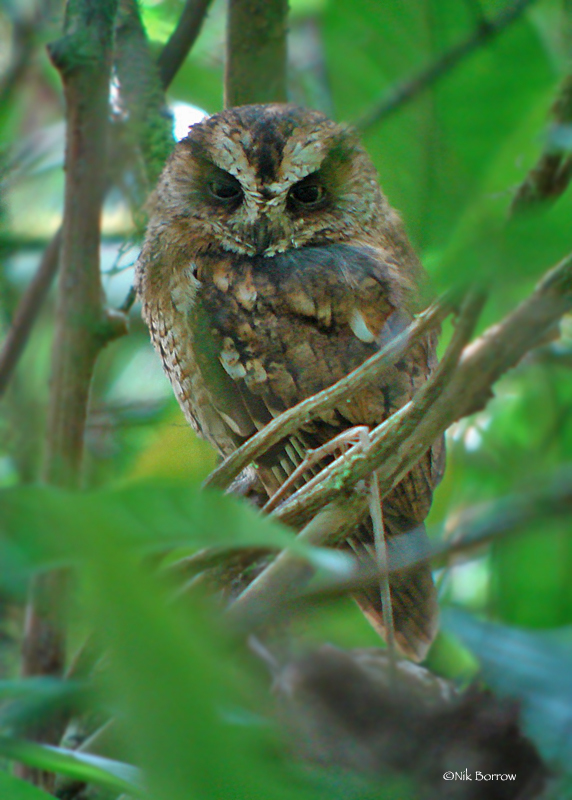
The São Tomé scops-owl (Otus hartlaubi), alternatively known as petit-duc de Sao Tomé, or autillo de Santo Tomé, is a species of owl in the true owl (a.k.a. Strigidae) family which is one of the two families of owl. Within that family, this owl is in the scops owl (a.k.a. Otus) genus; this is the genus of owls having the largest number of species.
From the article São Tomé scops owl on Wikipedia (CC BY-SA), quoted section by section
Description
The São Tomé scops owl is a small, secretive owl with small ear-tufts. It has a light reddish-brown facial disc with a white chin and white eyebrows. The crown and upper-parts are chestnut with rufous wavy markings and black shaft streaks. Their scapulars have white spots and black tips. The flight feathers are buff with white mottling and narrow. There are buff bars on the tail. The underparts are rufous with fine vermiculations of brown and white and bold black streaking. Juveniles are paler. It is a small owl, about 18 cm (7.1 in) long, weighing about 79 g (2.8 oz). Females of the species are somewhat larger than males.
Voice. The São Tomé scops owl's voice is a high-pitched 'hu-hu-hu', and also a low-pitched, raucous 'kwow'. It differs from the African scops owl (Otus senegalensis) and the flute sounds of the Eurasian scops owl (Otus scops).
Range & habitat
This owl species is endemic to São Tomé Island, which is part of São Tomé and Príncipe, in the Gulf of Guinea, off the western equatorial coast of Central Africa. This owl's natural habitats are subtropical or tropical moist lowland forest and subtropical or tropical moist montane forest where it is relatively widespread and the population is probably several hundred birds.
Wikipedia: “Distribution and habitat”
What it does
This species of owl is the only one on the island, except for the common barn owl. Its diet consists of insects, grasshoppers, beetles, moths, and small lizards. This owl is nocturnal (like most owls) and is not shy toward humans. It roosts close to tree trunks or within them. It sometimes calls during the day.
Wikipedia: “Behaviour”
Listen
Looking for field recordings…
Where it lives
Recorded sightings
—
geo-referenced records in GBIF, from museums, herbaria and field observers.
Drag the globe to turn it. Dots are where records exist, not a range map; darker means more records.
In the stacks
Searching the stacks…
Every page naming Otus hartlaubi in the Biodiversity Heritage Library →
This page is assembled live from iNaturalist, GBIF, Wikipedia, the Source Library and the Internet Archive. It is not yet part of the hand-edited codex. iNaturalist taxon 20213.