On eBird ↗
Sun Parakeet
Live sightings near you, the range map, bar charts of when it is seen, and Macaulay Library photos and recordings.
Sun Parakeet
Aratinga solstitialis
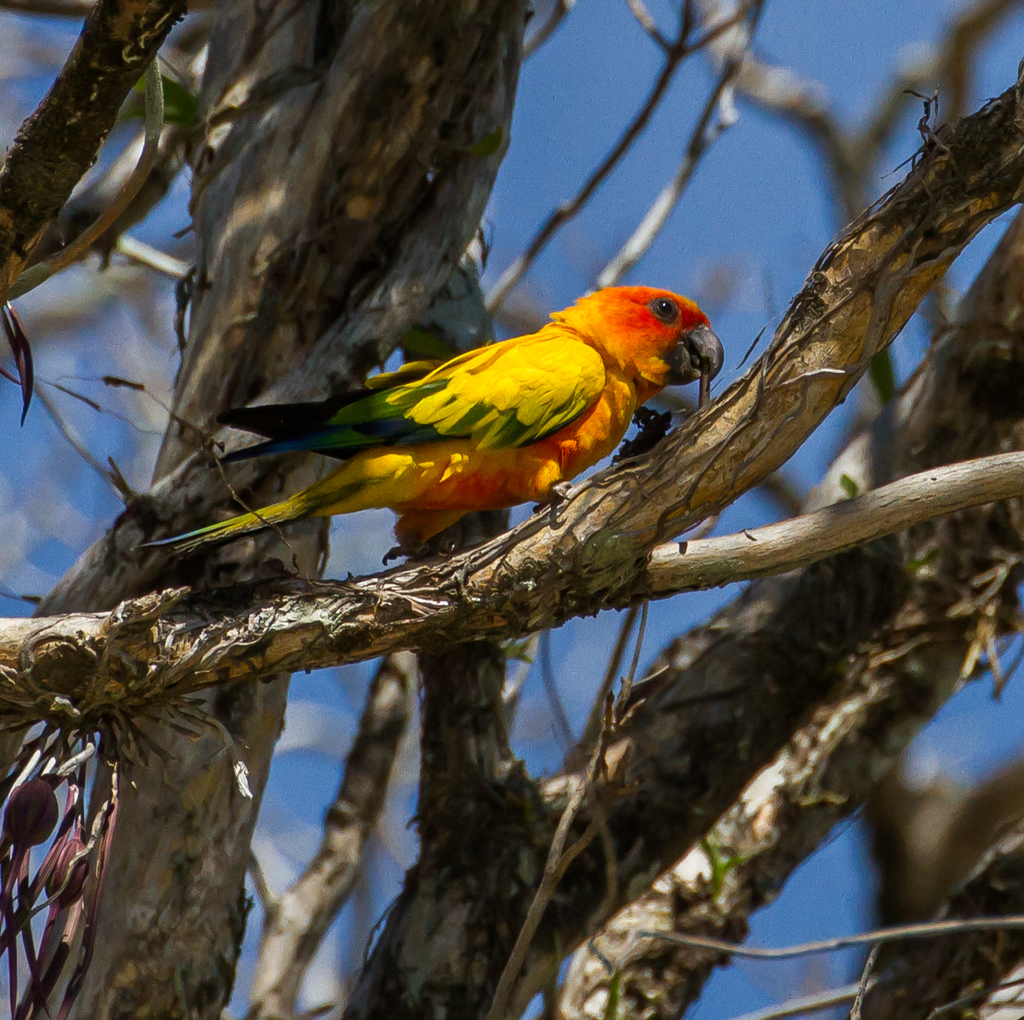
The sun conure (Aratinga solstitialis), also known as the sun parakeet, is a medium-sized, vibrantly colored parrot native to northeastern South America. The adult male and female are similar in appearance, with black beaks, predominantly golden-yellow plumage, orange-flushed underparts and face, and green and blue-tipped wings and tails. Sun conures are very social birds, typically living in flocks. They form monogamous pairs for reproduction, and nest in palm cavities in the tropics. Sun conures mainly feed on fruits, flowers, berries, blossoms, seeds, nuts, and insects. Conures are commonly bred and kept in aviculture and may live up to 30 years. This species is currently threatened by loss of habitat and trapping for plumage or the pet trade. Sun conures are now listed as endangered by the International Union for Conservation of Nature.
From the article Sun conure on Wikipedia (CC BY-SA), quoted section by section
Description
On average, sun conures weigh around 110 g (4 oz) and are around 30 cm (12 in) long. The sexes are similar in plumage, although hens may be lighter and slenderer in body, having a shorter tail, with a smaller, rounder head and a smaller beak. Adults have a rich yellow crown, nape, mantle, lesser wing coverts, tips of the greater wing coverts, chest, and underwing coverts. The face and belly are orange with red around the ears. The base of the greater wing coverts, tertials, and base of the primaries are green, while the secondaries, tips of the primaries, and most of the primary coverts are dark blue. The tail is olive-green with a blue tip. From below, all the flight feathers are dark greyish. The bill is black. The legs and the bare eye ring are grey, but the latter often fades to white in captivity (so using amount of grey or white in the eye ring for determining "purity" of an individual can be misleading). It is easily confused with the closely related jandaya parakeet and sulphur-breasted parakeet, but the former has entirely green wing coverts, mantle, and vent, while the latter has green mottling to the mantle and less orange to the underparts. The sun conure is also superficially similar to the pale-billed golden parakeet. Juvenile sun conures display a predominantly green plumage and resemble similarly aged sulphur-breasted parakeets. …
Range & habitat
Sun conures live in a relatively small region of northeastern South America – the north Brazilian state of Roraima, southern Guyana, extreme southern Suriname, and southern French Guiana. They also occur as vagrants to coastal French Guiana. Their status in Venezuela is unclear, but recent sightings from the southeast near Santa Elena de Uairén have been reported. They may occur in Amapá or far northern Pará (regions where the avifauna generally is very poorly documented), but this remains to be confirmed. Populations found along the Amazon River in Brazil are now known to belong to the sulphur-breasted parakeet. Sun conures are mostly found in tropical habitats, but their exact ecological requirements remain relatively poorly known. They are widely reported as occurring within dry savanna woodlands and coastal forests, but recent sightings suggest they mainly occur at altitudes less than 1,200 m (3,900 ft), at the edge of humid forests growing in foothills in the Guiana Shield, and cross more open savannah habitats only when traveling between patches of forest. Sun conures have been seen in shrublands along the Amazon riverbank, as well as forested valleys and coastal, seasonally flooded forests. These conures usually inhabit fruiting trees and palm groves.
Wikipedia: “Distribution and habitat”
What it does
Like other members of the genus Aratinga, the sun conure is very social and typically occurs in large flocks of 15 to 30 individuals. They rarely leave the flock, but when they get separated from the group, they squawk and scream in a high-pitched voice, which can carry for hundreds of yards, allowing individuals to communicate with their flock and return to them. Flocks are relatively quiet while feeding, but are known to be very vocal and make loud noises when in flight. They can travel many miles in a single day, and they are fast, direct flyers. Nonverbal communication is also practised, with a variety of physical displays. Birds within a flock rest, feed one another, preen, and bathe throughout the daylight hours. They move through the trees using their beaks for extra support. They also have the ability to use their feet like hands to help hold, examine, or eat items. Sun conures have been reported to nest and roost in tree cavities. When in molt, conures are uncomfortable, so are easily irritable. Bathing, warm rainfalls, and humidity allow the sheaths of each pin feather to open more easily and lessen their discomfort. Sun conures are extremely smart and curious, so require constant mental stimulation and social interaction. Their speech and ability to learn tricks in captivity are quite moderate. …
Wikipedia: “Behavior”
In human culture
The sun conure is noted for its very loud squawks and screams compared to its relatively small size, and have been recorded reaching over 120 decibels. It is capable of mimicking humans, but not as well as some larger parrots. It is popular as a pet because of its bright coloration and curious nature. Due to its inquisitive temperament, it demands a great deal of attention from owners, with whom it can be loving and cuddly. Hand-reared pets can be very friendly towards people with whom they are familiar, but they may be aggressive with strangers and even territorial with visitors. Sun conures are capable of learning many tricks and can even perform in front of a live audience. They enjoy listening to music, to which they occasionally sing and dance. Like many parrots, they are determined chewers and require toys and treats on which to chew. Other activities enjoyed by sun conures include taking baths and preening feathers. Many owners clip their conures' wings, but this is not necessary if the proper precautions are put in place. Due to environmental hazards, conures should not be allowed to fly unsupervised. Sun conures are great candidates for outdoor flight when well trained, as they are loyal, but risk potential must be minimized. In captivity, their lifespans range from 15 to 30 years. A red-factor colour mutation has been produced in aviculture. …
Wikipedia: “Aviculture”
Listen
Looking for field recordings…
Where it lives
Recorded sightings
—
geo-referenced records in GBIF, from museums, herbaria and field observers.
Drag the globe to turn it. Dots are where records exist, not a range map; darker means more records.
In the stacks
Searching the stacks…
Every page naming Aratinga solstitialis in the Biodiversity Heritage Library →
This page is assembled live from iNaturalist, GBIF, Wikipedia, the Source Library and the Internet Archive. It is not yet part of the hand-edited codex. iNaturalist taxon 202471.