On eBird ↗
Pacific Swift
Live sightings near you, the range map, bar charts of when it is seen, and Macaulay Library photos and recordings.
Pacific Swift
Apus pacificus
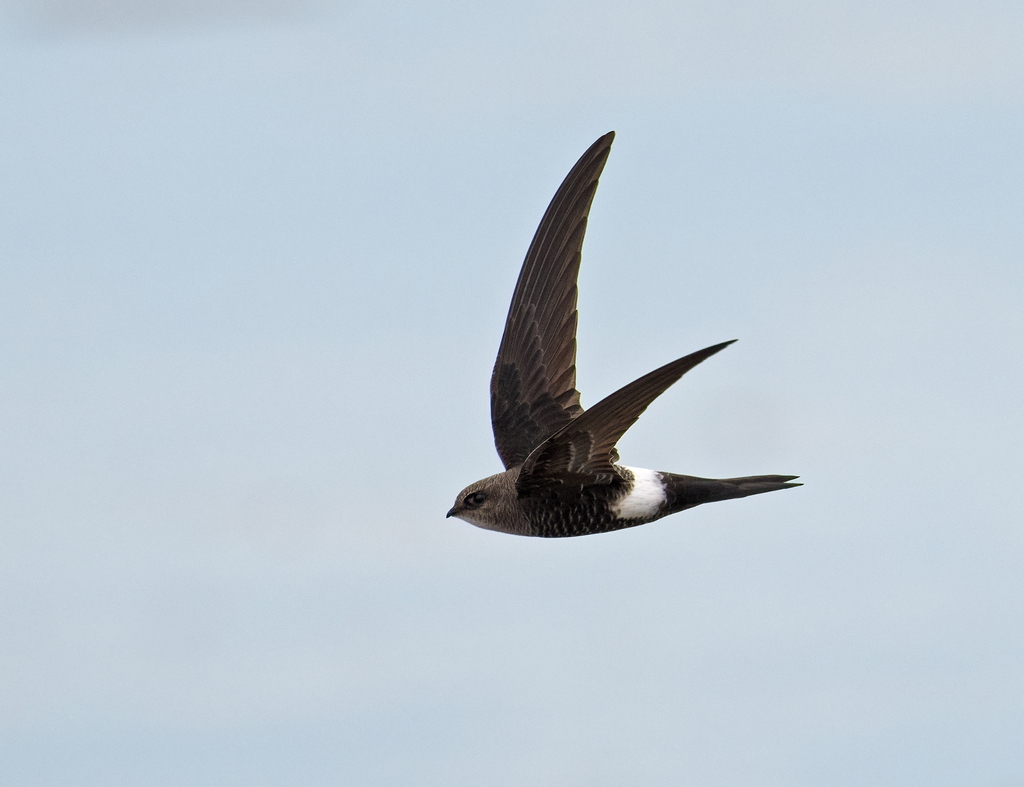
The Pacific swift (Apus pacificus) is a species of bird that is part of the Swift family. It breeds in eastern Asia. It is strongly migratory, spending the northern hemisphere's winter in Southeast Asia and Australia. The general shape and blackish plumage recall its relative, the common swift, from which it is distinguished by a white rump band and heavily marked underparts. The sexes are identical in appearance, although young birds can be identified by pale fringes to the wing feathers that are absent in adults. This swift's main call is a screech typical of its family. It is one of a group of closely related Asian swifts formerly regarded as one species.
The Pacific swift is found in a wide range of climatic zones and habitats. It breeds in sheltered locations such as caves, natural rock crevices or under the roofs of houses. The nest is a half-cup of dry grass and other fine material that is gathered in flight, cemented with saliva and attached to a vertical surface. The two or three white eggs are incubated for about seventeen days to hatching. Subsequently, the chicks have a long but variable period in the nest before they are fully fledged. When the parents cannot find sufficient food in bad weather, the young can survive for days without being fed by metabolising body fat.
From the article Pacific swift on Wikipedia (CC BY-SA), quoted section by section
Description
At 17–18 cm (6.7–7.1 in) in length, the Pacific swift is the largest of the Apus swifts. It has a 43-to-54-cm (17-to-21-in) wingspan. Females are slightly heavier than males, averaging 44.5 g (1.57 oz) against 42.5 g (1.50 oz). It is similar in general shape to the common swift, although slightly longer-winged and with a more protruding head. The fork of the tail is deeper, and the rump is broader. The upperparts are black, apart from a white rump band and a somewhat greyer head. The underparts are black, although white fringes to the feathers give the belly a scaly appearance when seen well from below. The tail and the upper wings are black, and the underwings are brown. The eyes are brown and the small bill and very short legs are black. The sexes are identically plumaged, and juveniles differ from the adults only in that the feathers show pale fringes, particularly on the wings. The southern subspecies, A. p. kurodae, has a narrower white rump (15 mm/0.6 in against the nominate form's 20 mm/0.8 in), a grey throat and blacker underparts. Juveniles of migratory Apus swifts have a partial moult prior to migration, but retain the larger wing feathers. The moult is completed in the wintering grounds, where adults have a complete moult. This species is usually straightforward to identify. …
Range & habitat
The nominate subspecies, A. p. pacificus, breeds in eastern Asia from the Ob River northeast to Kamchatka and east to the Kuril Islands, Sakhalin and Japan. It is strongly migratory, wintering in southern Indonesia, Melanesia and Australia, including Tasmania. It is a common migrant through coastal Malaysia, Sumatra and Java with "vast numbers" crossing the Strait of Malacca. Subspecies A. p. kurodae breeds from southeastern Tibet through eastern China to southern Japan, Taiwan and Orchid Island. It is a relatively short-distance migrant, wintering in the Philippines, Malaysia and northern Indonesia. As a powerful long-distance migrant, the nominate subspecies of Pacific swift has occurred as a vagrant far from its normal range. Birds have been recorded from Brunei, the Maldives, New Zealand and Macquarie Island, and there have been multiple occurrences in the Seychelles. In the US, this species is casual in the Pribilof and Aleutian Islands; a claimed 2010 sighting from the Yukon will be the first for Canada and the mainland of North America if ratified. In South America, there is a 1959 record from Colombia. There are 13 European records as of 2013, from Denmark (two), Spain, Sweden (four) and the UK (seven). It is possible that this overstates the true number of visiting birds. …
Wikipedia: “Distribution and habitat”
What it does
All swifts feed on insects caught in flight, and the Pacific swift has been recorded as consuming bees, wasps, termites, moths and flies. A Chinese study found that it caught a wide variety of insect prey and considered that most of the species eaten were harmful to agriculture or forestry, leading to improved agricultural yield in a number of geographical domaines. The Pacific swift tends to hunt higher than sympatric swifts, sharing its airspace mainly with white-throated needletails. It typically feeds at heights up to 300 m (980 ft), only flying close to the ground in poor weather. It often forages near low-pressure areas, which serve both to raise insects from the ground and to give the swifts additional lift. The swifts circle through the insect swarms in flocks typically of tens or hundreds of birds, although sometimes reaching tens of thousands in Australia. In Siberia, Pacific swifts feed at dusk to much later hours than the common swift, sometimes until midnight, and migrants have been seen flying with bats in the Philippines. The young are fed balls of insects bound with saliva. During bad weather, increased competition leads to malnourishment within populations, where young swifts are often not fed for days and survive on stored body fat.
Wikipedia: “Feeding”
Listen
Looking for field recordings…
Where it lives
Recorded sightings
—
geo-referenced records in GBIF, from museums, herbaria and field observers.
Drag the globe to turn it. Dots are where records exist, not a range map; darker means more records.
In the stacks
Searching the stacks…
Every page naming Apus pacificus in the Biodiversity Heritage Library →
This page is assembled live from iNaturalist, GBIF, Wikipedia, the Source Library and the Internet Archive. It is not yet part of the hand-edited codex. iNaturalist taxon 202491.