On eBird ↗
Sula Megapode
Live sightings near you, the range map, bar charts of when it is seen, and Macaulay Library photos and recordings.
Sula Megapode
Megapodius bernsteinii
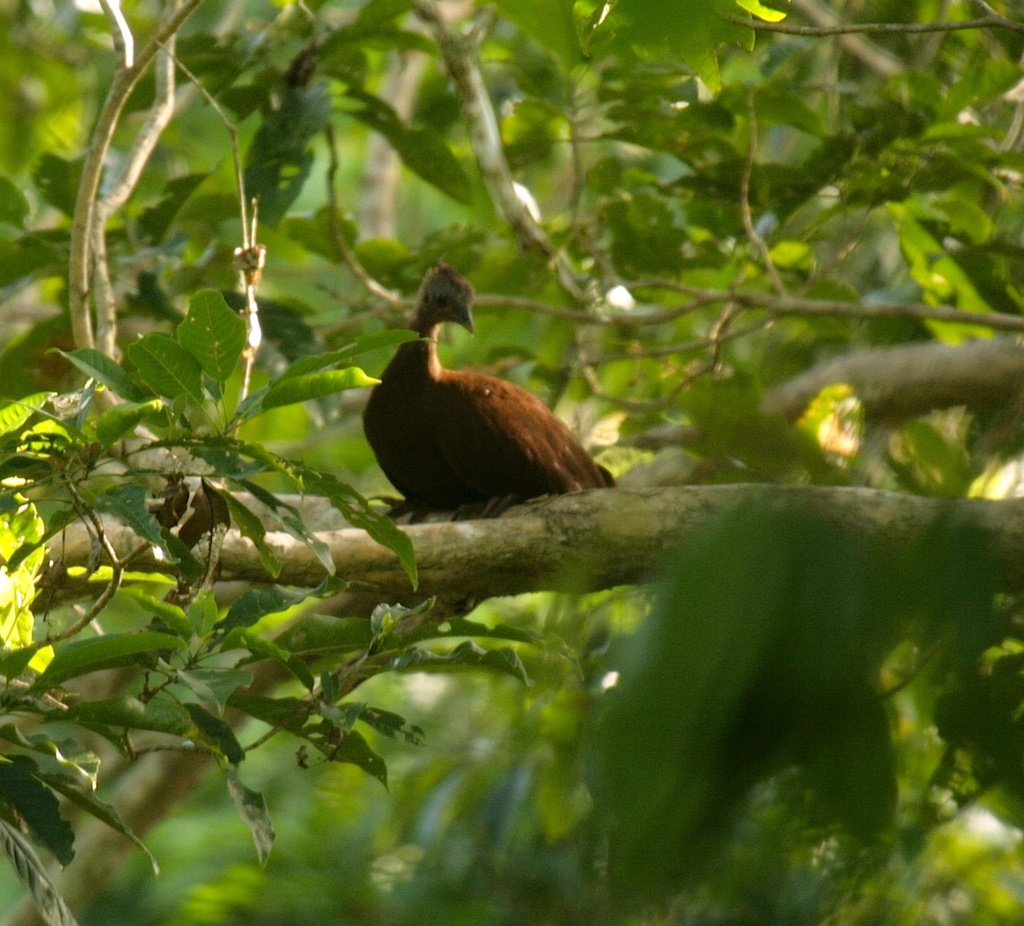
The Sula megapode or Sula scrubfowl (Megapodius bernsteinii) is a species of bird in the family Megapodiidae. It is found only in the Banggai and Sula Islands between Sulawesi and the Maluku Islands in Indonesia, where its habitats are subtropical or tropical dry forest, subtropical or tropical moist lowland forest, subtropical or tropical mangrove forest, and subtropical or tropical moist shrubland. It is threatened by habitat destruction.
From the article Sula megapode on Wikipedia (CC BY-SA), quoted section by section
Description
The Sula scrubfowl is a medium-sized ground-dwelling bird growing to a length of between 30 and 35 cm (12 and 14 in). The sexes are similar in appearance, being a uniform reddish-brown colour and having a short, pointed crest and long red or orange-red legs and feet.
Range & habitat
It is known only from the Banggai and Sula Islands, groups of islands between Sulawesi and the Maluku Islands in Indonesia. Habitats include lowland forests as well as dense scrub near forests and farmland, at altitudes of up to 450 m (1,500 ft).
Wikipedia: “Distribution”
What it does
The species usually forages in pairs, but on one occasion, a group of five birds moving about and feeding together was recorded, perhaps an adult pair and their young. The diet mainly consists of roots and invertebrates, including earthworms. Very little was known of the breeding habits of this bird so a study was undertaken in 1991. Nine birds were in the vicinity of the study site, four pairs and a single bird. There was much vocalisation mostly in the form of duetting and choruses, with all the birds joining in synchrony. Calling took place in the mornings and to a lesser extent in the afternoons indicating the presence of birds close to the nest. The study nest was a cone-shaped mound in a fallow cultivated field close to scrub and forest remnants. It was built over two rotting logs and was constructed of sand and clay. Eggs are laid by the female in the mound and covered with soil (this was not observed). During the month-long observation period, a bird (or sometimes two) would approach the mound on most days and rake the surface with its claws. The bird faced downhill and scratched the surface with alternate feet, working in one instance for 116 minutes. Another bird could sometimes be heard in the nearby undergrowth. …
Wikipedia: “Ecology”
Listen
Looking for field recordings…
Where it lives
Recorded sightings
—
geo-referenced records in GBIF, from museums, herbaria and field observers.
Drag the globe to turn it. Dots are where records exist, not a range map; darker means more records.
In the stacks
Searching the stacks…
Every page naming Megapodius bernsteinii in the Biodiversity Heritage Library →
This page is assembled live from iNaturalist, GBIF, Wikipedia, the Source Library and the Internet Archive. It is not yet part of the hand-edited codex. iNaturalist taxon 2026.