On eBird ↗
Sandy Scops-Owl
Live sightings near you, the range map, bar charts of when it is seen, and Macaulay Library photos and recordings.
Sandy Scops-Owl
Otus icterorhynchus
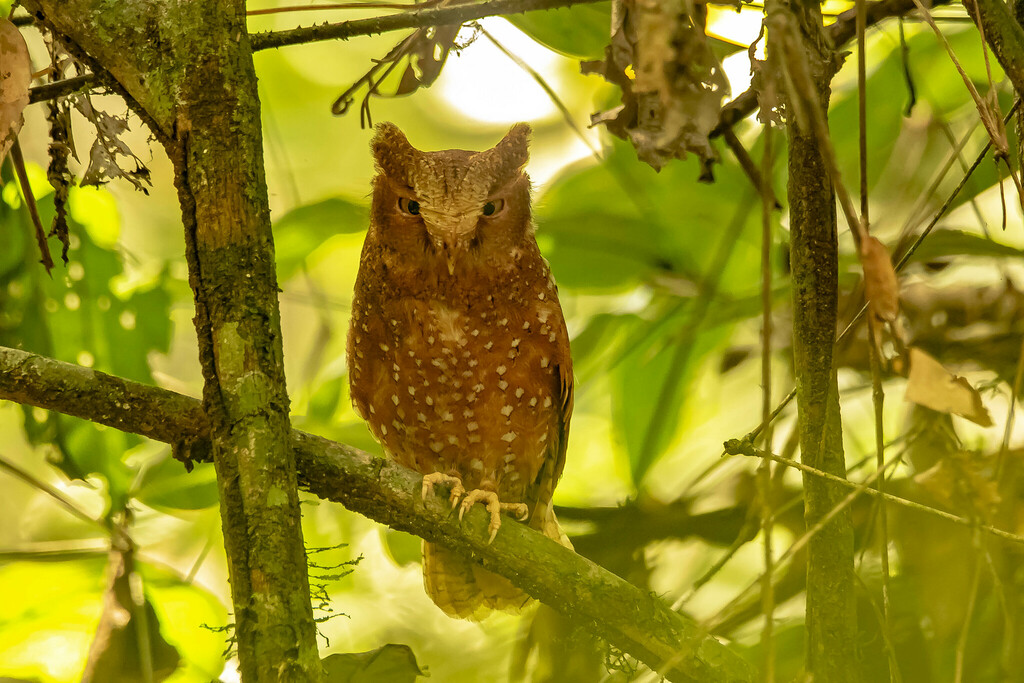
The sandy scops owl (Otus icterorhynchus), or cinnamon scops owl, is an owl form the familay Strigidae found in Africa.
From the article Sandy scops owl on Wikipedia (CC BY-SA), quoted section by section
Description
A small owl which has an overall pale rufous colour, a plain face, a pale yellow bill and yellow eyes. The pale stripe along the shoulders is quite obvious. The adults are pale rufous brown, finely spotted with white and barred with buff. The underparts are paler and more rufous with buff bars and white spots on the belly and vent. The tail, flight feathers and greater upperwing coverts are rufous barred with black. Length is about 15 cm (5.9 in), and wingspan is 45 cm (18 in).
Voice. The sound is a long whistling "twooo" which descends in pitch.
Range & habitat
The sandy scops owl has a scattered distribution across the African tropical rainforest; it has been recorded from Guinea, Liberia, Ivory Coast, Ghana, Cameroon, Gabon, Congo, Democratic Republic of Congo and Central African Republic. The sandy scops owl occurs in lowland evergreen forest, open canopy forest and scrub, or in open forest mosaic land.
Wikipedia: “Distribution and habitat”
What it does
The sandy scops owl is rarely seen and little is known about its habits. It is probably crepuscular and insectivorous feeding largely on grasshoppers and crickets. The breeding season is probably during February and March.
Wikipedia: “Behaviour”
Listen
Looking for field recordings…
Where it lives
Recorded sightings
—
geo-referenced records in GBIF, from museums, herbaria and field observers.
Drag the globe to turn it. Dots are where records exist, not a range map; darker means more records.
In the stacks
Searching the stacks…
Every page naming Otus icterorhynchus in the Biodiversity Heritage Library →
This page is assembled live from iNaturalist, GBIF, Wikipedia, the Source Library and the Internet Archive. It is not yet part of the hand-edited codex. iNaturalist taxon 20275.