On eBird ↗
Short-eared Owl
Live sightings near you, the range map, bar charts of when it is seen, and Macaulay Library photos and recordings.
Short-eared Owl
Asio flammeus
The short-eared owl (Asio flammeus) is a species of typical owl (family Strigidae). Owls belonging to genus Asio are known as the eared owls, as they have tufts of feathers resembling mammalian ears. These "ear" tufts may or may not be visible. Asio flammeus will display its tufts when in a defensive pose, although its very short tufts are usually not visible. The short-eared owl is found in open country and grasslands. The scientific name is...
From the article Short-eared owl on Wikipedia (CC BY-SA), quoted section by section
Description
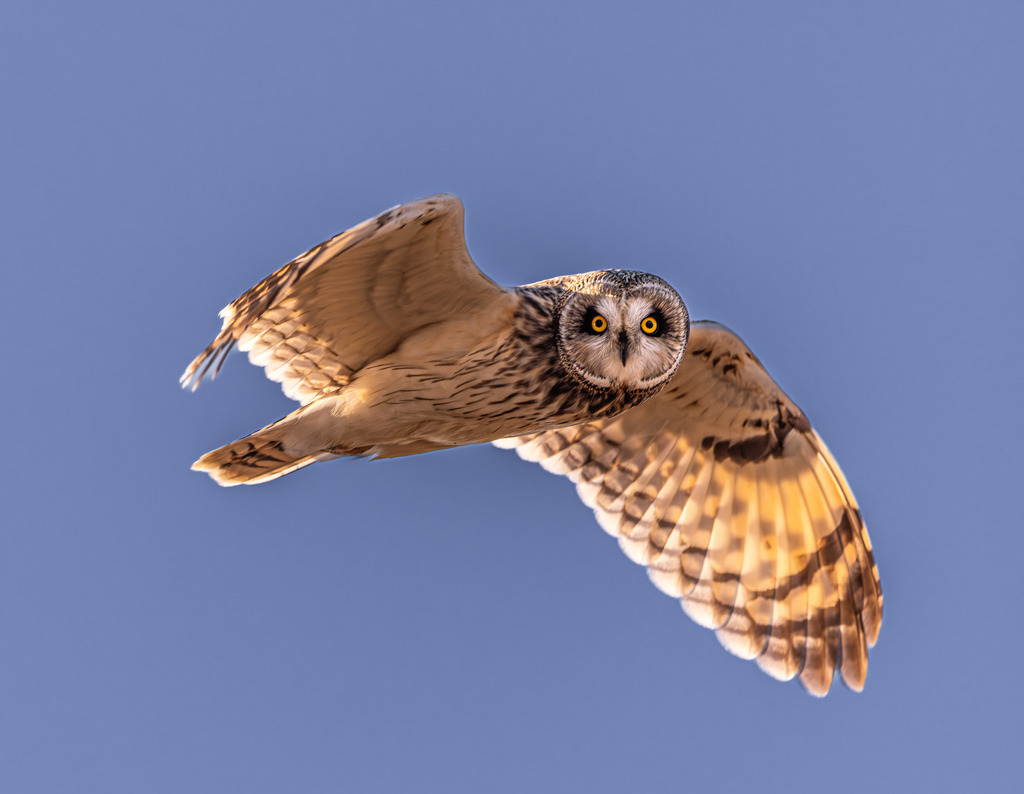
The short-eared owl is a medium-sized owl measuring 34–43 cm (13–17 in) in length and weighing 206–475 g (7.3–16.8 oz). It has large eyes, a big head, a short neck, and broad wings. Its bill is short, strong, hooked and black. Its plumage is mottled tawny to brown with a barred tail and wings. The upper breast is significantly streaked. Its flight is characteristically floppy due to its irregular wingbeats. The short-eared owl may also be described as "moth or bat-like" in flight. Wingspans range from 85 to 110 cm (33 to 43 in). Females are slightly larger than males. The yellow-orange eyes of A. flammeus are exaggerated by black rings encircling each eye, giving the appearance of them wearing mascara, and large, whitish disks of plumage surrounding the eyes like a mask.
Calls. Short-eared owls have a scratchy bark-like call. Raspy waowk, waowk, waowk or toot-toot-toot-toot-toot sounds are common. A loud eeee-yerp is also heard on breeding grounds. However, short-eared owls are silent on the wintering grounds.
Separation from the long-eared owl. Through much of its range, short-eared owls occurs with the similar-looking long-eared owl. At rest, the ear-tufts of the long-eared owl serve to easily distinguish the two (although long-eared owls can sometimes hold their ear-tufts flat). …
Range & habitat
The short-eared owl occurs on all continents except Antarctica and Australia; thus it has one of the most widespread distributions of any bird. A. flammeus breeds in Europe, Asia, North and South America, the Caribbean, Hawaii and the Galápagos Islands. It is partially migratory, moving south in winter from the northern parts of its range. The short-eared owl is known to relocate to areas of higher rodent populations. It will also wander nomadically in search of better food supplies during years when vole populations are low. (See a map of the short-eared owl's distribution across the New World.)
Wikipedia: “Distribution and habitat”
What it does
Hunting occurs mostly at night, but this owl is known to be diurnal and crepuscular as well. Its daylight hunting seems to coincide with the high-activity periods of voles, its preferred prey. It tends to fly only feet above the ground in open fields and grasslands until swooping down upon its prey feet-first. Several owls may hunt over the same open area. Its food consists mainly of rodents, especially voles, but it will eat other small mammals such as rabbits, mice, ground squirrels, shrews, rats, bats, muskrats and moles. It will also occasionally depredate smaller birds, especially when near sea-coasts and adjacent wetlands at which time they attack shorebirds, terns and small gulls and seabirds with semi-regularity. Avian prey is more infrequently preyed on inland and centers on passerines such as larks, icterids, starlings, tyrant flycatchers and pipits. Insects supplement the diet and short-eared owls may prey on roaches, grasshoppers, beetles, katydids and caterpillars. Competition can be fierce in North America with the northern harrier, with which the owl shares similar habitat and prey preferences. Both species will readily harass the other when prey is caught. Because of the high pH in the stomach of owls they have a reduced ability to digest bone and other hard parts, so they eject pellets containing the remains of their prey.
Wikipedia: “Food and feeding”
Listen
Looking for field recordings…
Where it lives
Recorded sightings
—
geo-referenced records in GBIF, from museums, herbaria and field observers.
Drag the globe to turn it. Dots are where records exist, not a range map; darker means more records.
In the stacks
Searching the stacks…
Every page naming Asio flammeus in the Biodiversity Heritage Library →
This page is assembled live from iNaturalist, GBIF, Wikipedia, the Source Library and the Internet Archive. It is not yet part of the hand-edited codex. iNaturalist taxon 20315.