On eBird ↗
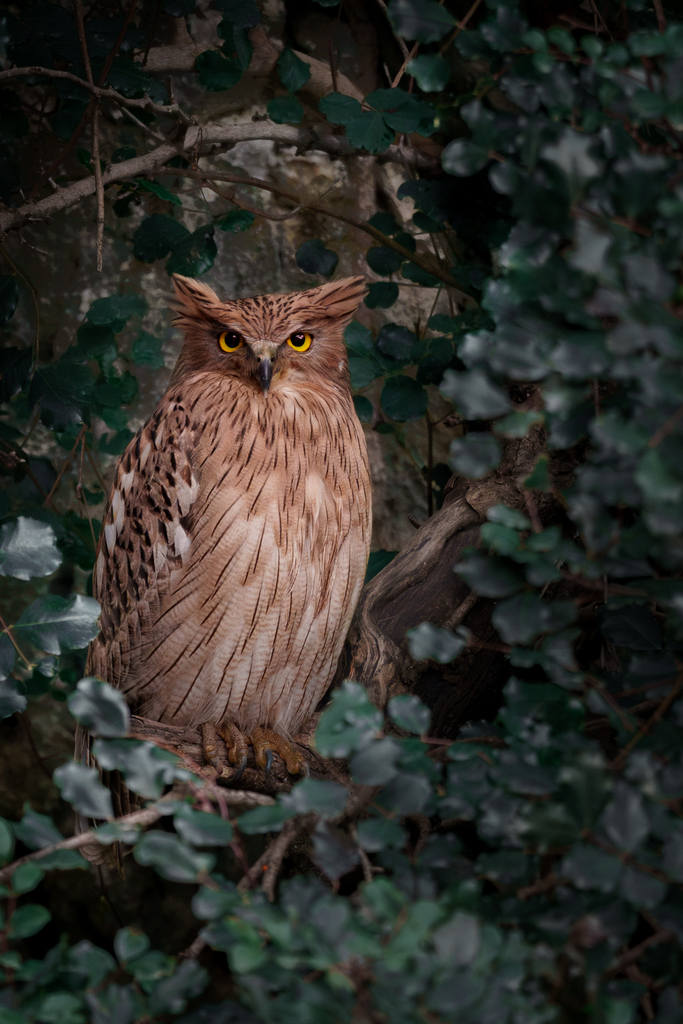
Brown Fish-Owl
Live sightings near you, the range map, bar charts of when it is seen, and Macaulay Library photos and recordings.
Brown Fish-Owl
Ketupa zeylonensis
The brown fish owl (Ketupa zeylonensis) is a species of owl that is part of the family known as typical owls, Strigidae, which contains most living owls. It inhabits the warm subtropical and humid tropical parts of continental Asia and some offshore islands. Of the four living species of fish owl, it is the most widely distributed, most common and best-studied. It occupies a range of over 7,000 km (4,300 mi) from eastern China to Palestine.
From the article Brown fish owl on Wikipedia (CC BY-SA), quoted section by section
Description
The brown fish owl has prominent ear tufts and rufous brown upperparts that are heavily streaked with black or dark brown. Its underparts are buffy-fulvous to whitish, with wavy dark brown streaks and finer brown barring. Its throat is white and conspicuously puffed. Its facial disk is indistinct, the bill dark and the iris golden yellow. Its featherless feet are yellow. Two-year old brown fish owls are somewhat paler than adults. Female and male differ slightly in size. In body size, it ranges from 48 to 61 cm (19 to 24 in) with a wingspan from 125 to 140 cm (49 to 55 in). Its weight varies considerably, ranging from 1.1 to 2.5 kg (2.4 to 5.5 lb). Some of the variability is attributed to the range of sizes across the subspecies. Also, females are invariably at least somewhat larger than males and condition of birds is variable. It is slightly larger than the buffy fish owl with a darker brown hue. Compared to eagle owls of similar length, fish owls tend to be even shorter in tail length and even heavier in build, have relatively larger wings, have considerably longer legs, and have a rough texture to the bottom of their toes. At least the latter two features are clear adaptations to aid these owls in capturing fish. Diurnal raptors who feed largely on fish have similar, if not identical, rough texture under their toes, which helps these birds grasp slippery fish. …
Range & habitat
The brown fish owl is an all-year resident throughout most tropical and subtropical parts of the Indian subcontinent to Southeast Asia and adjoining regions. West of its main range, it is patchily distributed to the Levant (possibly extinct) and southern Asia Minor (recently rediscovered). The typical habitat of brown fish owls is forest and woodland bordering streams, lakes or rice fields. It inhabits mainly the lowlands, from open woodland to dense forest as well as in plantations; in the Himalayas foothills it ranges into submontane forest up to 1,500 m (4,900 ft) above mean sea level or so but not higher. It frequently spends the day in stands of bamboo or other large shady trees. They be found around water reservoirs, along canals, on the outskirts of villages and along sea coasts. Western birds are found in semiarid landscape and may breed in oases in arid regions. Regardless of habitat, it rarely strays far from larger bodies of water such as rivers and lakes. Being a large predatory bird, the brown fish owl is only rarely found at a high population density, an exception being Sri Lanka, where this particular owl's adaptability to human habitat change has been beneficial in continued high numbers.
Wikipedia: “Distribution and habitat”
What it does
The calls of the buffy fish owl are described as a deep humming boom-uh-boom, a hup hup hu and a loud huhuhuhuhuhuhu. A trisyllabic tu-hoo-hoo is seemingly the territorial song emitted before breeding. Its call has been described as comparable to that of a distant Eurasian bittern (Botaurus stellaris). The buffy fish owl is nocturnal but can often be located by the small birds that mob it while roosting in a tree. However, in some areas it may be semi-diurnal and has been seen hunting during daytime, especially in cloudy weather. Brown fish owl primarily hunt by stationing itself on a rock overhang or hanging perch over water, or by wading into shallow waters. It grabs food by gliding over the water, nearly skimming it with its feet and grabbing its prey by quickly extending its long legs. It feeds mainly on fishes, frogs and aquatic crustaceans, especially Potamon crabs. It usually selects the larger freshwater fish available in waterways. Compared to the tawny fish owl, which prefers flowing waters, brown fish owls frequently hunt in still or stagnant waters. By number in the Melghat Tiger Reserve in India, freshwater crabs of the family Gecarcinucidae (of genus Barytelphusa) almost totally dominated the diet. Brown fish owls may be attracted to ornamental fish ponds or commercial fisheries in order to exploit the easily caught fish at such locations. …
Wikipedia: “Behaviour and ecology”
Listen
Looking for field recordings…
Where it lives
Recorded sightings
—
geo-referenced records in GBIF, from museums, herbaria and field observers.
Drag the globe to turn it. Dots are where records exist, not a range map; darker means more records.
In the stacks
Searching the stacks…
Every page naming Ketupa zeylonensis in the Biodiversity Heritage Library →
This page is assembled live from iNaturalist, GBIF, Wikipedia, the Source Library and the Internet Archive. It is not yet part of the hand-edited codex. iNaturalist taxon 20343.