On eBird ↗
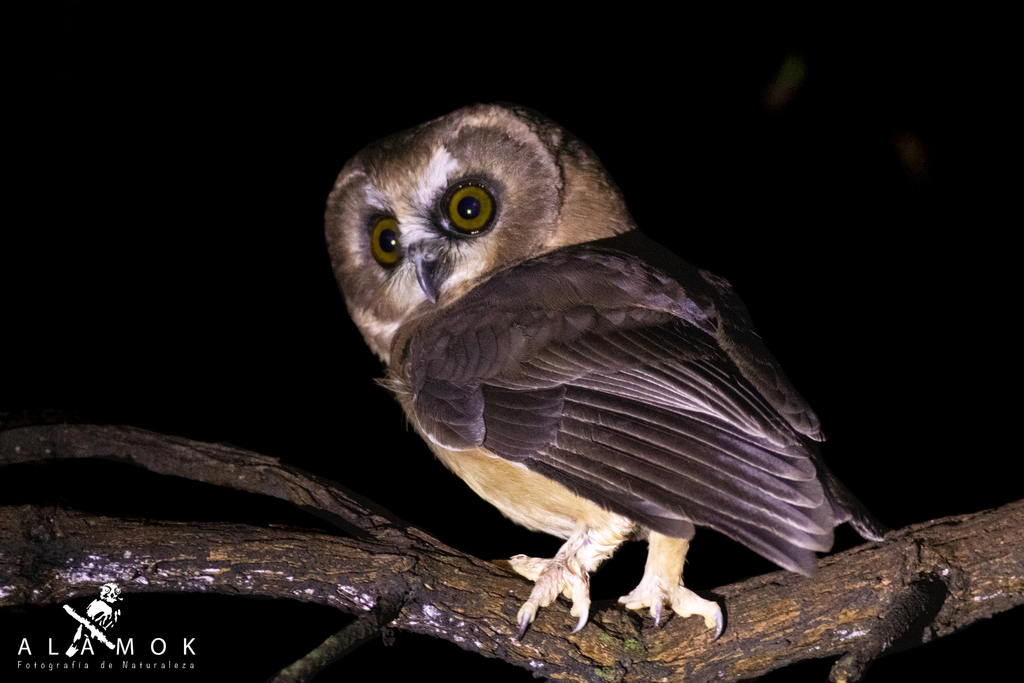
Unspotted Saw-whet Owl
Live sightings near you, the range map, bar charts of when it is seen, and Macaulay Library photos and recordings.
Unspotted Saw-whet Owl
Aegolius ridgwayi
The unspotted saw-whet owl (Aegolius ridgwayi) is a small owl. It is a resident breeder in the highlands of Central America from southern Mexico south to western Panama, mainly above 2500 m. it has occasionally been considered conspecific with the northern saw-whet owl. There are currently no recognized subspecies.
From the article Unspotted saw-whet owl on Wikipedia (CC BY-SA), quoted section by section
Description
The unspotted saw-whet owl is 18 to 21.5 cm (7.1 to 8.5 in) long and weighs about 80 to 90 g (2.8 to 3.2 oz). Its upperparts, throat, and upper breast are plain sepia brown and the lower breast and belly plain cinnamon buff. The tail is a darker brown and the wings generally a grayer brown. Its facial disk is brown with a narrow white border; the lores, chin, and "eyebrows" are whitish. It has yellow eyes. The two putative subspecies other than the nominate differ only slightly from it.
Range & habitat
The nominate subspecies of unspotted saw-whet owl is found from central Costa Rica into western Panama. A. r. tacanensis is found in Mexico's Chiapas state. A. r. rostratus is found in Guatemala and northwestern El Salvador. The species inhabits humid temperate montane forest. Vegetation communities include humid oak forest, cloudforest, and pine-oak forest. It generally stays in the forest canopy but can be found in more open areas with scattered trees but close to forest edges. In elevation it ranges between 1,700 and 3,000 m (5,600 and 9,800 ft) in the northern part of its range, between 2,200 and 2,900 m (7,200 and 9,500 ft) in Costa Rica, and between 2,100 and 3,500 m (6,900 and 11,500 ft) in Panama.
Wikipedia: “Distribution and habitat”
What it does
The unspotted saw-whet owl is nocturnal. It is usually solitary, except in the breeding season, and is thought to be territorial. Its flight is described as "fluttery, agile, with quick wingbeats."
Feeding. The unspotted saw-whet owl's diet has not been detailed. Small mammals such as shrews and rodents are thought to be its primary prey. It is also thought to take birds and bats.
Breeding. The unspotted saw-whet owl's breeding phenology is not well known. Its breeding season appears to span between at least March and July. It nests in cavities, either natural or made by woodpeckers, and is thought to lay five or six eggs.
Vocalization. The male unspotted saw-whet owl's territorial call is "a whistled hoo hoo hoo…" given about 10 times over three to five seconds. Females give "a hight, slightly hissing ssirr". Both sexes give "a surprisingly loud shriek and a shrill short chipper". The call of tree frogs of genus Anotheca is extremely similar to the owl's song and easily confused with it.
Wikipedia: “Behavior”
Listen
Looking for field recordings…
Where it lives
Recorded sightings
—
geo-referenced records in GBIF, from museums, herbaria and field observers.
Drag the globe to turn it. Dots are where records exist, not a range map; darker means more records.
In the stacks
Searching the stacks…
Every page naming Aegolius ridgwayi in the Biodiversity Heritage Library →
This page is assembled live from iNaturalist, GBIF, Wikipedia, the Source Library and the Internet Archive. It is not yet part of the hand-edited codex. iNaturalist taxon 20352.