On eBird ↗
Elf Owl
Live sightings near you, the range map, bar charts of when it is seen, and Macaulay Library photos and recordings.
Elf Owl
Micrathene whitneyi
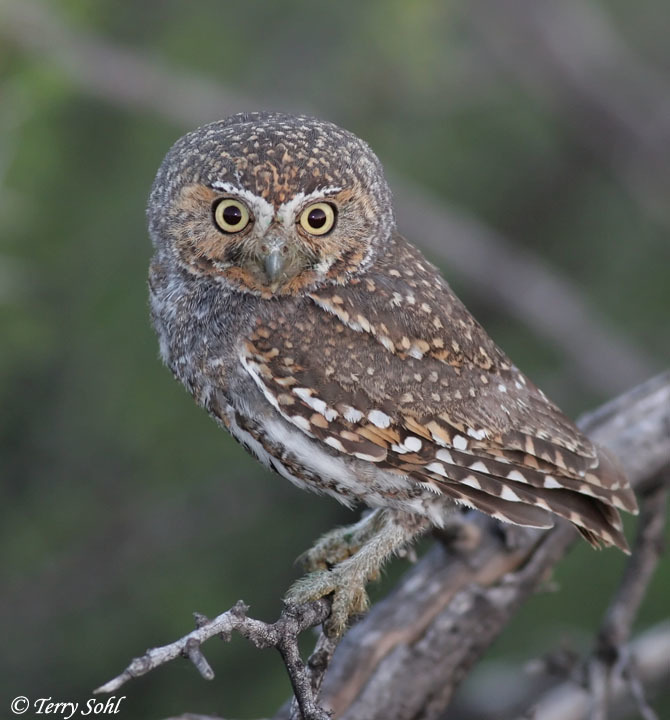
The elf owl (Micrathene whitneyi) is a member of the owl family Strigidae, that breeds in the southwestern United States and Mexico. It is the world's lightest owl, although the long-whiskered owlet and the Tamaulipas pygmy owl are of a similarly diminutive length. The mean body weight of this species is 40 g (1.4 oz). These tiny owls are 12.5 to 14.5 cm (4.9 to 5.7 in) long and have a wingspan of about 27 cm (10.5 in). Their primary projection extends...
From the article Elf owl on Wikipedia (CC BY-SA), quoted section by section
Description
The elf owl is the world's smallest and lightest owl, although the long-whiskered owlet and the Tamaulipas pygmy owl are of a similarly diminutive length. The mean body weight of this species is 40 g (1.4 oz). These tiny owls are 12.5 to 14.5 cm (4.9 to 5.7 in) long and have a wingspan of about 27 cm (10.5 in). Their primary projection (flight feather) extends nearly past their tail. They have fairly long legs and often appear bow-legged. They are often found in chaparral and are easily found during their breeding season. During dusk and just before dawn are the times this owl is most active when they can often be heard calling to one another in a high-pitched whinny or chuckle. These songs often consist of 5–7 notes that repeat in short duration, similar to the sound of a young puppy. The distinctive vocalizations of elf owls vary according to sex, with males exhibiting a wider repertoire of complex notes as opposed to females of the same species. Males have two primary classifications of songs, each of which share similar characteristics of structure and function. Most avian observers refer to "Class A" songs to describe those that vary in length (generally 5–15 notes) and are used as both territorial proclamation and to herald the arrival of males to females in the area. …
Range & habitat
The elf owl is known to migrate in large groups, with patterns of migration varying depending on flock and habitat location. Some broods of elf owl migrate to the southwest United States (California, Arizona, New Mexico, and Texas) in the spring and summer for breeding. In the winter, it is found in central and southern Mexico. Migrant elf owls return north in mid-April to early May. Resident populations occur in a couple of places in south central Mexico and along the Baja peninsula.
Wikipedia: “Distribution and habitat”
What it does
Elf owls feign death when handled, an adaption that encourages a predator to relax its grip so that the owl can escape. Elf owls are also notoriously territorial. Territories are established by the male and are defended by both the male and the female, and males also tend to view their chosen female mate as a territory to be defended, as well. This defense is often accomplished through the use of song. During the breeding season, elf owls are monogamous and stay in breeding pairs, but can be found in small groups during migration and when mobbing predators. Adults as well as young can be subject to predation by other predatory birds such as jays, hawks, and owls.
Breeding. Elf owls usually choose abandoned, north-facing woodpecker cavities in saguaro cacti, sycamores, cottonwoods, and other hardwood trees, to raise their young. While some cavity nesters utilize vegetation as nesting substrate, elf owls have been observed removing this vegetation and prefer a bare cavity. While elf owls primarily use natural structures for their nesting, they have been known to nest in man-made structures such as telephone poles in urban areas. They generally mate for periods of three months, with male and female birds remaining in close proximity. …
Wikipedia: “Behaviour and ecology”
Listen
Looking for field recordings…
Where it lives
Recorded sightings
—
geo-referenced records in GBIF, from museums, herbaria and field observers.
Drag the globe to turn it. Dots are where records exist, not a range map; darker means more records.
In the stacks
Searching the stacks…
Every page naming Micrathene whitneyi in the Biodiversity Heritage Library →
This page is assembled live from iNaturalist, GBIF, Wikipedia, the Source Library and the Internet Archive. It is not yet part of the hand-edited codex. iNaturalist taxon 20379.