On eBird ↗
Black-banded Owl
Live sightings near you, the range map, bar charts of when it is seen, and Macaulay Library photos and recordings.
Black-banded Owl
Strix huhula
The black-banded owl (Strix huhula) is a species of owl in the family Strigidae. Entirely nocturnal, this midsized black and white neotropical bird is a resident species, and therefore never migrates out of its native South America. Its natural habitats are varied subtropical or tropical forests ranging from lowlands to areas of medium altitude, and it has been found in Argentina, Bolivia, Brazil, Colombia, Ecuador, French Guiana, Guyana, Paraguay, Peru, Suriname, and Venezuela.
From the article Black-banded owl on Wikipedia (CC BY-SA), quoted section by section
Description
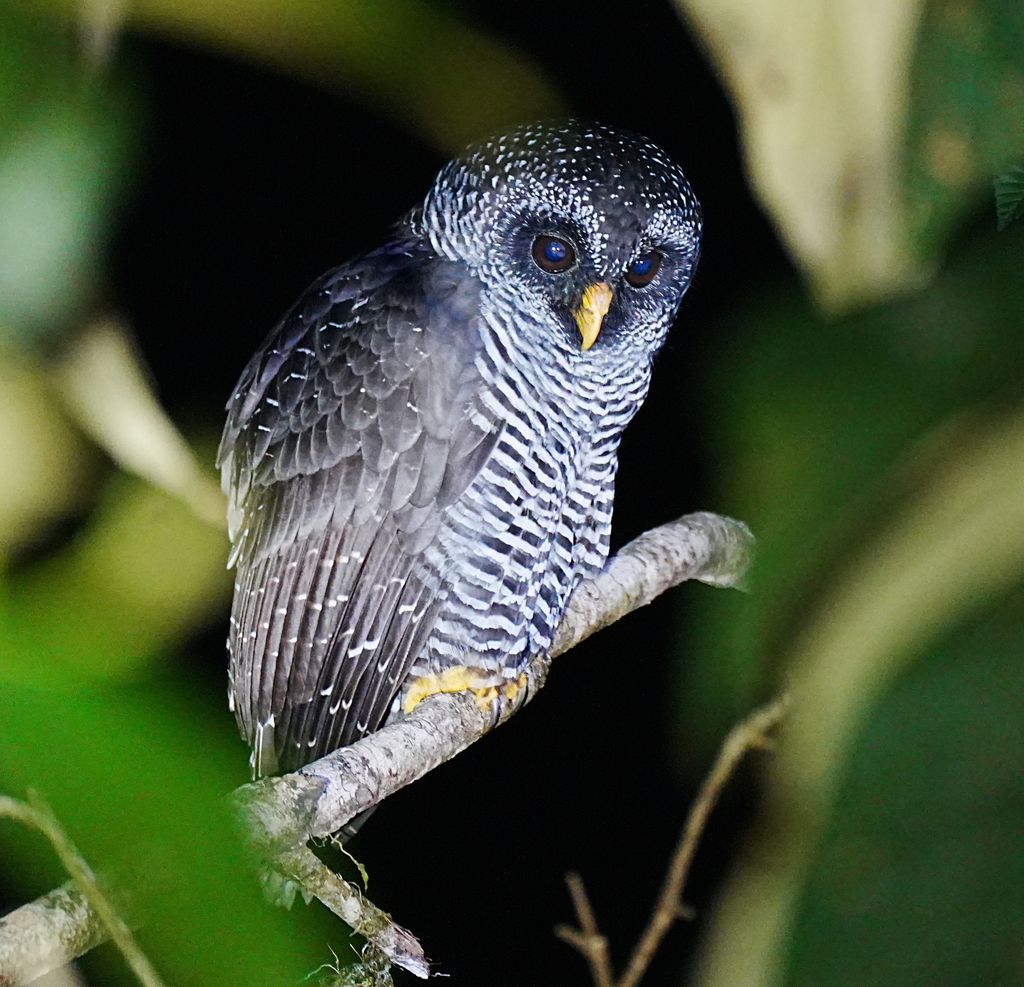
The black-banded owl is medium-sized (30–36 cm (12–14 in)), blackish all over and densely striated with horizontal, wavy, white bars. A black face mask encircle its eyes. It has a rounded head with no ear tufts, and a yellow-orange bill and feet. The tail is sooty-brown, with 4 to 5 narrow white bars and a white terminal band. Primary feathers are significantly darker than the rest of its plumage. Black bristles and feathers are found around the bill and along the leg to the base of the toes.
Range & habitat
Black-banded owls are mostly found below an elevation of 500 m (2,000 ft), with rare records of them at up to 1,400 m (5,000 ft). They inhabit various types of forests throughout the South-American landscape, mostly tropical and subtropical forests. In Ecuador they were almost exclusively recorded in the humid forest of the North-East, they were also found in the Atlantic, igapò, and terra-firme forests of Brazil, Araucaria forests, and man-made or disturbed habitats, such as clearings, agricultural land and suburban areas.
Wikipedia: “Habitat”
What it does
Little information is available on the food habits of this species, but bats have been found in the stomachs of adult birds and they have been observed eating and feeding moths to their nestlings. The black-and-white owl, the closest relative of the black-banded owl, has been seen capturing large insects, such as beetles (mostly scarabaeid, curculionid and cerambycid), grasshoppers (Acrididae), and cockroaches (Blattidae). As for vertebrate prey, they fed on bats (primarily Artibeus jamaicens) while Mottled Owls, another Ciccaba species, ate predominantly small rodents.
Wikipedia: “Diet”
Listen
Looking for field recordings…
Where it lives
Recorded sightings
—
geo-referenced records in GBIF, from museums, herbaria and field observers.
Drag the globe to turn it. Dots are where records exist, not a range map; darker means more records.
In the stacks
Searching the stacks…
Every page naming Strix huhula in the Biodiversity Heritage Library →
This page is assembled live from iNaturalist, GBIF, Wikipedia, the Source Library and the Internet Archive. It is not yet part of the hand-edited codex. iNaturalist taxon 20393.