On eBird ↗
Amazonian Motmot
Live sightings near you, the range map, bar charts of when it is seen, and Macaulay Library photos and recordings.
Amazonian Motmot
Momotus momota
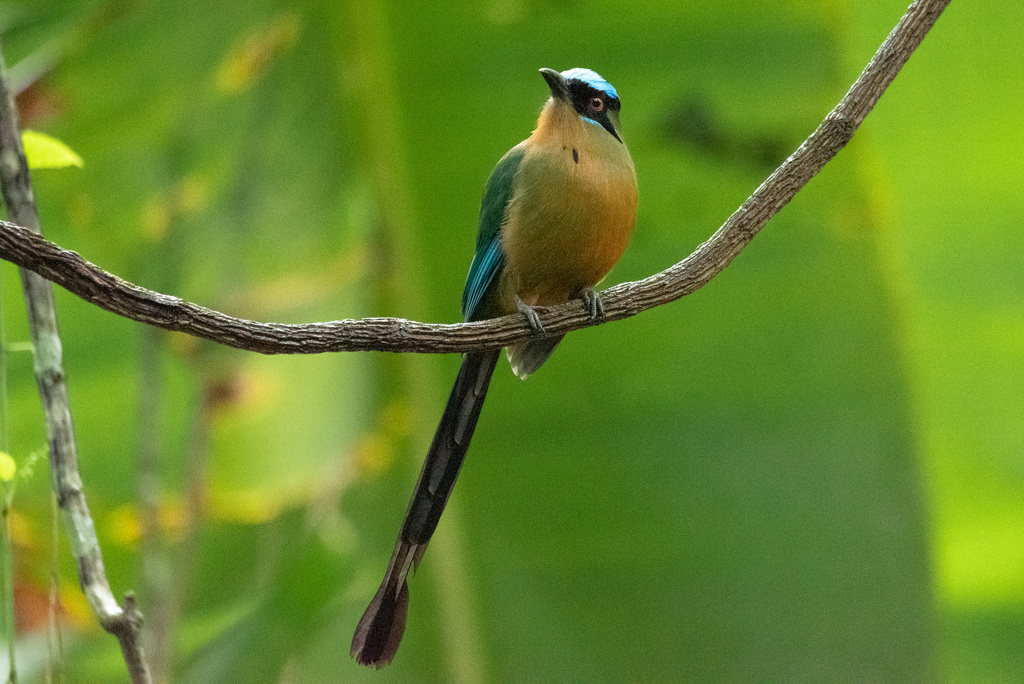
The Amazonian motmot (Momotus momota) is a colourful near-passerine bird found in the tropical regions from southern Mexico to northeastern Argentina. This species and the blue-capped motmot, whooping motmot, Trinidad motmot, Lesson's motmot, and Andean motmot were all considered conspecific.
From the article Amazonian motmot on Wikipedia (CC BY-SA), quoted section by section
Description
The Amazonian motmot's plumage varies among the subspecies. The bodies of all are shades of green. All have a long tail that has extended feathers with racquet tips that are green or black. Most have a black eyemask, though their size and shape differ. The central crown is black and surrounded or partially bordered by a blue band. The nominate subspecies has a chestnut nape. Momotus momota ignobilis and M. m. cametensis have more extensive chestnut on the neck and face.
Range & habitat
The Amazonian motmot is widely distributed in South America east of the Andes. Nine subspecies are recognized:
Momotus momota momota — eastern Venezuela, Guyana, Suriname, French Guiana, and northern Brazil M. m. microstephanus — southeastern Colombia, eastern Ecuador, and northwestern Brazil M. m. ignobilis — eastern Peru and western Brazil M. m. nattereri — northeastern Bolivia M. m. simplex — western to west central Brazil south of the Amazon M. m. cametensis — north central Brazil M. m. parensis — northeastern Brazil M. m. marcgravianus — eastern Brazil M. m. pilcomajensis — southern Bolivia, southern Brazil, and northwestern Argentina Throughout its range the Amazonian motmot inhabits the interior and edges of humid lowland forest. It is found up to 1,200 m (3,900 ft) in Venezuela, to 1,000 m (3,300 ft) in Ecuador, and to 750 m (2,460 ft) in Peru.
Wikipedia: “Distribution and habitat”
What it does
The Amazonian motmot is omnivorous. It has been documented eating insects and other arthropods, small mammals and reptiles, and fruit.
Wikipedia: “Feeding”
Listen
Looking for field recordings…
Where it lives
Recorded sightings
—
geo-referenced records in GBIF, from museums, herbaria and field observers.
Drag the globe to turn it. Dots are where records exist, not a range map; darker means more records.
In the stacks
Searching the stacks…
Every page naming Momotus momota in the Biodiversity Heritage Library →
This page is assembled live from iNaturalist, GBIF, Wikipedia, the Source Library and the Internet Archive. It is not yet part of the hand-edited codex. iNaturalist taxon 204447.