On eBird ↗
New Zealand Pipit
Live sightings near you, the range map, bar charts of when it is seen, and Macaulay Library photos and recordings.
New Zealand Pipit
Anthus novaeseelandiae
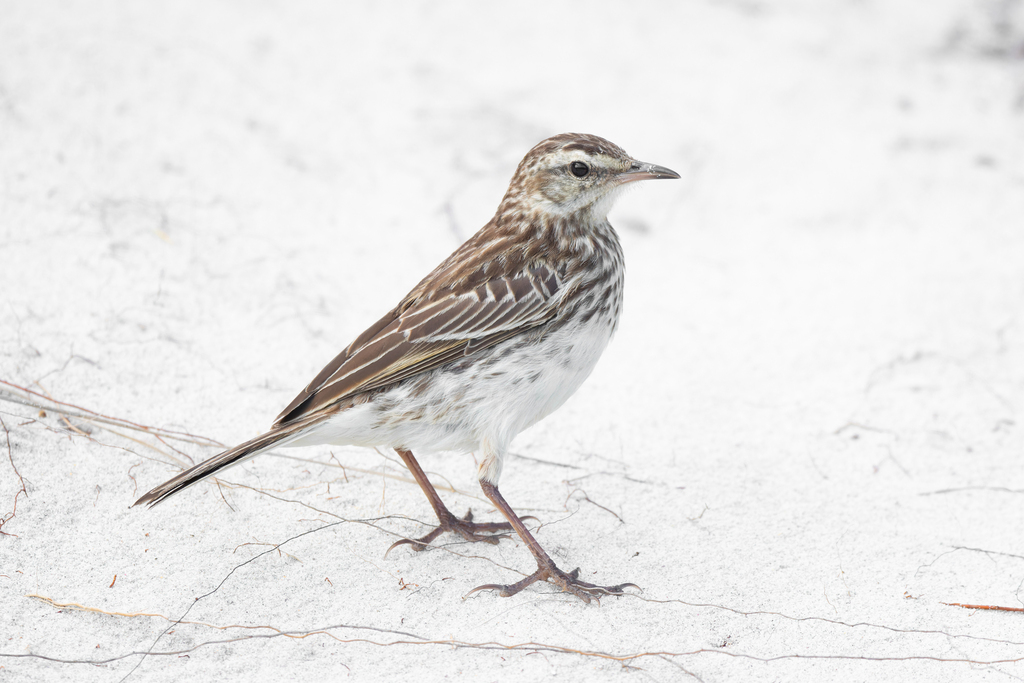
The New Zealand pipit (Anthus novaeseelandiae) is a fairly small passerine bird of open country in New Zealand and outlying islands. It belongs to the pipit genus Anthus in the family Motacillidae.
It was formerly lumped together with the Richard's, African, Mountain and Paddyfield pipits in a single species: Richard's pipit, Anthus novaeseelandiae. Many authors split the Australasian pipit further into two species: Australian pipit (Anthus australis) in Australia and New Guinea and New Zealand pipit (Anthus novaeseelandiae), also called pīhoihoi, in New Zealand.
From the article New Zealand pipit on Wikipedia (CC BY-SA), quoted section by section
Description
It is a slender bird, 16 to 19 cm long, and weighs about 40 grams. The plumage is pale brown above with dark streaks. The underparts are pale with streaks on the breast. There is a pale stripe over the eye and dark malar and moustachial stripes. The long tail has white outer-feathers and is often wagged up and down. The legs are long and pinkish-brown while the bill is slender and brownish.
What it does
It is a bird of open habitats such as grassland, farmland, roadsides, dry river beds, sand dunes and open woodland. It forages on the ground for small invertebrates such as beetles, spiders and insect larvae. It will also eat seeds such as those of grasses. The birds' numbers have declined in parts of New Zealand due to the improvement of pastures, use of pesticides and predation by introduced species.
Wikipedia: “Ecology”
Listen
Looking for field recordings…
Where it lives
Recorded sightings
—
geo-referenced records in GBIF, from museums, herbaria and field observers.
Drag the globe to turn it. Dots are where records exist, not a range map; darker means more records.
In the stacks
Searching the stacks…
Every page naming Anthus novaeseelandiae in the Biodiversity Heritage Library →
This page is assembled live from iNaturalist, GBIF, Wikipedia, the Source Library and the Internet Archive. It is not yet part of the hand-edited codex. iNaturalist taxon 204462.