- Animals
- ›Chordates
- ›Vertebrates
- ›Birds
- ›Perching Birds
- ›Old World Flycatchers, Robins, and Chats
- ›Ficedula
On eBird ↗
European Pied Flycatcher
Live sightings near you, the range map, bar charts of when it is seen, and Macaulay Library photos and recordings.
European Pied Flycatcher
Ficedula hypoleuca
The European pied flycatcher (Ficedula hypoleuca) is a small passerine bird in the Old World flycatcher family. One of the four species of Western Palearctic black-and-white flycatchers, it hybridises to a limited extent with the collared flycatcher. It breeds in most of Europe and across the Western Palearctic. It is migratory, wintering mainly in tropical Africa. It usually builds its nests in holes on oak trees.
This species practices polygyny, usually bigamy, with the male travelling large distances to acquire a second mate. The male will mate with the secondary female and then return to the primary female in order to help with aspects of child rearing, such as feeding.
From the article European pied flycatcher on Wikipedia (CC BY-SA), quoted section by section
Description
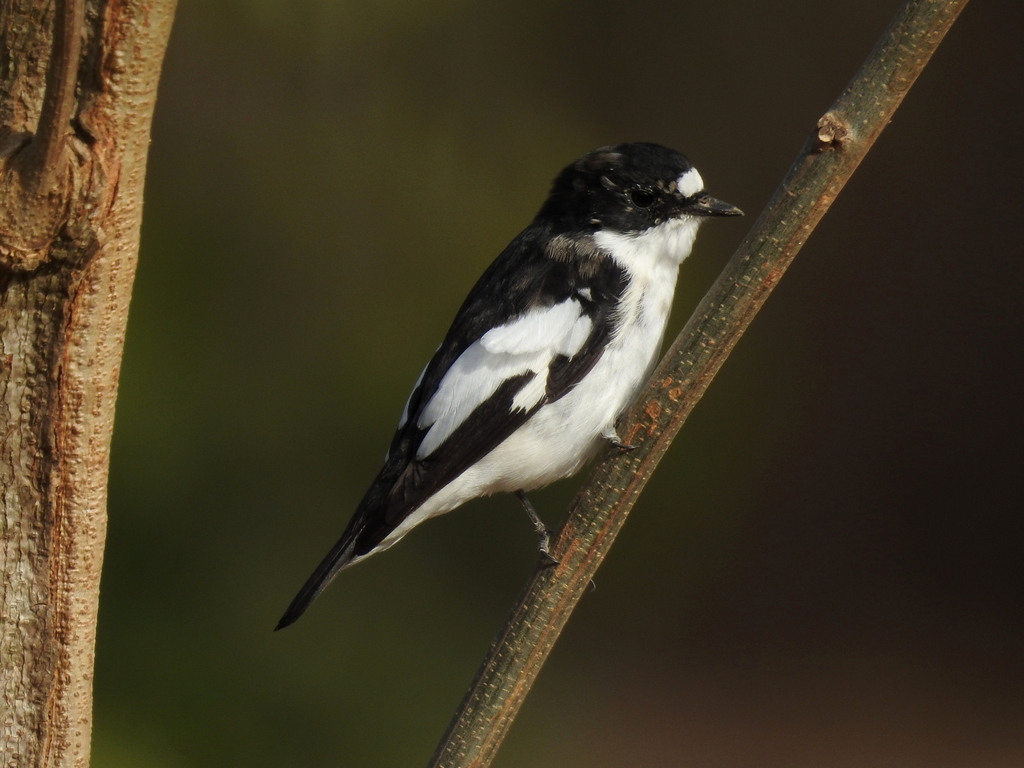
This is a 12–13.5 centimetres (4.7–5.3 in) long bird. The breeding male is mainly black above and white below, with a large white wing patch, white tail sides and a small forehead patch. The Iberian subspecies F. h. iberiae (known as Iberian pied flycatcher) has a larger forehead patch and a pale rump. Non-breeding males, females and juveniles have the black replaced by a pale brown, and may be very difficult to distinguish from other Ficedula flycatchers, particularly the collared flycatcher, with which this species hybridises to a limited extent. The bill is black, and has the broad but pointed shape typical of aerial insectivores. As well as taking insects in flight, this species hunts caterpillars amongst the oak foliage, and will take berries. It is therefore a much earlier spring migrant than the more aerial spotted flycatcher, and its loud rhythmic and melodious song is characteristic of oak woods in spring. The contact and alarm call is a short whistle 'whit, whit, whit'.
They are birds of deciduous woodlands, parks and gardens, with a preference for oak trees. They build an open nest in a tree hole, and will readily adapt to an open-fronted nest box. 4–10 eggs are laid.
Range & habitat
The European pied flycatcher has a very large range and population size, and is thus deemed to be of least concern by the IUCN. This species occupies areas of many different countries in Europe and northern Africa, also being present in the west Asian portion of Russia. More specifically, the nominate subspecies F. h. hypoleuca inhabits the UK, central Europe and Scandinavia, F. h. iberiae inhabits in the Iberian Peninsula, and F. h. tomensis in eastern Europe and Russia. The species is noted as a vagrant species in places in other countries in Africa and South Asia, such as Sudan and Afghanistan. This flycatcher typically spends winter in tropical Africa. The European pied flycatcher is a terrestrial bird, typically inhabiting open forests, woodlands, and towns. In 2005, the European population was listed to hold 3–7 million pairs.
Wikipedia: “Distribution and habitat”
What it does
The male mating behaviour has two key characteristics: desertion of the primary female and polyterritoriality. The males travel large distances, an average of 200–3,500 metres (660–11,480 ft), to find his second mate. After breeding with the secondary female, the males return to their first mate. The males of this species are polyterritorial; the males will acquire multiple nest sites to attract a female. Upon breeding with this first female, the male will procure more nesting sites, typically some distance from the site of the primary female, in order to attract a second female for mating. The males that have better success at polygyny are typically larger, older and more experienced at arriving earlier to the mating sites.
The female behaviour has also been studied in depth, especially due to the fact that some females accept polygyny while others are able to maintain monogamous relationships. The first female in a polygynous relationship does not suffer much in comparison to females in monogamous situations. These primary females gain greater reproductive success because they are able to secure full-time help from the male once he returns from his search for a second mate. The second female, however, often suffers from polygyny. These females have 60% less offspring than females that are in a monogamous relationship. …
Wikipedia: “Sex difference in mating behaviour”
Listen
Looking for field recordings…
Where it lives
Recorded sightings
—
geo-referenced records in GBIF, from museums, herbaria and field observers.
Drag the globe to turn it. Dots are where records exist, not a range map; darker means more records.
In the stacks
Searching the stacks…
Every page naming Ficedula hypoleuca in the Biodiversity Heritage Library →
This page is assembled live from iNaturalist, GBIF, Wikipedia, the Source Library and the Internet Archive. It is not yet part of the hand-edited codex. iNaturalist taxon 204512.